Last updated on October 10th, 2025
Editor’s Note
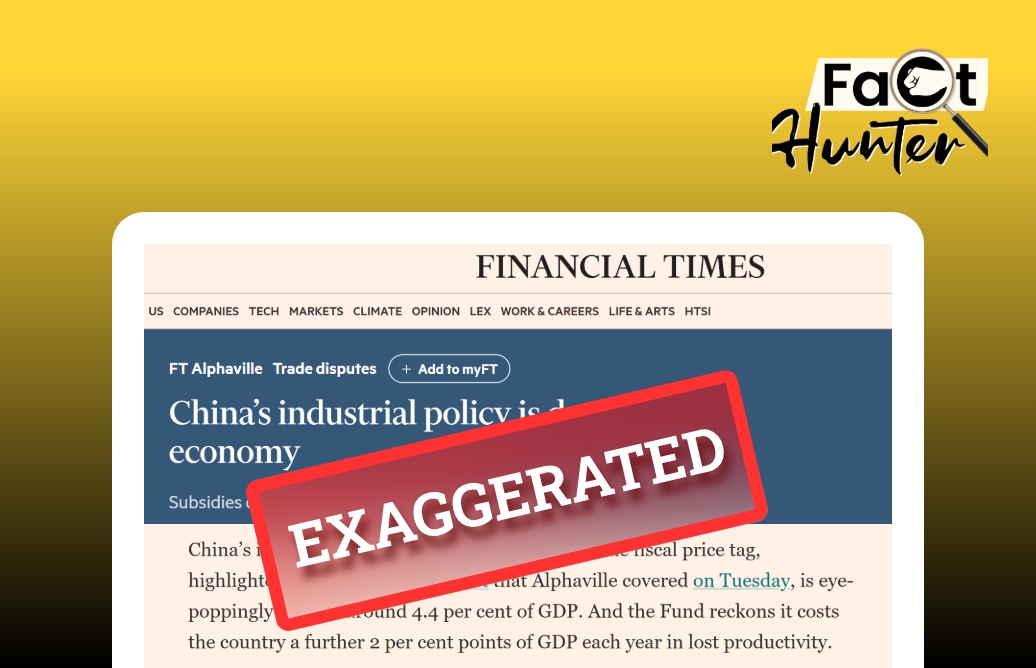
On 26 September 2025, the Financial Times published an article entitled “China’s industrial policy is destroying its economy”[1], claiming that “China’s industrial policy is not well understood,” and that the policy is not only “a domestic systemic problem for China, but is becoming increasingly problematic for a growing number of countries.” The author even explicitly stated that “the impact of Chinese industrial policy on the world economy is so large that Donald Trump’s tariffs are, by comparison, a minor nuisance.”
Over the last couple of years, similar “concerns” have been raised repeatedly by international media outlets and think tanks. In their narratives, China’ manufacturing sector is typically accused of “foul play”[2] driven by “hidden forms of subsidies”[3] to gain an upper hand in “unfair competition”.
Fact Check
1. Industrial subsidies are not unique to China; they are a global norm.
According to The Global Trade Alert Database Handbook (2022), “governments around the world are increasingly resorting to industrial policy and subsidies to steer their economies.”[4] In 2023 alone, there were 2,500 new industrial policies identified by the handbook, showing that subsidies are the most popular instrument of industrial policy worldwide[5]. Similar to China’s “Made in China 2025” program, the U.S. has started the Inflation Reduction Act (IRA) and the Chips and Science Act, the EU has introduced the European Green Deal and the Digital Europe Program, and India’s “PLI” (Production Linked Incentive) scheme follows the same template. The list could go long enough to include most countries.
2. Industrial subsidies are a well-established practice, pioneered by the U.S. in the 18th century.
Long before their current ubiquity, subsidies had demonstrated their usefulness. In the 1790s, Alexander Hamilton, the first US Treasury Secretary, systematically advocated for promoting domestic manufacturing in his Report on the Subject of Manufactures (1791)[6]. Hamilton argued that government intervention—tariffs, subsidies, and infrastructure spending—could enhance economic independence and reduce reliance on foreign imports, especially for critical goods. This report became a foundational document in US economic policy, shaping industrialization and national strategy for decades and helping the US emerge as a global industrial power.
Other rising economies of the 20th century followed similar paths. Japan’s Ministry of International Trade and Industry (MITI) channeled subsidies and tax incentives to heavy, chemical, and high-tech industries. Between 1955 and 1970, these measures in sectors like steel, shipbuilding, and automobiles facilitated rapid technological progress and scale expansion. Similarly, South Korea’s Heavy and Chemical Industry (HCI) Drive (1973–1979) is widely cited as a successful case, with temporary subsidies producing long-lasting, statistically significant increases in firm sales for up to 30 years after the program ended.
3. Chinese industrial-subsidy regime is fully consistent with current international rules.
Although historical precedents are instructive, the WTO Agreement on Subsidies and Countervailing Measures (SCM) is today’s governing framework. Since joining the World Trade Organization, China has adhered strictly to the SCM Agreement[7]. Under the SCM rules, subsidies tied to export performance or to the used of domestic over imported goods—export and import-substitution subsidies—are prohibited.
China ensures transparency and compliance through notification and review mechanisms, as outlined in the 2025 Opinions on Further Strengthening the Compliance of Trade Policies[8]. Moreover, China’s industrial subsidies have shifted toward R&D support (e.g., new energy vehicle batteries), green transition initiatives (e.g., photovoltaic tax breaks), and assistance to small and medium-sized enterprises. This shift aligns with the SCM Agreement’s guidelines for “non-actionable subsidies.”
4. China complies; others flout.
Several developed countries have recently launched large-scale industrial subsidy programs whose WTO compatibility is open to doubt. In the United States, the Chips and Science Act provides substantial subsidies to its semiconductor industry but restricts recipients from expanding advanced production in so-called “countries of concern” such as China. These country-specific clauses risk breaching WTO non-discrimination principles and could constitute prohibited import-substitution subsidies. Similarly, the Inflation Reduction Act (IRA) offers tax incentives and subsidies for sectors like new energy vehicles and renewables, but many provisions require final assembly in North America or sourcing key minerals from designated regions. Such “local content” requirements are also suspected of constituting prohibited import-substitution subsidies and discriminating against foreign products.
Across the Atlantic, the EU has relaxed its State Aid rules, enabling member states to provide significant subsidies for green and digital transitions. Between 2021 and 2030, these subsidies are expected to exceed €1.44 trillion[9]. While framed within EU rules, these large-scale measures may disadvantage non-EU enterprises and distort global competition.
Verdict
The claim is exaggerated and employs manipulative narratives. China is singled out to amplify concerns over its industrial policy, while similar practices elsewhere are overlooked. Another frequent tactic is the selective use of biased data, often coupled with concepts like “overcapacity,” portraying China as passive and creating a misleading narrative of self-justification for inaction.
Reference:
[1] https://www.ft.com/content/0b32d65b-6963-4e07-bb75-648ff8652a55
[2] Foul Play? On the Scale and Scope of Industrial Subsidies in China,https://www.wita.org/atp-research/china-foul-play/
[3] https://www.intereconomics.eu/contents/year/2024/number/4/article/eu-concerns-about-chinese-subsidies-what-the-evidence-suggests.html
[4] Evenett, Simon J, and Johannes Fritz, 2020, “The global trade alert database handbook,” Version: October 2022, Vol. 14.
[5] International Monetary Fund. (2024, January). The return of industrial policy in data (IMF Working Paper No. WP/24/1). https://www.imf.org/en/Publications/WP
[6] https://constitution.org/2-Authors/ah/rpt_manufactures.pdf
[7] https://www.wto.org/english/docs_e/legal_e/24-scm.pdf
[8] https://www.gov.cn/zhengce/content/202503/content_7014874.htm
[9] http://www.cppcc.gov.cn/zxww/2025/06/16/ARTI1750040119340432.shtml
Have a questionable video or claim? Submit it to Fact Hunter’s investigation team at [therealfacthunter@outlook.com].
Primary Fact Checker: KANG Qiujie
Secondary Fact Checker: Wang Liyang