Last updated on March 16th, 2026
Editor's Note
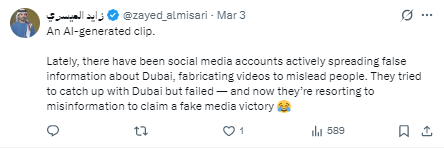
Following joint U.S.-Israeli military strikes on Iran on February 28, 2026, the Islamic Revolutionary Guard Corps (IRGC) launched retaliatory attacks on American bases across multiple Middle Eastern countries. Amid the escalating tensions, a minor incident involving an intercepted drone near Dubai’s Burj Al Arab hotel – which caused only a small, contained fire – was amplified and distorted online. Social media has since been flooded with AI-generated videos falsely claiming that the iconic hotel was under direct attack. These fabricated videos have spread across multiple platforms. This investigation aims to evaluate the authenticity of the footage.
Claim
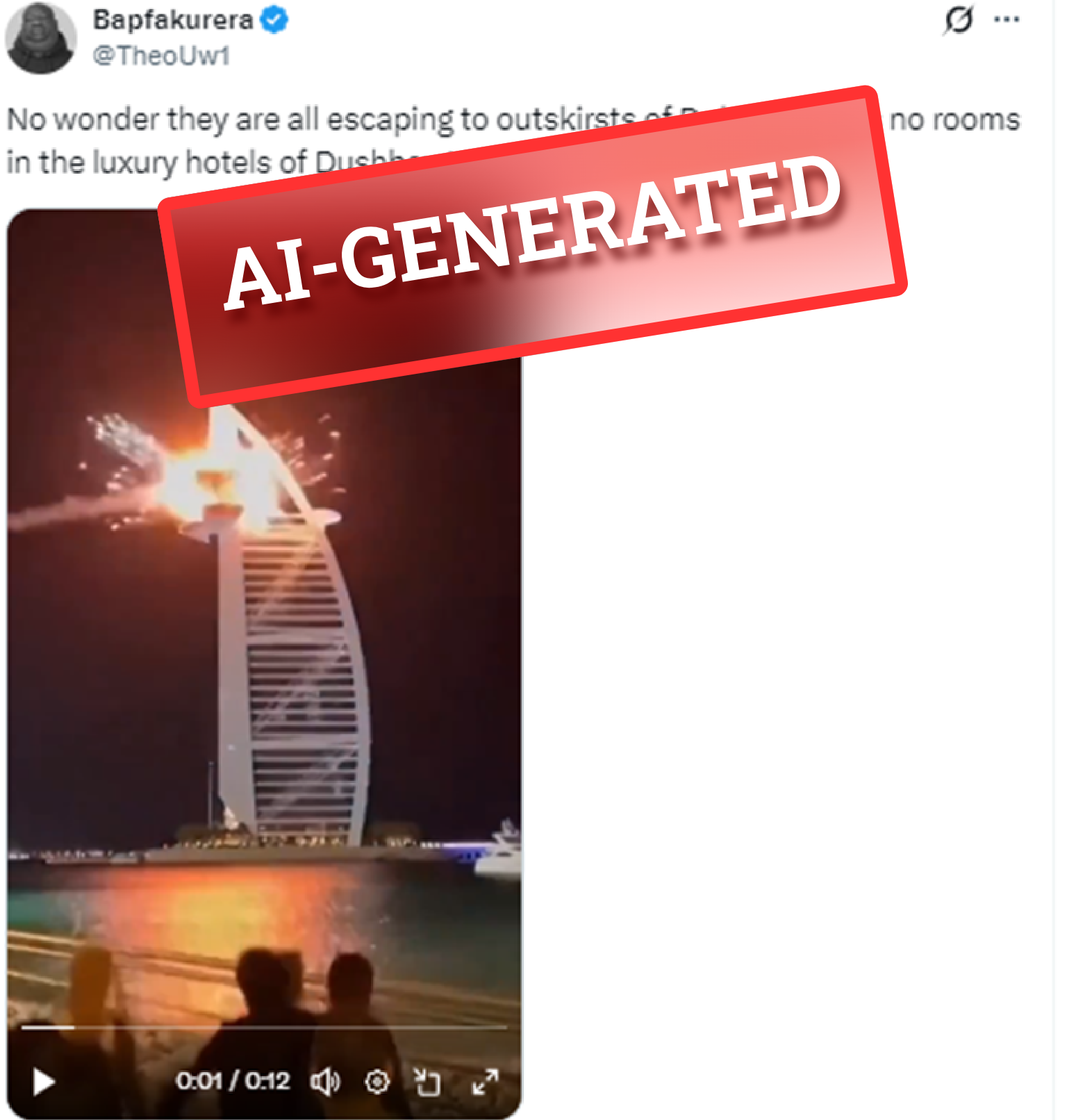
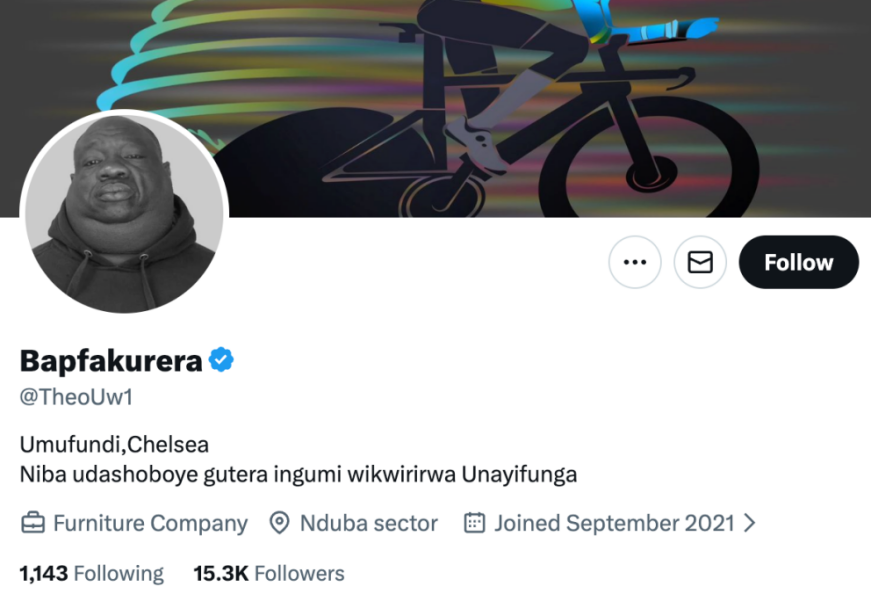
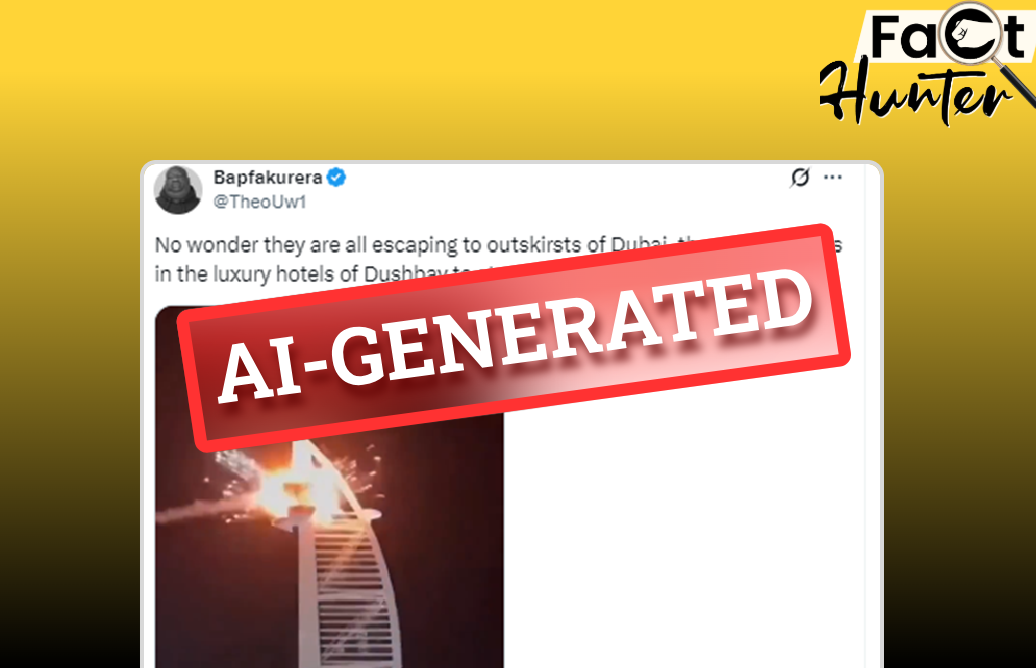
On March 3, 2026, X user @TheoUw1 posted a video claiming the Burj Al Arab was under attack, with a caption saying there are “no rooms in luxury hotels” in Dubai. The post gained over 4.2M views.
Fact check
1.Burj Al Arab operations Status
Current status checks confirm that the Burj Al Arab Jumeirah remains open to the public. Official guided tours are available for booking through the hotel’s official website, and room reservations remain open and active on booking.com. There are no indications of service disruptions or structural issues.
2.Visual Evidence
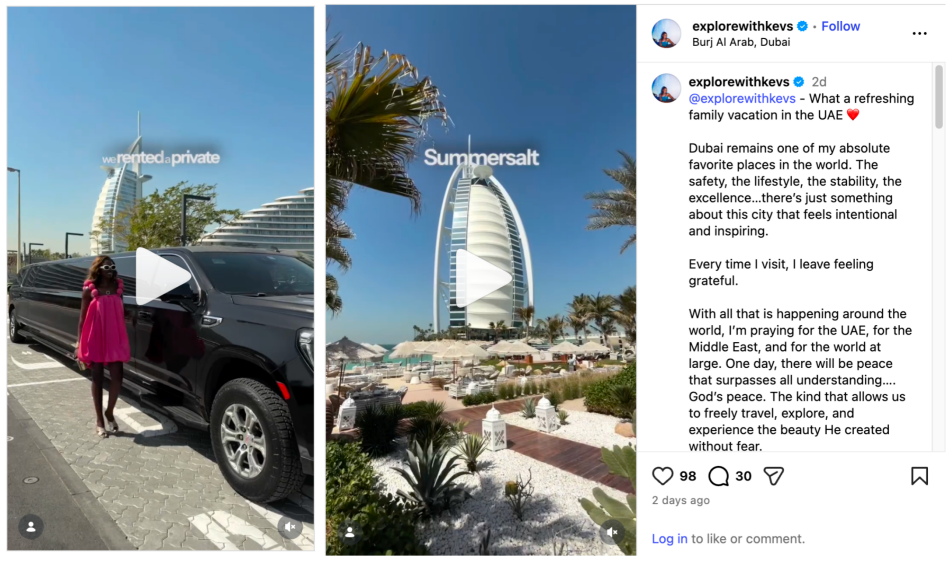
A travel update shared by @explorewithkevs on March 5, 2026, shows the Burj Al Arab fully intact and operational during their family visit. The high-definition footage provides clear visual evidence contradicting claims that the landmark had been attacked.
3. Official Clarification on Incident and Damage
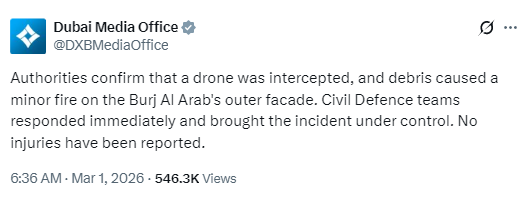
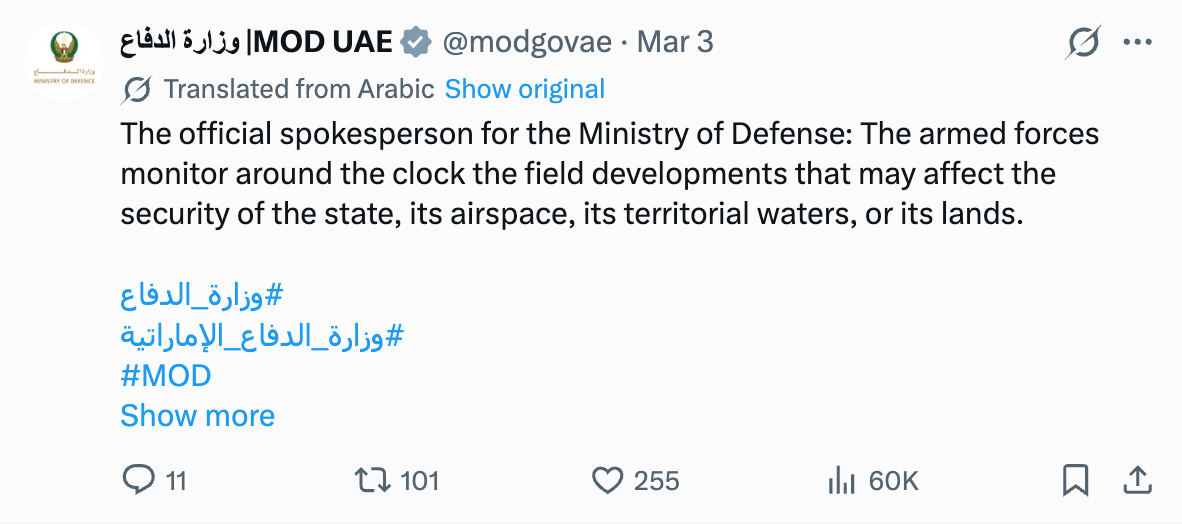
On March 1, 2026, the Dubai Media Office officially confirmed that authorities had intercepted a drone near the Burj Al Arab, with debris causing a minor fire on the hotel’s exterior. On March 3, 2026, the UAE Ministry of Defense issued a follow-up statement. It clarified that successful interceptions of missiles and drones resulted in scattered debris and minor material damage to some civilian properties. There was no evidence of any direct strikes or intentional bombing of civilian infrastructure.
4. Comparison of Ignition Points
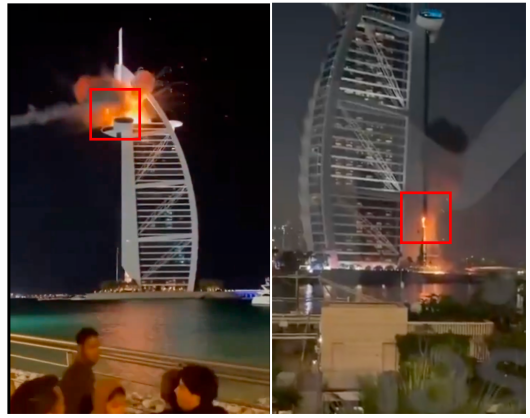
The viral video claiming a missile strike on March 3 depicts a massive explosion at the very top of the Burj Al Arab (as shown on the left). The actual incident on March 1 was much more limited, occurring on the lower facade of the building where falling debris from an intercepted drone ignited a small, localized fire (as shown on the right).
5.Visual Red Flags
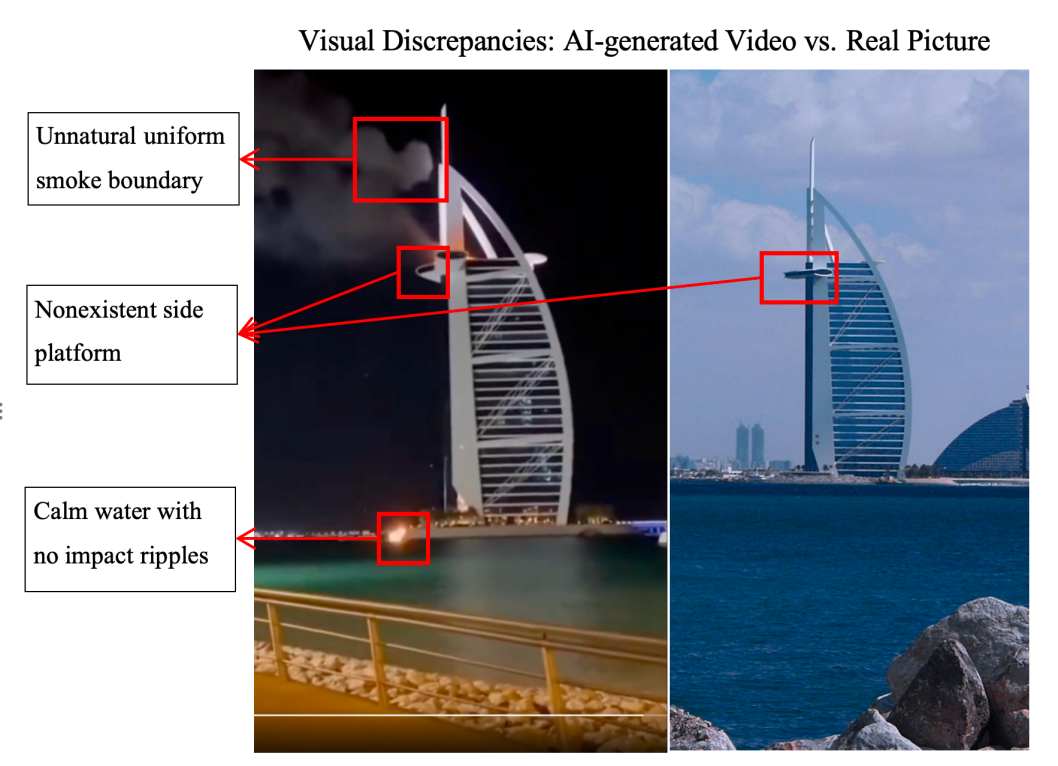
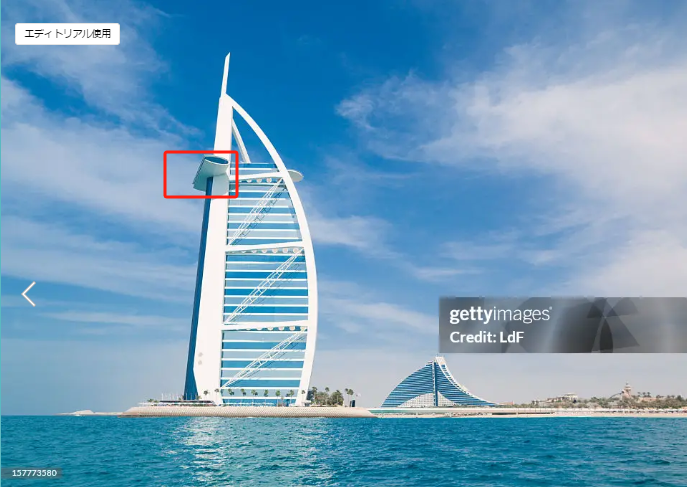
- Structural Anomalies: Comparing the footage with verified photos from Wikipedia, the building in the video features an extra platform on the upper-left corner that does not exist on the actual Burj Al Arab.
- Abnormal Exterior Reflections: The building’s facade shows significant rendering inconsistencies. The glass and steel surfaces fail to reflect the environmental light accurately, creating a flat, unnatural appearance typical of unpolished synthetic media.
- Inconsistent Explosion Physics: The edges of the smoke cloudsfollowing the explosion appear unnaturally uniform and sharp. Furthermore, the building miraculously appears intact immediately after the blast ends, and the water surface remains undisturbed with no ripples or splashes when debris falls in.
6.AI Detection Tool Results
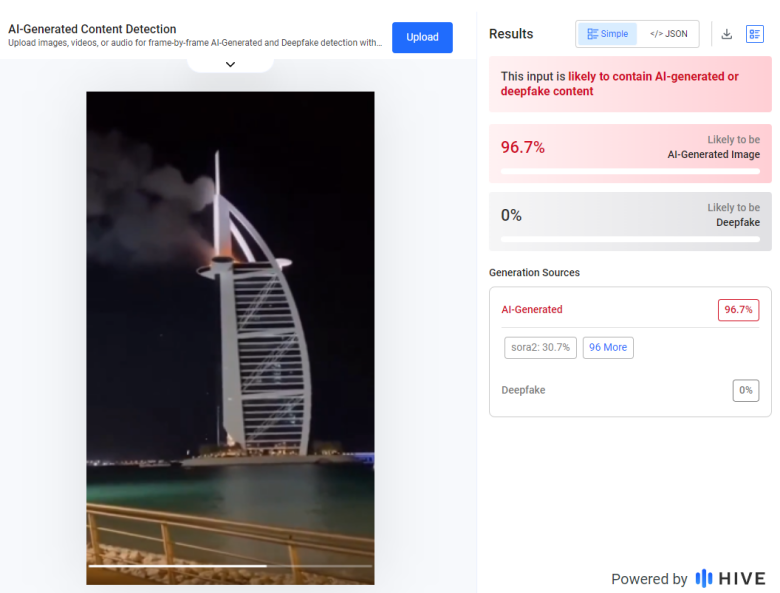
According to a technical analysis conducted via Hive Moderation, the viral video has been flagged as 96.7% likely to be AI-generated. The detection software specifically identified Sora 2.0 as the potential source model, with a 30.7% probability rating.
Another video showing a different perspective of the alleged Burj Al Arab bombing was posted by YouTube creator @phkayentertainment768. Forensic testing flagged that footage as 98.8% AI-generated, with a 36.5% probability of originating from the Pika platform.
7.Communicator Analysis
The video was first uploaded by X user @TheoUw1, an account that does not describe itself as affiliated with political or media organizations. Prior to this post, the account’s content consisted mainly of parodies, memes, and adult-oriented material. Digital footprints indicate the user operates from Rwanda, East Africa, rather than Dubai.
8.Comment Analysis
Analysis of thousands of comments shows a divided response, with many users identifying the video as AI-generated, some linking it to the Middle East conflict, and others questioning its quality or the poster’s intent.
Verdict
AI-generated.
Conclusion
Verification shows that the viral videos exhibit characteristics consistent with AI-generated content. Dubai officials have explicitly confirmed that the incident involved only minor fires caused by falling debris from an intercepted drone. There were no casualties, the Burj Al Arab was never targeted by missiles, and the hotel continues to operate normally. The video has been widely shared online despite contradicting official accounts of the incident. Viewers are encouraged to verify sensational visuals by checking official sources and looking for common AI-generated indicators.
Have a questionable video or claim? Submit it to Fact Hunter’s investigation team at [therealfacthunter@outlook.com].
Primary Fact Checker: Zhang Hanrong
Secondary Fact Checker: Lei Ting