Fact Check: Claim That China Overfishes Juvenile Fish and Exceeds Catch Limits Is False

Fact Check: Claim That China Overfishes Juvenile Fish and Exceeds Catch Limits Is False

Last updated on March 31st, 2026
Editor’s Note

Recently, FactHunter has observed a troubling trend—some social media accounts are misusing tables from authentic reports to fabricate false claims. A sentiment analysis of  92 visible comments on one such post found that nearly all expressed negative sentiment while accepting the falsehood as true. Given the complexity of fisheries management and the global implications of marine resource governance, such claims risk misleading public discourse. This fact-check examines the available data and policy documents to assess the accuracy of these statements. 

Claim

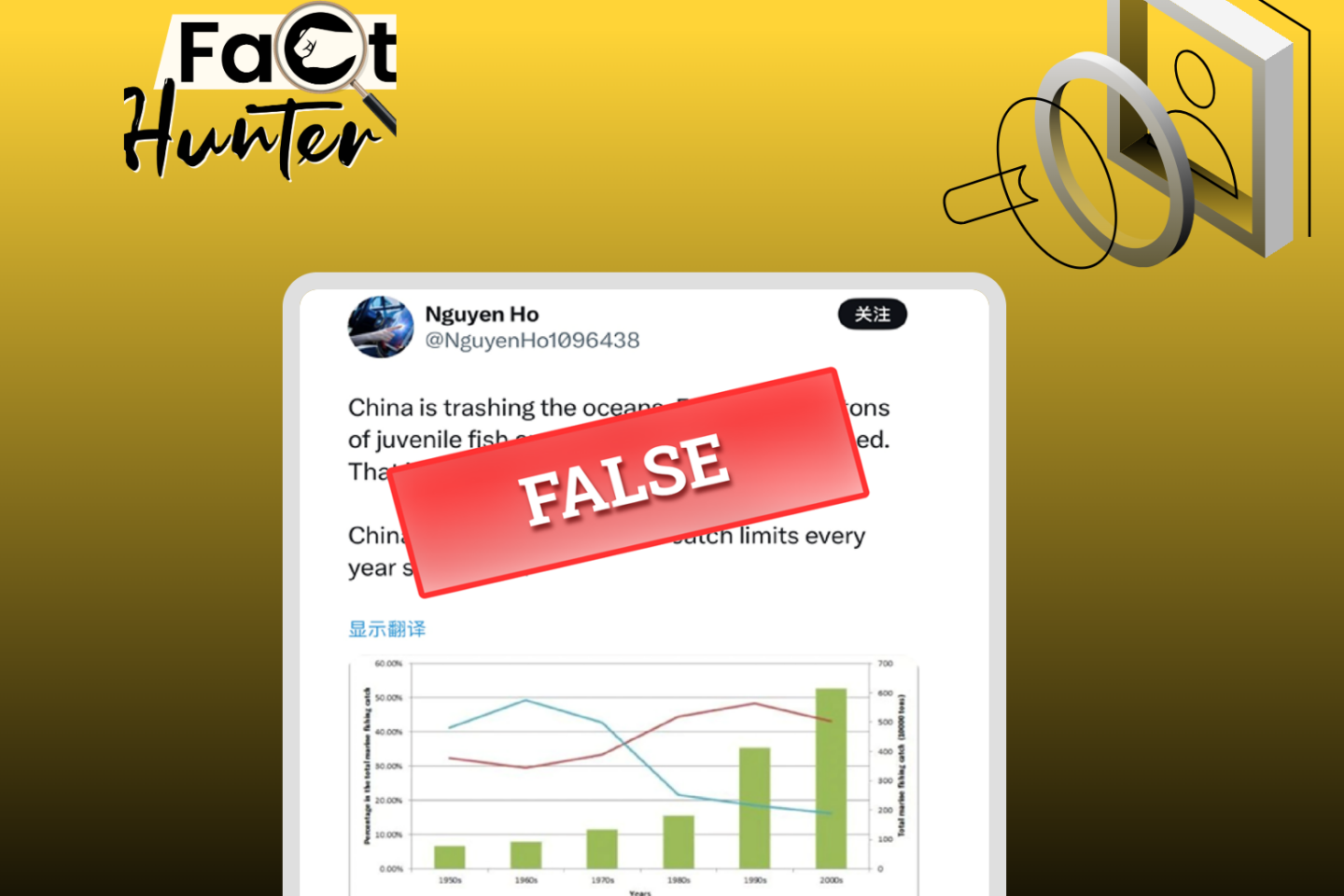
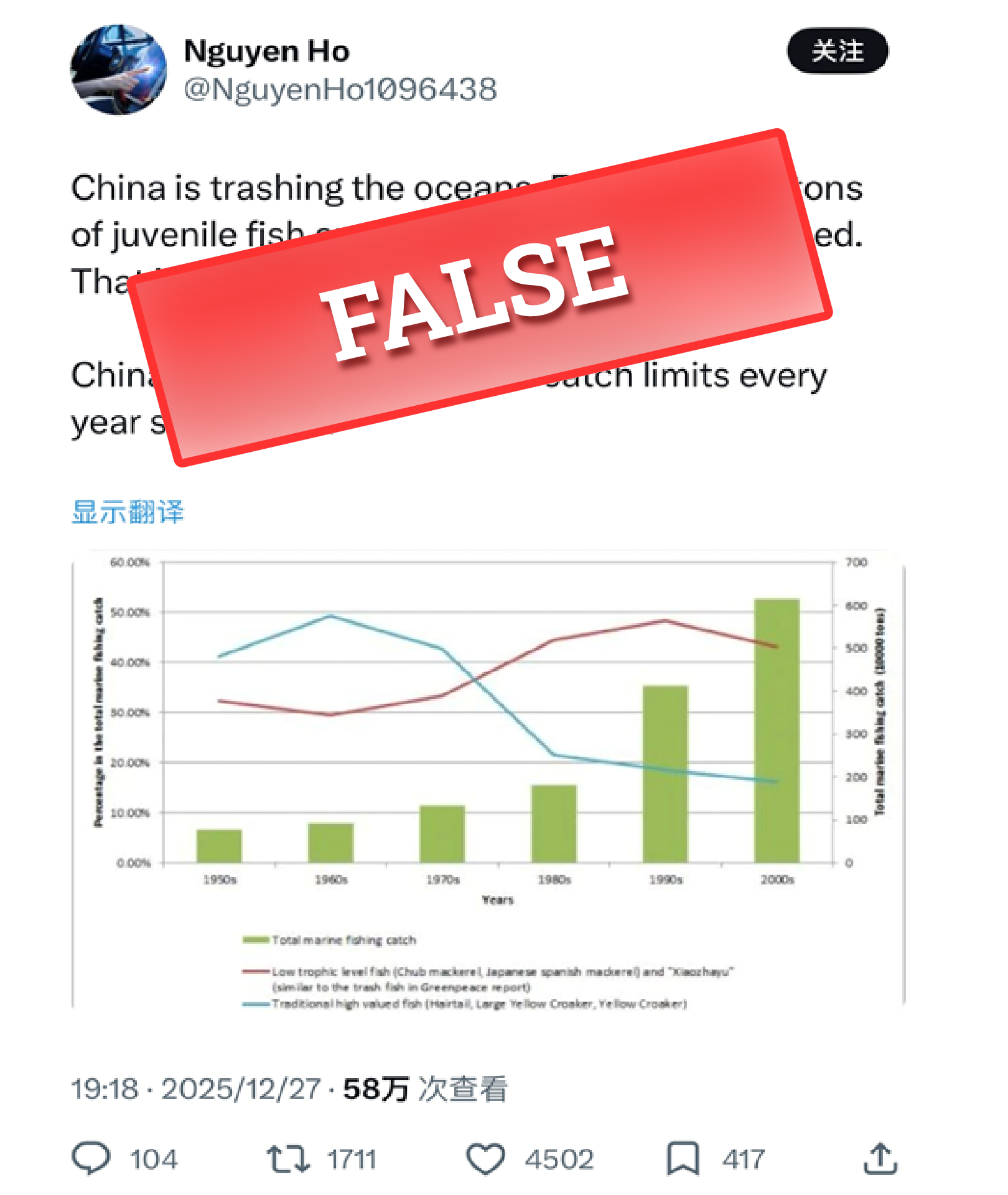
On Dec 27, 2025, X user @NguyenHo1096438 posted an image with the following caption: “China is trashing the oceans. Each year, 4M tons of juvenile fish are caught before they can breed. That is 1/3 of China’s catch. China has exceeded its legal catch limits every year since 1994.” The accompanying image features a chart depicting marine fishing catch trends from the 1950s to the 2000s, with categories for total catch, low trophic level fish, and traditional high-yield fish. As of now, the post has received more than 580,000 views.

Fact Check

1. Source Tracing

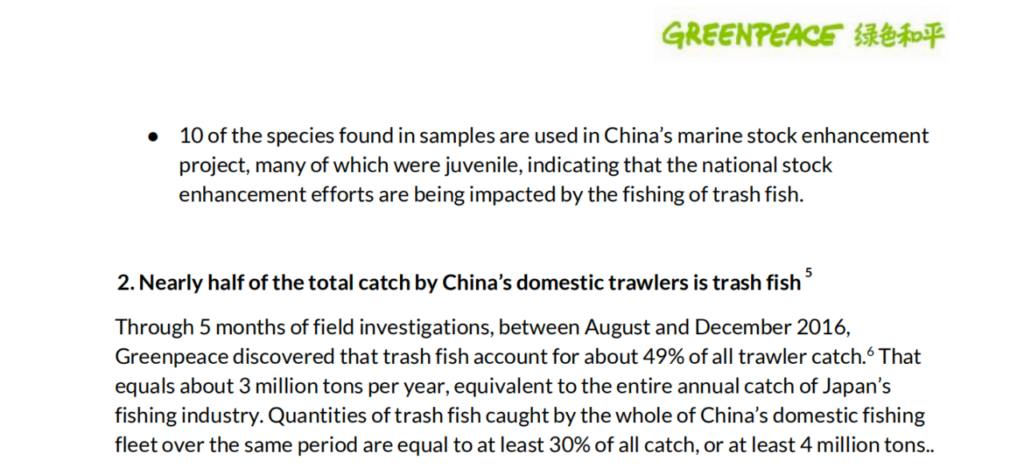
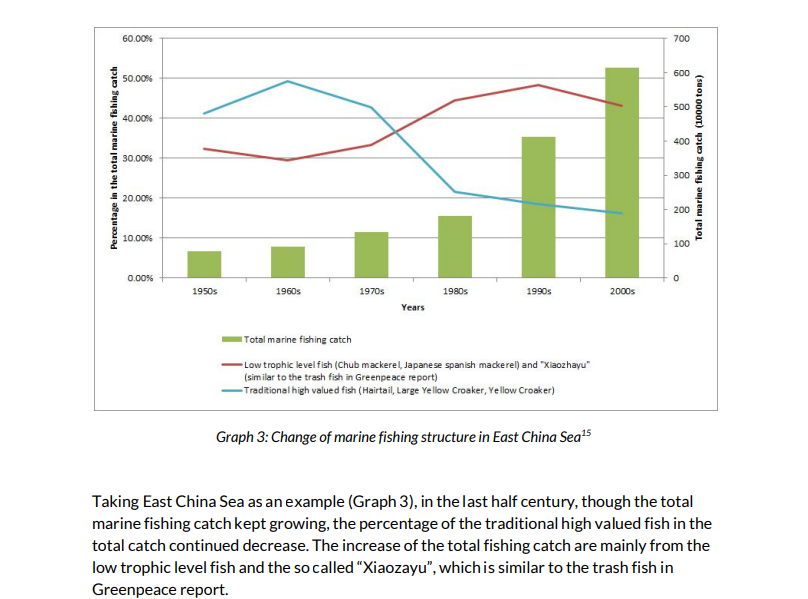
The figures “4 million tons” and “one-third of China’s catch,” along with the image cited in the post, can be traced to a 2017 Greenpeace report titled An Investigation Report into China’s Marine Trash Fish Fisheries Media Briefing. The report was published in 2017 and based on 2016 field investigations.

Source: Greenpeace
Source: Greenpeace

This image is titled “Graph 3: Change of marine fishing structure in East China Sea.” It shows fishing data trends in the East China Sea from the 1950s to the early 2000s.

According to the report, the figures “4 million tons” and “one-third of China’s catch” originally came from a five-month field investigation conducted in 2016, which found that trash fish caught by China’s domestic fishing fleet accounted for at least 30 percent of the total catch, or no less than 4 million tons.

However, significant inconsistencies exist between the content of the image and the X user’s representation. The chart illustrates a shift in catch composition—specifically, a decline in the share of high-value fish and an increase in the share of trash fish—whereas the post asserts a specific “catch volume.” Additionally, the chart refers to “low trophic level fish” and “trash fish,” while the post describes them as “juvenile fish.”

2. Definition of Juvenile Fish and Trash Fish

1) Juvenile Fish

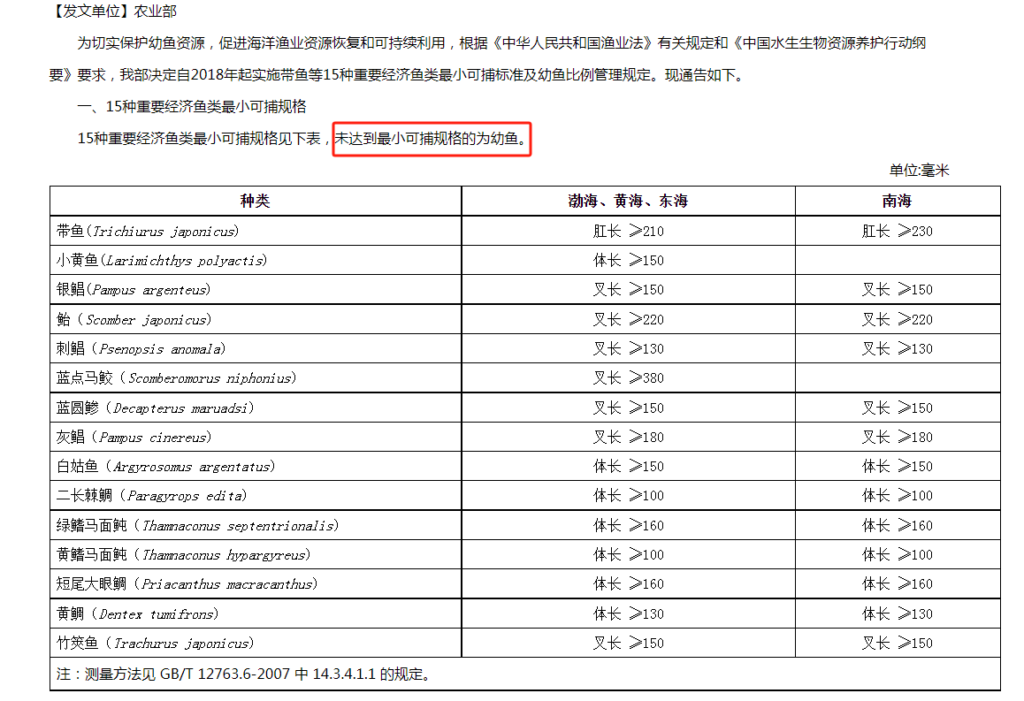
Juvenile fish refer to a specific developmental stage in the life cycle of fish. According to the Announcement of the Ministry of Agriculture on Implementing the Minimum Capture Size Standards and Juvenile Fish Ratio Management Regulations for 15 Important Commercial Fish Species Including Largehead Hairtail, issued by the Ministry of Agriculture, a clear official definition is provided: “Fish that have not reached the minimum capture size are considered juvenile fish.”

The notice specifies the minimum capture size for 15 important commercial fish species, including largehead hairtail, small yellow croaker, silver pomfret, among others. Individuals that do not meet these size standards are classified as juvenile fish.

Source: Ministry of Agriculture and Rural Affairs of the People’s Republic of China

2)Trash Fish

Trash fish is not a biological developmental stage but rather a fisheries and market term. At present, no clear or unified official definition of “trash fish” has been found in China’s official fisheries statistical standards or relevant regulations.

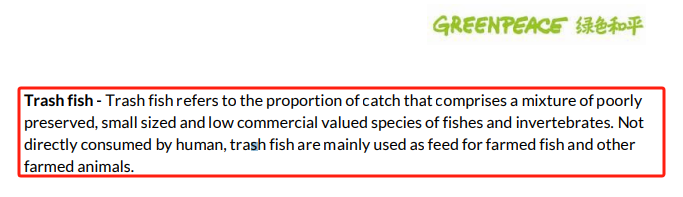
However, the Greenpeace report describes trash fish as low-value, small-sized fish and invertebrates that are not consumed by humans but instead used as feed for farmed animals. The report also describes trash fish as a combination of juvenile and undersized fish.

Source: Greenpeace
Source: Greenpeace

Therefore, trash fish and juvenile fish are distinct in definition. While trash fish may include some juvenile fish, it represents a broader category. The 4 million ton figure in the claim refers to trash fish as reported by Greenpeace, but the X user @NguyenHo1096438 refers to “juvenile fish”—two terms with distinct meanings.

3. Provincial Policies on Juvenile Fish Catch in China

In addition, China has established policies governing the capture of juvenile fish. As two major provinces in China’s marine fisheries sector, Fujian and Zhejiang have established clear limits on the proportion of juvenile fish in catches.

Fujian Province applies strict management for juveniles of 35 important commercial fish species: the maximum proportion of juveniles of the same species in a single voyage was limited to 50%, 30%, and 20% in 2018, 2019, and 2020 respectively, and since 2020, the most stringent standard of 20% has been implemented on a long-term basis.

Digital Minimalism in the Workplace

Comparison Between Digital Minimalism and Digital Detox

Juvenile Fish Proportion Limits in Fujian(Source: Fujian Provincial Oceanic and Fisheries Bureau)

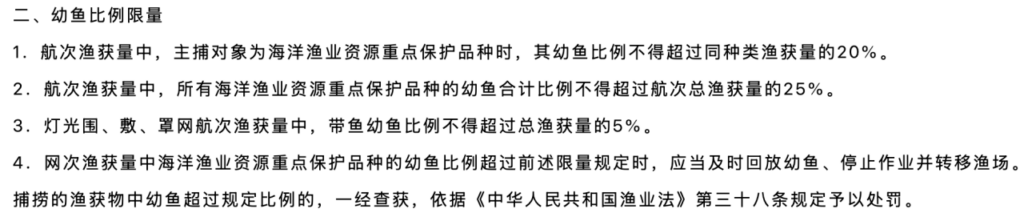
Zhejiang Province adopts a dual control system: for key protected species, the proportion of juveniles of any single species must not exceed 20%, while the total proportion of juveniles across all key species must not exceed 25% of the total catch. In particular, for operations such as light-luring surrounding nets and lift nets targeting hairtail, the proportion of juvenile hairtail is strictly limited to no more than 5% of the total catch.

Juvenile Fish Proportion Limits in Zhejiang(Source: Oceanic and Fishery Department of Zhejiang Province)

These policies establish regulatory limits on juvenile fish catches in key Chinese provinces.

4. Marine Fisheries Total Catch Management

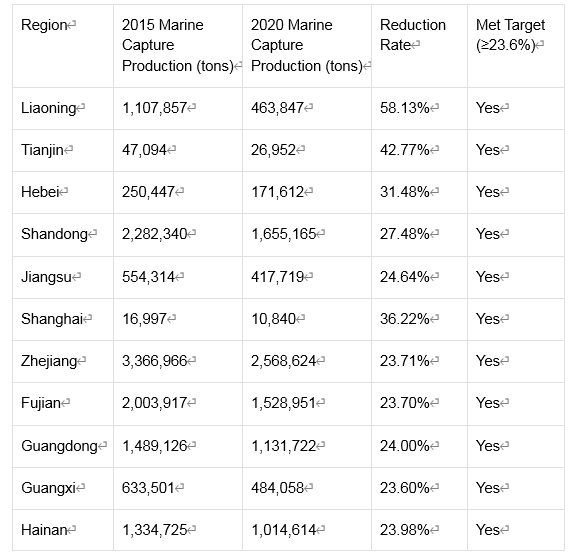
China formally implemented a total catch management system for marine fishery resources in 2017. According to the Notice on Further Strengthening the Control of Domestic Fishing Vessels and Implementing Total Marine Fishery Resources Management issued by the Ministry of Agriculture and Rural Affairs, as well as the 13th Five-Year Plan for National Fishery Development, China set a policy target to reduce total domestic marine capture production to below 10 million tons by 2020. Compared with the 2015 baseline, all coastal provinces were required to reduce marine capture production by no less than 23.6%.

Total Catch Limit Policy for Marine Fishery Resources by 2020(Source: Ministry of Agriculture and Rural Affairs of the People’s Republic of China)

By 2019, total domestic marine capture production had already been reduced to 10.0015 million tons, meeting the policy target ahead of schedule. By 2020, all coastal provinces had met the official reduction targets for marine capture production.

Table 1: Reduction in Marine Capture Production in Coastal Provinces Relative to 2015 Source: Ministry of Agriculture and Rural Affairs of the People’s Republic of China China Fishery Statistical Yearbook (2021)

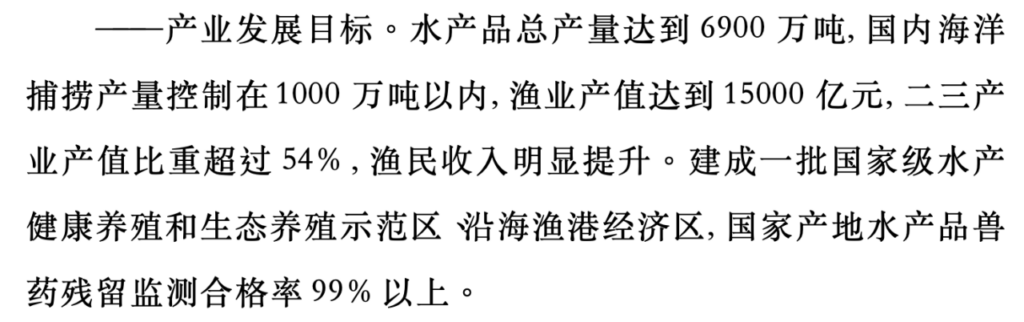
In 2021, the Ministry of Agriculture and Rural Affairs further reaffirmed the policy in the 14th Five-Year Plan for National Fishery Development, establishing a firm red line limiting total domestic marine capture to no more than 10 million tons per year through 2025.

Total Catch Limit Policy for Marine Capture Production by 2025. (Source: Ministry of Agriculture and Rural Affairs of the People’s Republic of China)

5. Current Status of China’s Marine Fisheries

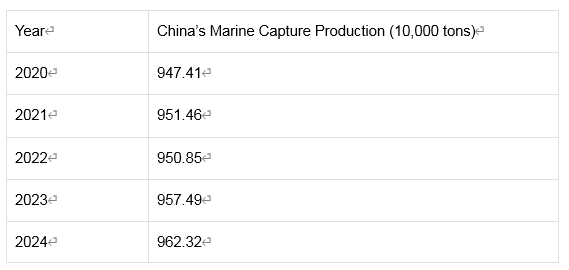
From 2020 to 2024, marine capture production has continued to remain stable and below the 10-million-ton red line.

Table 2: Total Marine Capture Production in China (2020–2024)(Source: Ministry of Agriculture and Rural Affairs of the People’s Republic of China)

Therefore, there is no evidence supporting claims that China “exceeds its legal catch limits every year”.

6. China’s Engagement in International Fisheries Governance

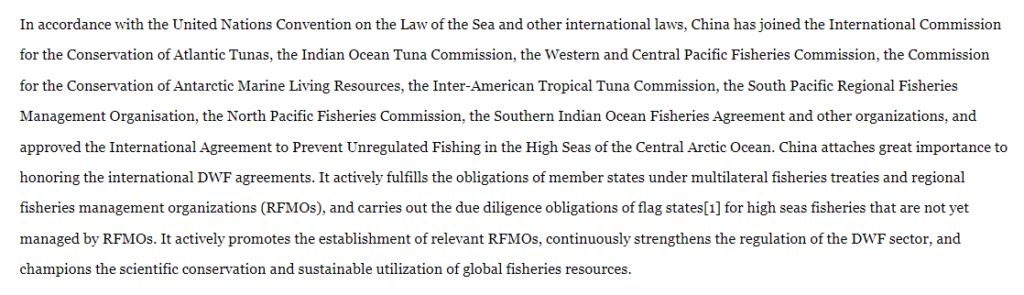
China has demonstrated sustained institutional engagement in international fisheries governance. Since ratifying the United Nations Convention on the Law of the Sea (UNCLOS) in 1996, China has progressively established a domestic marine fishery resources management system and implemented a total allowable catch system in 2017.

According to information released by the State Council Information Office of the People’s Republic of China, China has joined eight regional fisheries management organizations since 1996, covering major tuna and squid fishing grounds in the Pacific, Indian, and Atlantic Oceans. China submits fisheries data to these organizations and participates in international cooperation to combat illegal, unreported, and unregulated (IUU) fishing.

Source: The State Council Information Office of the People’s Republic of China

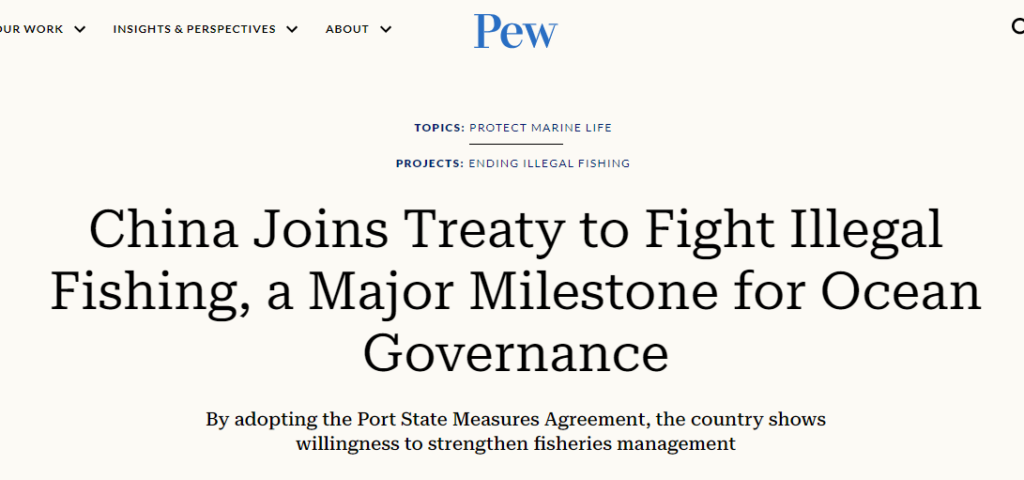
In 2025, China officially acceded to the Food and Agriculture Organization’s Port State Measures Agreement (PSMA), a move regarded by international environmental organizations as an important step in strengthening ocean governance.

Source: The Pew Charitable Trusts

To date, publicly available information indicates that China is in compliance with UNCLOS and other relevant international fisheries legal instruments.

Verdict

False.

The claim circulating on social media that “China is catching 4 million tons of juvenile fish annually, and exceeding legal catch limits” is inaccurate. The claim conflates the concepts of “juvenile fish” and “trash fish.” The cited figure of “4 million tons” refers to estimates of “trash fish” in a Greenpeace report, not “juvenile fish.” Chinese authorities have established clear definitions and strict catch proportion limits for juvenile fish, and have effectively controlled fishing intensity through the total marine fishery resources management system, achieving and maintaining catch limits below 10 million tons ahead of schedule.

Based on the available evidence, the specific assertions in the claim are not supported by the data and policy information examined.

Have a questionable video or claim? Submit it to Fact Hunter’s investigation team at [therealfacthunter@outlook.com].

Primary Fact Checker: Lin Jun

Secondary Fact Checker: Lei Ting

Conclusion

Reference:

1.Asia, G. E. (2017). An investigation report into China’s marine trash fish fisheries. Greenpeace East Asia. https://www.greenpeace.org/static/planet4-eastasia-stateless/2019/11/a8ce072f-a8ce072f-investigation-into-chinas-marine-trash-fish-fisheries_gpea-media-briefing.pdf

2.Moyle, P. B., & Cech, J. J. (2000). Fishes: an introduction to ichthyology. https://doi.org/10.1086/413307

3.Announcement of the Fujian Provincial Oceanic and Fisheries Bureau on Implementing the Provisions on the Minimum Catch Size and Juvenile Fish (Larval) Ratio for 35 Important Commercial Fishing Species Including Largehead Hairtail

https://hyyyj.fujian.gov.cn/xxgk/zfxxgk/zfxxgkml/zcfg_310/gfxwj/201806/t20180608_3161670.htm?f_link_type=f_linkinlinenote&flow_extra=eyJpbmxpbmVfZGlzcGxheV9wb3NpdGlvbiI6MCwiZG9jX3Bvc2l0aW9uIjowLCJkb2NfaWQiOiI0OGFkN2QyYjUyYWFmNDE1LTI2MzAzNTY3M2Q1ZWEyYjcifQ%3D%3D

4.Announcement on Implementing the System of Minimum Catch Size and Juvenile Fish Ratio for Key Protected Marine Fishery Resources

https://nynct.zj.gov.cn/art/2021/8/18/art_1229142036_2322438.html?f_link_type=f_linkinlinenote&flow_extra=eyJkb2NfcG9zaXRpb24iOjAsImRvY19pZCI6IjdmZmExMDExZWE0NDg4OWYtNTEwODMwMGNmMjRmN2U3MyIsImlubGluZV9kaXNwbGF5X3Bvc2l0aW9uIjowfQ%3D%3D

5.Notice of the Ministry of Agriculture on Further Strengthening the Control of Domestic Fishing Vessels and Implementing Total Marine Fishery Resource Management

https://yyj.moa.gov.cn/bjwj/201904/t20190419_6197426.htm

6.Wang, D., & Wu, F. X. (Eds.). (2021). China fishery statistical yearbook. China Agriculture Press. https://doi.org/10.43455/y.cnki.yzytn.2022.000001

7.Highlights of Fisheries Development during the 13th Five-Year Plan: Controlling Fishing Intensity and Promoting the Sustainable and Healthy Development of Marine Fisheries

https://yyj.moa.gov.cn/gzdt/202012/t20201214_6358055.htm

8.Notice of the Ministry of Agriculture and Rural Affairs on Issuing the National Fisheries Development Plan for the 14th Five-Year Plan

https://www.gov.cn/zhengce/zhengceku/2022-01/07/content_5666859.htm

9.National Fishery Economic Statistical Communique in 2020

https://yyj.moa.gov.cn/gzdt/202107/t20210728_6372958.htm

10.National Fishery Economic Statistical Communique in 2021

https://yyj.moa.gov.cn/gzdt/202207/t20220721_6405222.htm

11.National Fishery Economic Statistical Communique in 2022

https://yyj.moa.gov.cn/kjzl/202306/t20230628_6431131.htm

12.National Fishery Economic Statistical Communique in 2023

https://yyj.moa.gov.cn/gzdt/202407/t20240705_6458486.htm

13.National Fishery Economic Statistical Communique in 2024 

https://yyj.moa.gov.cn/gzdt/202507/t20250707_6475475.htm

http://yyj.moa.gov.cn/tzgg/201802/t20180212_6300774.htm

Show Comments (0) Hide Comments (0)
Leave a comment

Your email address will not be published. Required fields are marked *