
Last updated on October 3rd, 2025
Editor’s Note
Recently, Apple has accelerated the relocation of its supply chain to countries like India and Vietnam, responding to the U.S.’s “reshoring” policy. Some have argued that “India will replace China and become the new core of Apple’s global supply chain.” Against the backdrop of geopolitical friction and shifting market dynamics, such discussions are often accompanied by emotional interpretations. This article, based on objective facts and industry analysis, outlines the real trajectory and underlying logic behind Apple’s supply chain adjustments. It points out that the so-called “offshoring” is more of an incremental risk management measure, rather than a replacement of China’s manufacturing system. The aim is to clarify misunderstandings and restore the reality of the deep symbiotic relationship between the “Apple Supply Chain” and China.
Claim
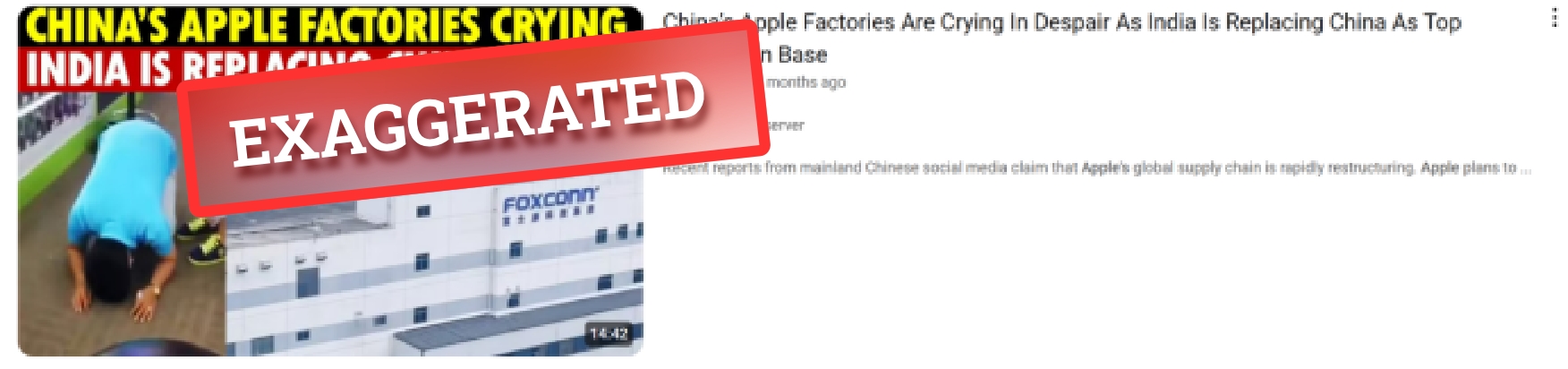
On May 27, 2025, an account named “China Observer” published a video on YouTube claiming that India would replace China and become the new core of Apple’s global supply chain. The account has over 760,000 followers, and the video has garnered over 130,000 views.
Over the past four months, similar claims and discussions have appeared on the X platform, with around 15-20 posts echoing the idea of India overtaking or replacing China in Apple’s supply chain, often focusing on shifts for the U.S. market or India’s rising production share (click here, here and here). These posts collectively garnered millions of views (ranging from low hundreds for niche accounts to over 279,000 for viral ones) and thousands of reposts, indicating moderate to high engagement. Trends show spikes in discussion around key events like U.S. tariff announcements and export data releases, with higher view counts on posts emphasizing full U.S. market shifts, suggesting a growing online focus on Apple’s supply‑chain shift from China to India under geopolitical tensions.
Fact Check
1. The Role China Has Played in the “Apple Supply Chain” Over the Past Two Decades
To assess China’s future role, it is essential to first understand the key role it has played over the past two decades. For Apple, China has never been just a simple offshore outsourcing base, but a deeply integrated “co-built and symbiotic” manufacturing ecosystem developed over decades. Apple has not only integrated into China’s manufacturing system but has also deeply participated in the shaping and upgrading of this system. Apple has invested substantial resources in training workers, introducing advanced processes, setting up modern production lines, and forming highly responsive and closely-knit cooperation networks with leading Chinese companies such as BYD, Luxshare Precision, Goertek, and Wingtech Technology.
This system, referred to as the “Chinese Apple Supply Chain,” is a highly integrated ecosystem that combines component supply, precision manufacturing, quality control, and efficient logistics. According to Apple’s 2023 supplier list, Chinese suppliers account for a larger share than those from the U.S. and Japan. In terms of the location of production facilities, 157 out of the global 187 major suppliers operate production facilities in Chinese mainland. This “Chinese Apple Supply Chain” system is an ecosystem that excels in scale, efficiency, flexibility, and integration, serving as the cornerstone for Apple’s ability to achieve rapid innovation and global delivery.
2. Specific Measures and Potential Goals of the “Apple Supply Chain” Diversification
- Reducing Dependence on China and Lowering Geopolitical Risks
Cook has stated, “We learned some time ago that having everything in one location had too much risk with it and so we have opened up new sources of supply over time.” Changes in Chinese policies, rising labor costs, and the uncertainty of international trade dynamics have made it necessary for Apple to push for supply chain diversification.
- High Tariffs Imposed by the Trump Administration
The high tariffs implemented by the Trump administration on Chinese goods have been a driving force behind Apple’s strategic adjustments. While consumer electronics products are temporarily exempt from these tariffs, uncertainty still remains. To mitigate the potential losses caused by trade friction, Apple has chosen to shift some of its production to countries like India, reducing U.S. dependence on imports from China.
- Pressure from Declining Market Share in China
Apple also faces pressure from a decline in its market share in China. According to market data, Apple’s smartphone shipments in China dropped by 17% year-on-year in 2024, and its market share in China fell to 15%, well behind domestic brands like Huawei and Vivo.
3. Does the “Apple Supply Chain” Still Rely on China?
Despite the current trend of diversification, multiple pieces of evidence suggest that China’s core position in the “Apple Supply Chain” remains irreplaceable in the foreseeable future.
- China’s Mature Industrial Ecosystem and Deeply Integrated Supply Chain
China possesses a mature industrial ecosystem and a deeply integrated supply chain that countries like India cannot currently match. India’s production faces several structural challenges: small enterprise sizes, lack of capital support, infrastructure gaps, an immature industrial ecosystem, and labor laws that restrict production efficiency. Most critically, India’s iPhone assembly heavily relies on key components (such as chips, sensors, and displays) imported from China. If there are supply disruptions in China, India currently lacks the capacity, scale, and speed to respond. Competitors like Samsung and Motorola have also expanded in India, but their scale and speed are far behind Apple’s, indicating systemic challenges in establishing a mature supply chain in India. India’s manufacturing capability lags behind China both in depth and breadth, and it will require a long period of development before it can begin to take shape.
- India as a Strategic Supplement, Not a Replacement
For Apple, the expansion into India and Vietnam is more of a risk diversification “supplementary strategy” rather than a “replacement plan.” There is ample evidence that India is a strategic complement to China, not a large-scale replacement. Apple’s strategy in India represents complex risk management rather than abandoning China. The scale difference is particularly striking: according to Tech Wire Asia, even by the end of 2025, India may account for 15%-20% of iPhone production, while China will still dominate the majority. According to The Times of India, industry analysts predict that by 2027, India will take on approximately 26%-30% of production. However, due to India’s lower per capita income, its domestic market potential is far less than China’s. Apple’s ultimate goal is more likely to form a “50% China, 50% India” coexistence model to achieve supply chain resilience.
4. Strategic Moves Under Geopolitical Pressure
- Cook’s Strategic Balance under Geopolitical Pressure
As a shrewd business leader, Cook’s strategy has been to seek balance under geopolitical pressure rather than making a complete shift. To maintain a friendly relationship with the Trump administration, Cook has engaged in extensive lobbying and investment commitments, successfully securing tariff exemptions for Apple. For example, in 2019, Cook succeeded in getting tariff exemptions for certain Mac Pro components, despite Trump’s demand on Twitter for Apple to move production back to the U.S.. Cook argued that high tariffs would benefit competitors like Samsung, ultimately securing the exemption for Apple. In 2025, the Trump administration planned to impose tariffs as high as 100% on semiconductor products. Cook successfully secured exemptions for these tariffs by demonstrating Apple’s investment commitments in the U.S.. This illustrates that Apple’s supply chain decisions are deeply influenced by the political environment, but the final decisions always come down to business feasibility and global strategic balance.
- Apple’s Investment in India: A Cautious and Gradual Approach
Apple is a company that seeks extreme efficiency, quality, and profitability, and its decisions are based on calm business calculations. Apple’s investment in India is cautious and gradual, reflecting practical limitations and strategic thinking. Apple will not easily abandon the manufacturing system it has invested billions of dollars in building in China, which offers immense efficiency and scale advantages, unless other regions can provide a more cost-effective solution. This, however, cannot be achieved in the short term.
5. The Future Will Be an Era of “China Plus” Coexistence
The path forward will be one of continued coexistence, rather than one side replacing the other. India will not replace China but will act as its “supplement,” providing Apple with negotiation leverage, backup capacity, and signaling “supply chain diversification” to the market. Apple’s investment trajectory supports this view: the company is investing in the U.S., Vietnam, and India simultaneously, forming a multi-hub strategy rather than a simple shift from China to India. Even if the assembly location changes, the underlying supply chain of hundreds of components behind the iPhone will remain deeply integrated with Chinese manufacturers for a long time.
The narrative of Apple’s manufacturing shift needs to be redefined: this is not a race to “decouple” from China but a strategic adjustment to build resilience on the foundation of deep dependency. The success of its diversification strategy should not be measured by whether India can fully replace China, but by whether it has strengthened the overall supply chain’s risk resistance capabilities. The two-decade-long deep symbiotic relationship between China and Apple has already created massive sunk costs and structural dependence. Therefore, the “Apple Supply Chain” not only still needs China, but for the foreseeable future, it will continue to rely on China as the core pillar of its global strategy, given China’s mature, efficient, and innovative manufacturing ecosystem.
Background
Since the early 21st century, China has gradually become the core base of Apple’s global supply chain, forming a highly integrated manufacturing ecosystem that includes components, modules, full-device assembly, and logistics. Since 2025, influenced by the U.S.’s tariff policies toward China, fluctuations in the Chinese market, and geopolitical uncertainties, Apple has accelerated its supply chain diversification, planning to shift some of its iPhone, iPad, and other product supplies for the U.S. market to India and Vietnam. At the same time, Apple announced a $500 billion investment over the next four years to strengthen domestic manufacturing and R&D in the U.S.. However, China continues to maintain its dominant position in Apple’s global production network. Currently, India accounts for approximately 14% of iPhone production, with key components still dependent on China’s supply chain. The future “Apple Supply Chain” landscape is expected to show a “China-dominant, multi-country supplementary” coexistence model.
Verdict: Exaggerated
The claim that India will completely replace China as the core of Apple’s global supply chain is exaggerated. Apple’s strategy indicates a future of coexistence rather than replacement, with China continuing to play a dominant role in the supply chain. While Apple is diversifying its production to countries like India and Vietnam, it remains heavily reliant on China for key components and manufacturing. The future “Apple Supply Chain” will likely feature a “China-dominant, multi-country supplementary” model. Consumers and investors should be aware that China’s role in Apple’s supply chain will remain significant.
Have a questionable video or claim? Submit it to Fact Hunter’s investigation team at [therealfacthunter@outlook.com].
– Fact Checker
– Primary Fact Checker: SUN Chenghao, WAN Dai
– Secondary Fact Checker: MA Xianzhi





It is realy helpful!!!
Great