
Last updated on May 29th, 2026
Editor’s Note
According to an investigation by Asahi Shimbun, Japan’s crowdsourcing platform CrowdWorks has seen a surge in paid orders for producing videos related to China using AI tools, forming a commercialized content generation chain. Against this backdrop, a video claiming that a Chinese woman apparently “fell into despair within five minutes” after criticizing Tokyo Station and Japan’s Shinkansen high-speed trains has been circulating online. This report examines the video’s source, visual characteristics, media cross-verification, AI traces, and narrative patterns to identify potential misinformation and analyze how such content is produced and disseminated.
Claim
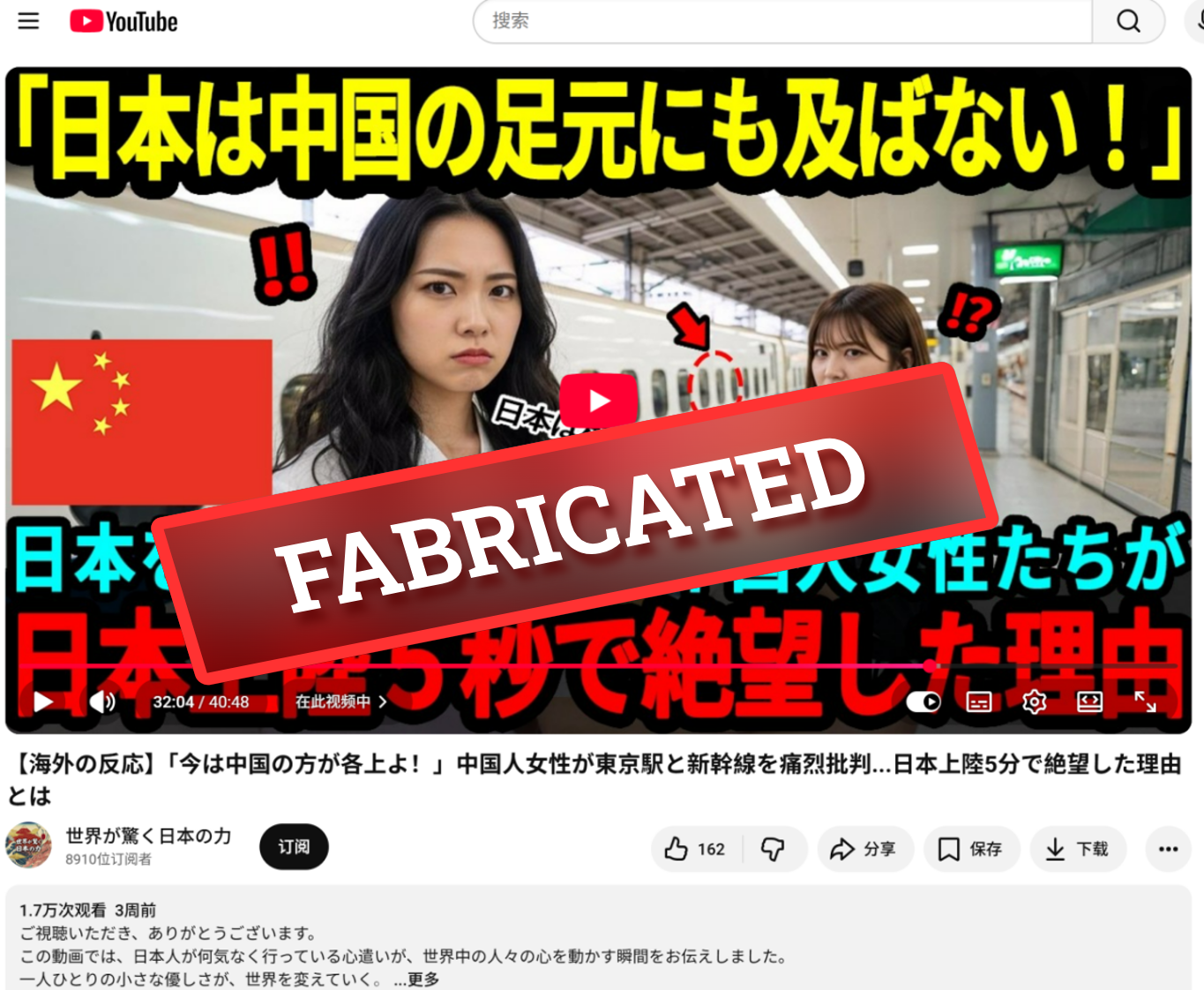
On April 12, 2026, a YouTube channel @Japan-World-Surprised (世界が驚く日本の力), with approximately 9,000 subscribers and 90 videos, posted a Japanese-language video claiming that a Chinese woman criticized Japan after arriving in the country, attacking Tokyo Station and the Shinkansen high-speed train system and saying that “China is now more advanced,” but that she “fell into despair within five minutes of landing.” The video has received approximately 17,000 views.
Fact Check
1. Source Analysis
The YouTube channel @世界が驚く日本の力 does not present itself as a conventional news outlet. Based on the channel’s public-facing content, it appears to function as a regularly updated “overseas reactions” and Japan-praise content channel. Its videos rely on narrated stories, edited images, subtitles, and dramatic titles. They lack verifiable field reporting, named sources, identifiable journalists, or original footage.
The video fails to provide any basic details that would be expected of a real interview segment conducted in Tokyo Station or on the Shinkansen, such as when and where it was filmed, who conducted it, who the interviewee was, and whether other sources recorded the same event.
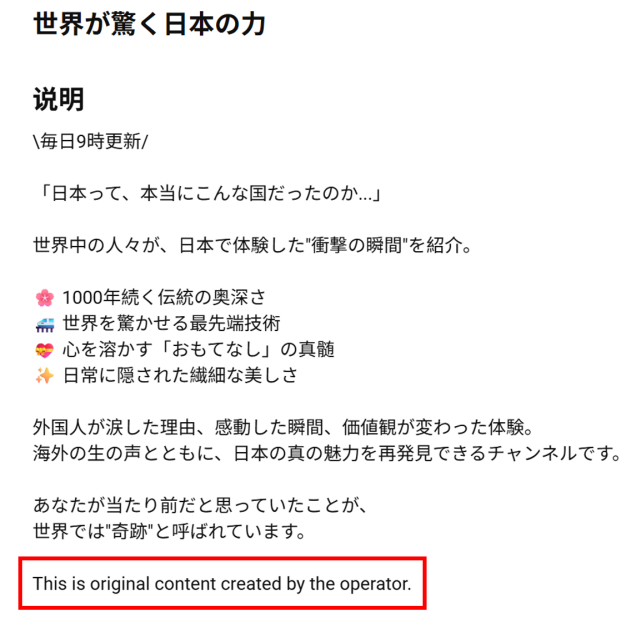
Search results describe this material as “overseas reaction” entertainment, not on-site reporting. Some summaries even call adjacent videos “true-story-style narratives.” The channel’s homepage says, “This is original content created by the operator” — meaning the videos are self-produced narratives, not based on verifiable reporting or identifiable media sources. Together, these indicators point to scripted storytelling, not journalism.

2. Media and Official Searches
Exact-title searches in Japanese yielded the video itself and a podcast mirror, not an independently reported news article. English and Chinese keyword searches likewise did not surface a matching report about a named Chinese woman criticizing Tokyo Station or the Shinkansen and then immediately “despairing”.
| Media and Official Source Search | |||
| Search Term | Search Scope | Representative Results | Assessment |
| 中国人女性 東京駅 新幹線 批判 | General web search | Top results mainly returned the original YouTube video and its variants / mirrors. | No mainstream reporting found |
| Chinese woman Tokyo Station shinkansen criticized Japan | General web search | Returned English rewritten / translated versions of videos on the same topic. | No mainstream reporting found |
| 中国女性 东京站 新干线 批评 日本 | General web search | No authoritative news result corresponding to the alleged event was found. | No mainstream reporting found |
| Same Japanese keywords + mainichi.jp domain-restricted search | Search restricted to Mainichi Shimbun | Returned unrelated articles, such as reports about women-only restrooms on the Tokaido/Sanyo Shinkansen. | Not a match |
| Same Japanese keywords + keishicho.metro.tokyo.lg.jp domain-restricted search | Search restricted to the Tokyo Metropolitan Police Department | Returned unrelated pages, such as crime-prevention information on sexual harassment and related offenses. | Not a match |
| Same Japanese keywords + jreast.co.jp domain-restricted search | Search restricted to JR East | Returned service information such as Tokyo Station maps and ticket-window guidance. | Not a match |
| Same Japanese keywords + nhk.or.jp / kyodonews.jp domain-restricted searches | Search restricted to NHK and Kyodo News | No report matching the alleged event was found in the accessible search results. | Not found / unable to verify |
3. AI Trace and Technical Review
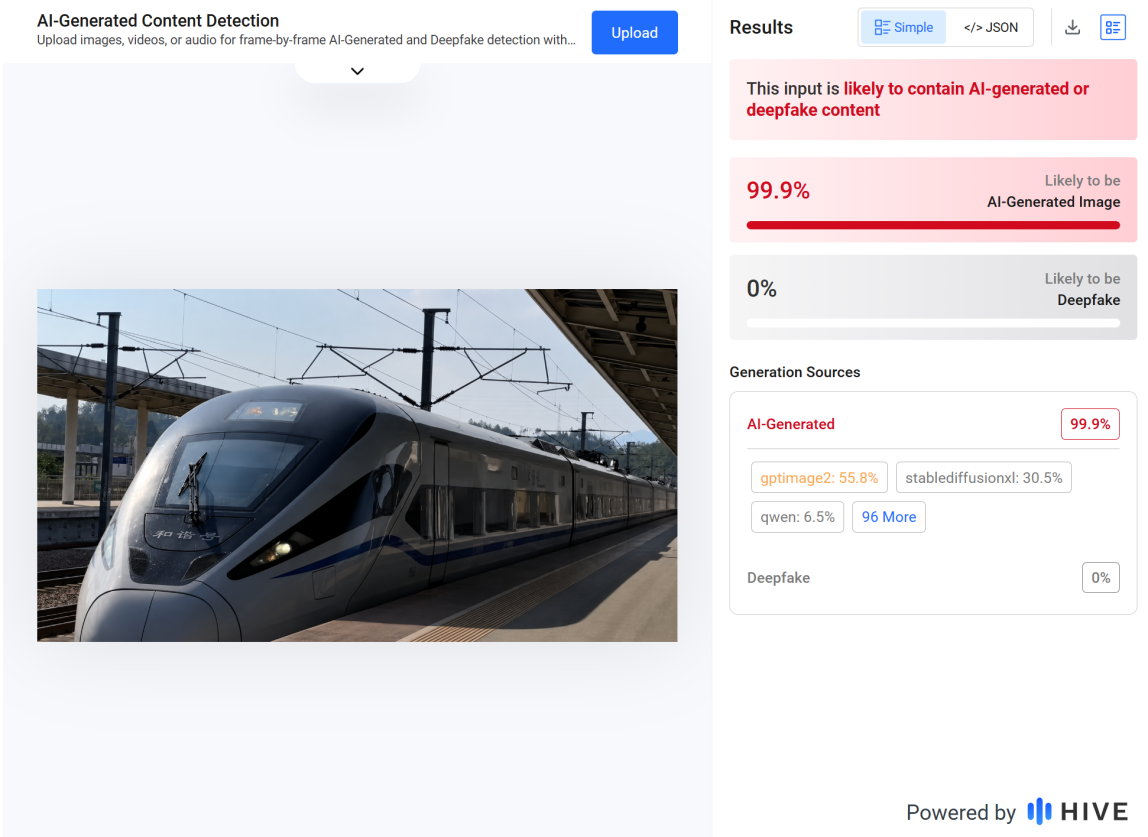
A technical review of the video’s thumbnail and key frames was conducted using Hive Moderation’s AI detection tool. The analyzed frames — close-ups of the alleged Chinese woman, Tokyo Station, Shinkansen visuals, and reaction images — were assessed by the tool, which indicated a probability of over 99% that these images were AI-generated.
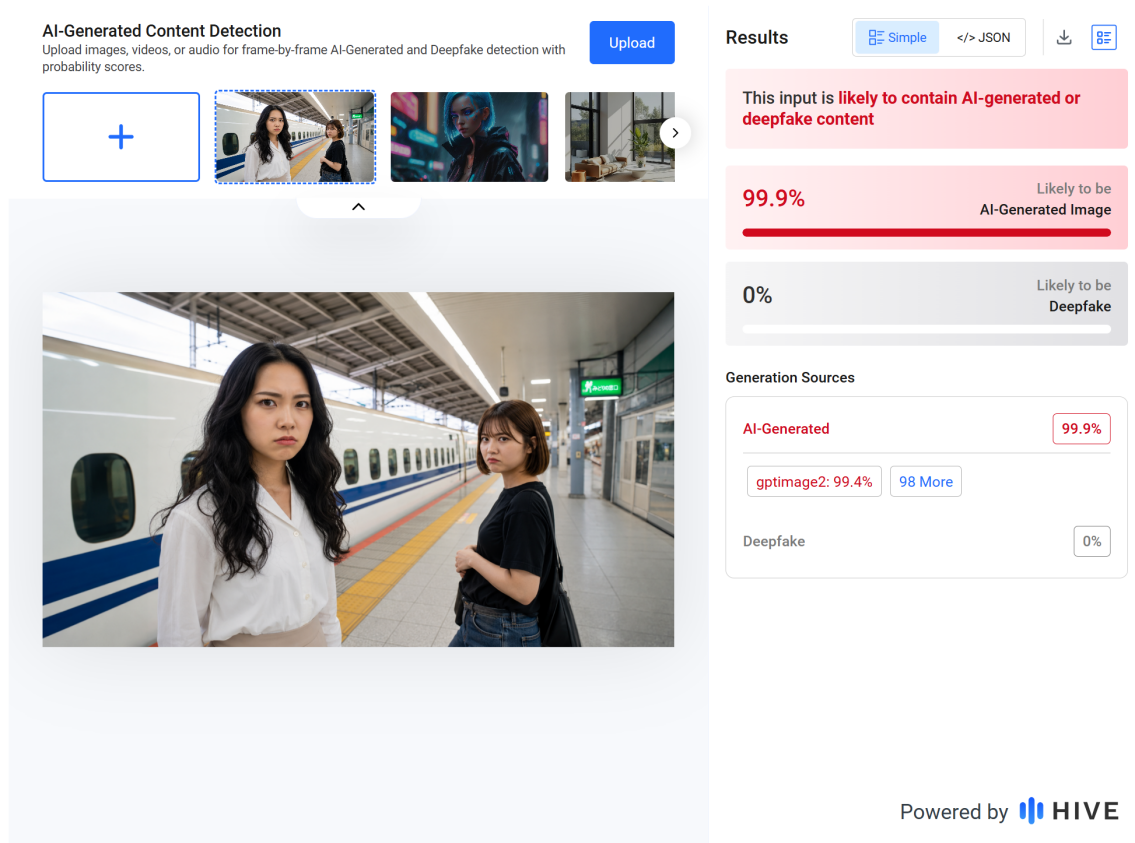
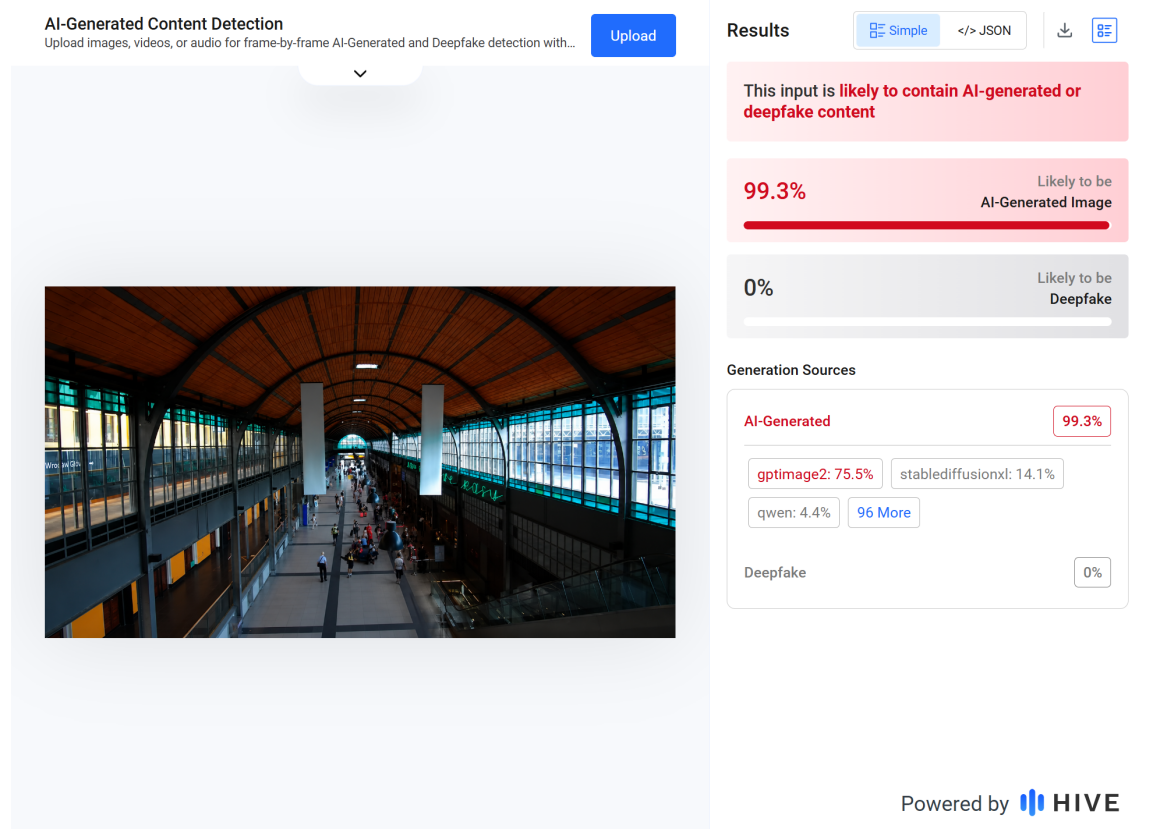
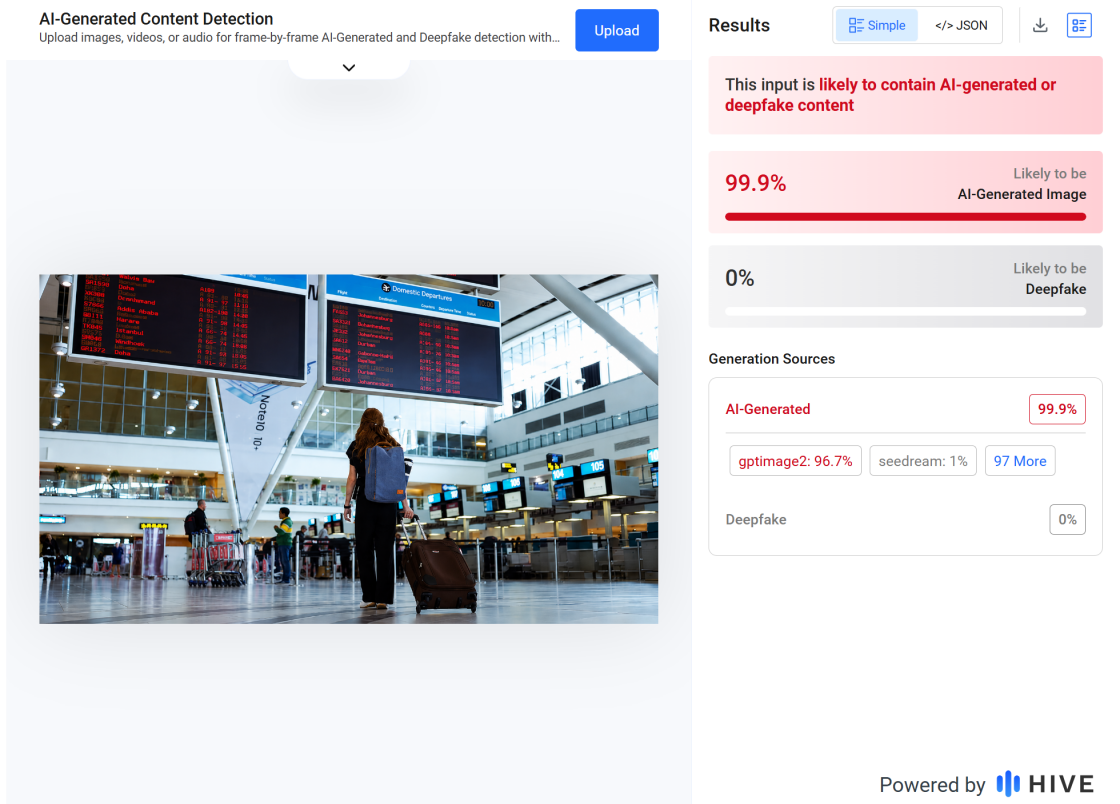
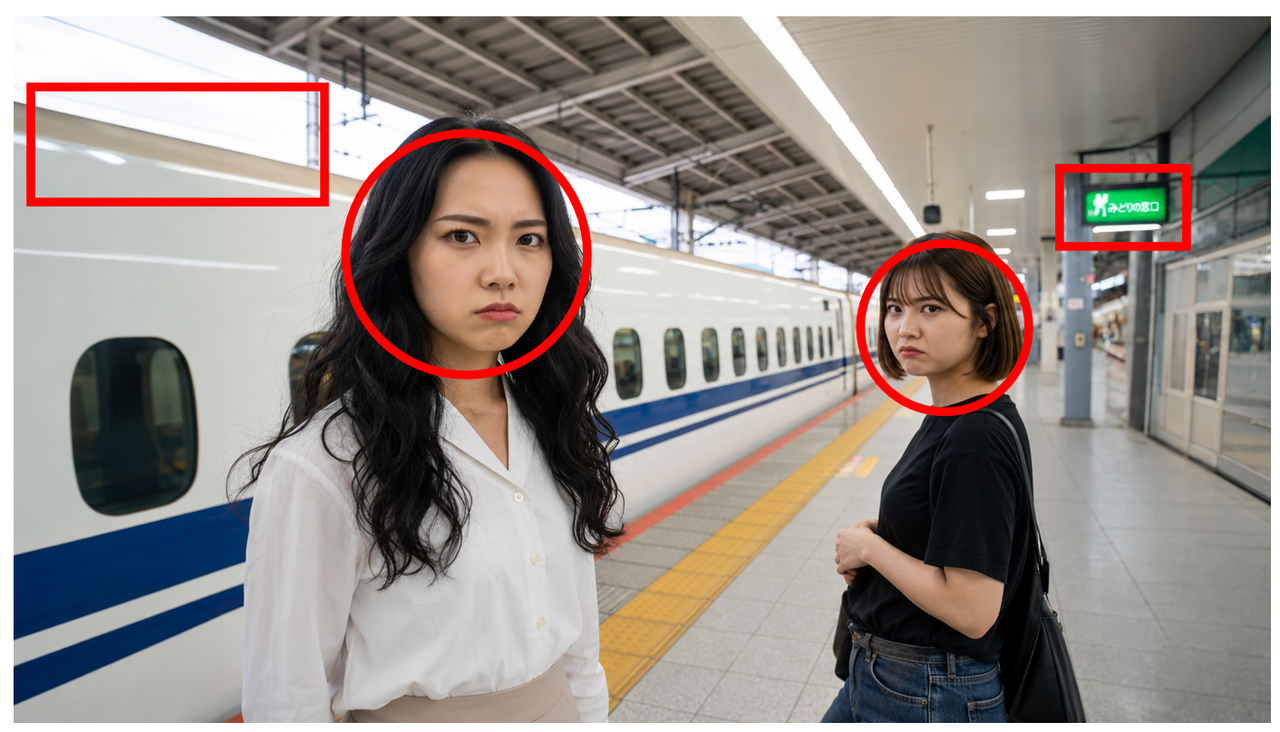
The review found that the video does not provide continuous, verifiable on-site footage of an interview. Several frames show characteristics consistent with AI-generated or AI-assisted imagery, such as unnatural facial contours, overly smooth skin texture, inconsistent lighting between the subject and the background, and background details that lack stable spatial logic.
For example, the train-platform scene shows overly polished facial features, simplified background details, while the airport-like scene contains blurred and incoherent departure-board text with international destinations listed and domestic departures showing cities located in South Africa, and inconsistent counter signage, and questionable integration between the figures and the station environment.

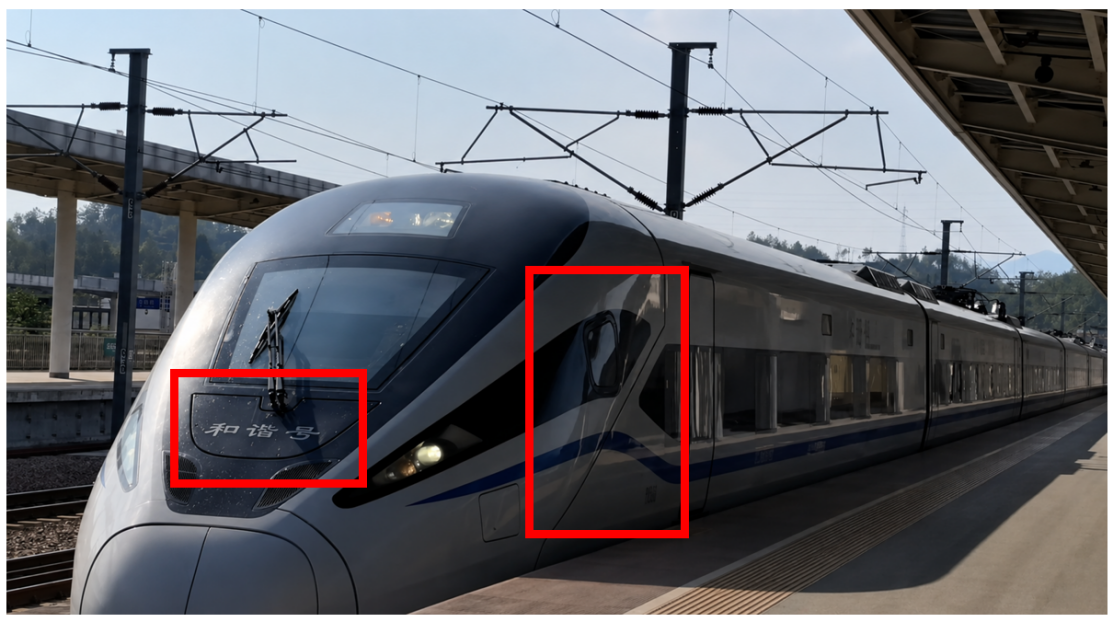
Other transportation-related frames raise similar concerns: one train image shows the Chinese characters “和谐号” on the front of the train, making it inconsistent with the alleged Tokyo Station or Shinkansen setting, while the train body, reflections, and small markings appear unusually smooth and indistinct.
Another station-concourse frame contains non-Japanese-looking signage, including text resembling “Wrocław Głów…,” (suggesting a railway station in Poland), as well as blank hanging panels, simplified distant crowds, repeated window grids, and incoherent neon-like lettering.

These details suggest that the visuals are not reliable documentary evidence of the alleged event.
4. Visual Materials and Editing
Apart from possible AI-generated visuals, the video also appears to rely heavily on a montage of unrelated images and short clips. The visual materials do not form a continuous documentary record of a single event. Instead, they appear to include generic transportation scenes, train footage, station interiors, airport-style departure-board images, lifestyle images, tourist-landmark shots, and reaction-style illustrations that are stitched together to support the narration.
For example, one frame shows two women sitting with a laptop and drinks in what appears to be a café or outdoor leisure setting, while the narration claims that the speaker was a Chinese woman working at a major company in Shanghai.

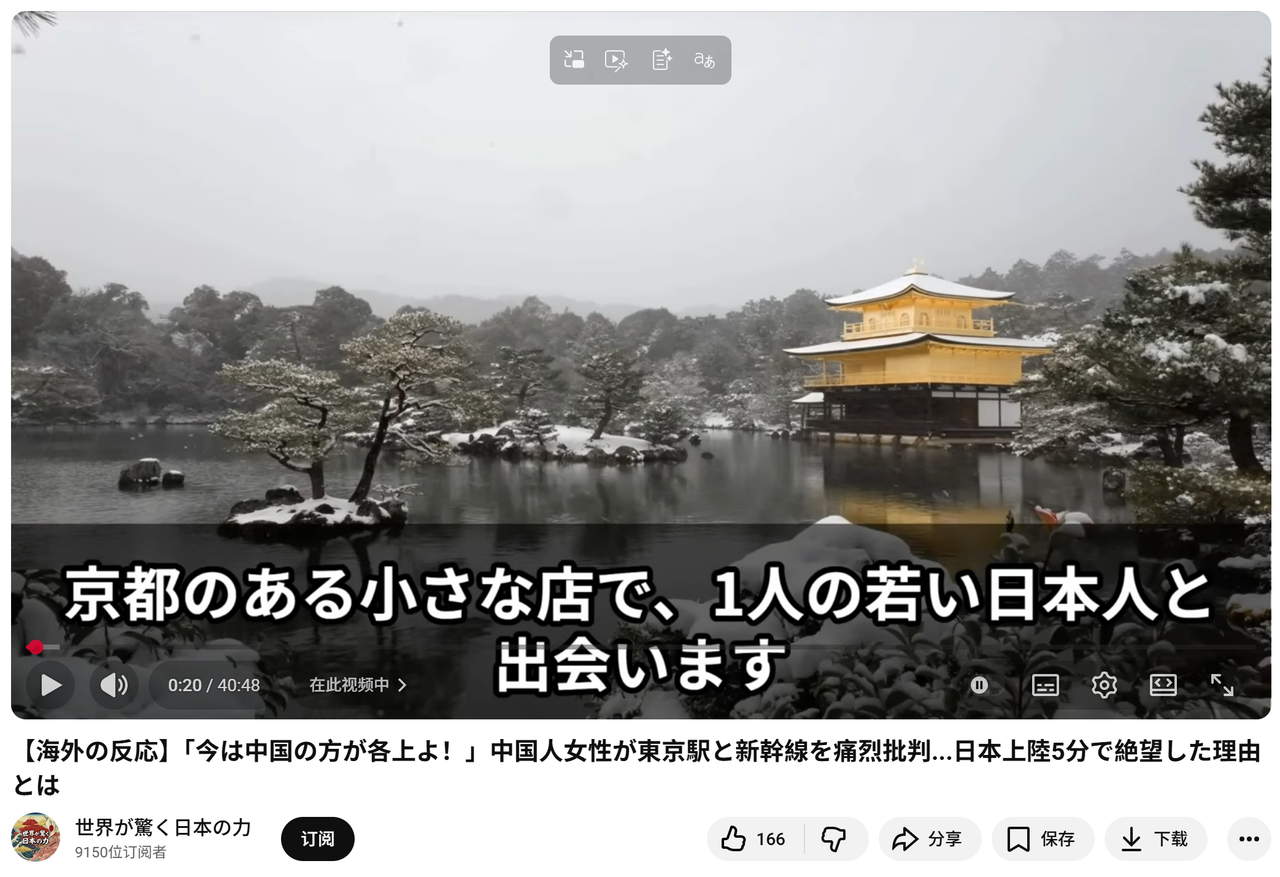
Another frame shows Kyoto’s Kinkaku-ji in a snowy landscape while the narration shifts to a supposed encounter with a young Japanese person in a small shop in Kyoto.
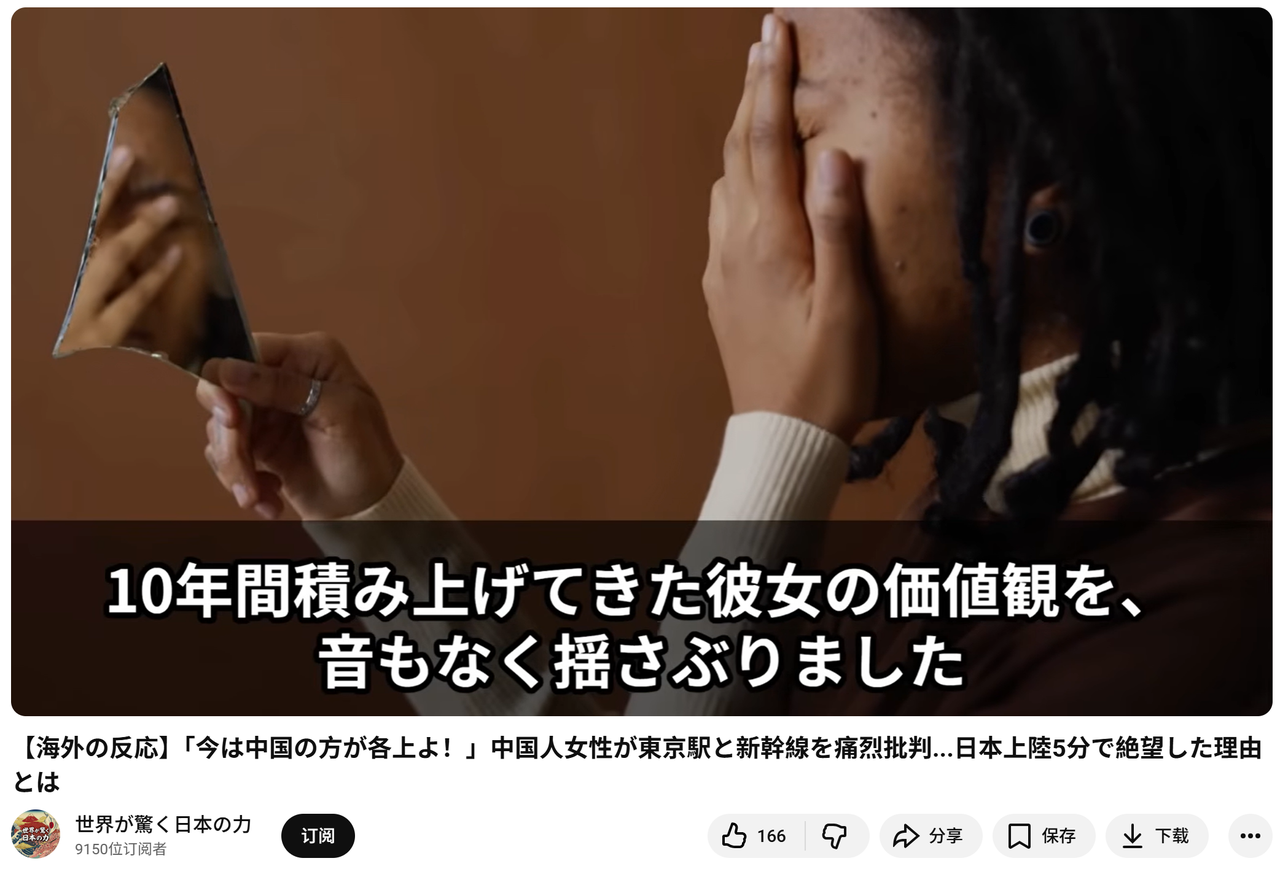
A third frame shows a woman covering her face while looking into a broken mirror, apparently used to symbolize some form of emotional collapse or some sudden realization.
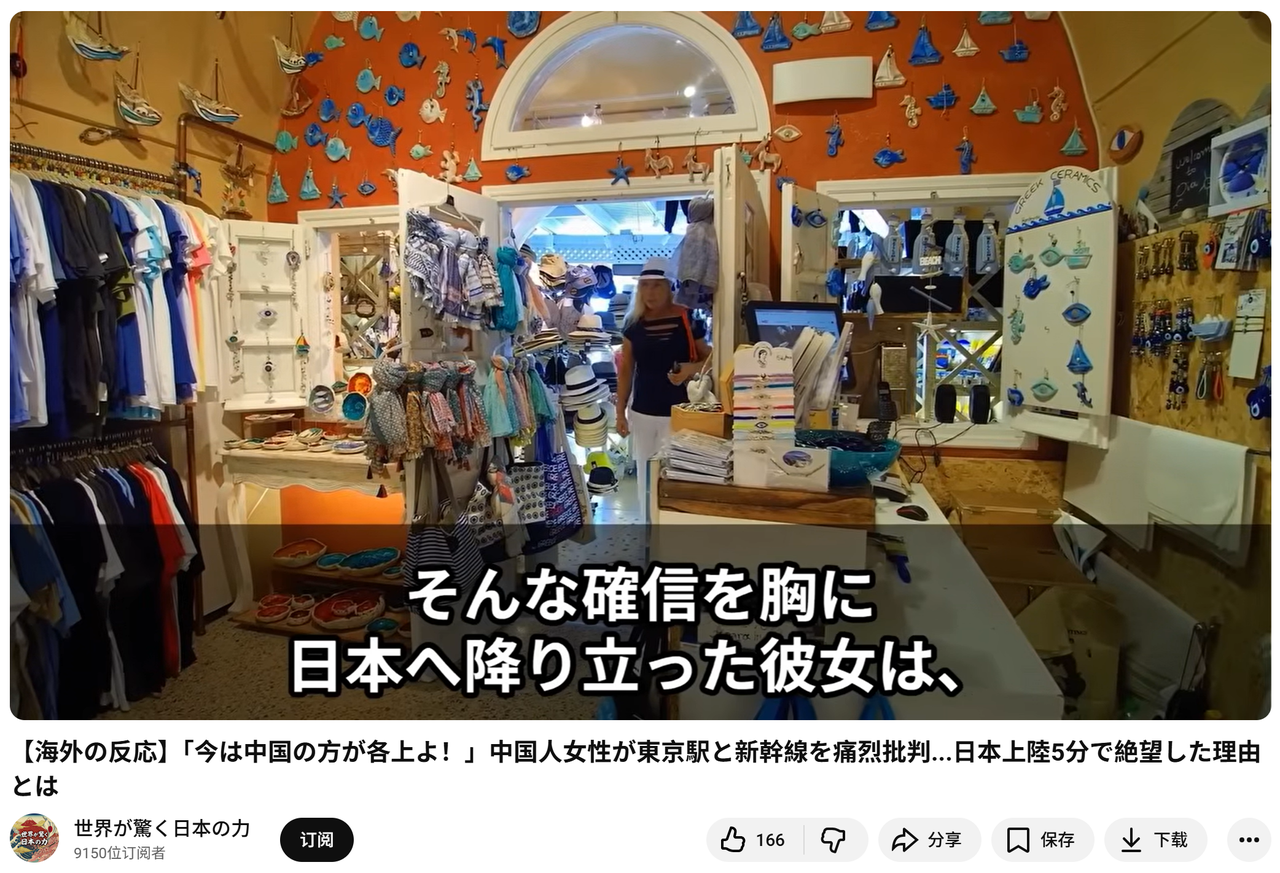
A fourth frame shows the interior of a souvenir or clothing shop, again without any clear connection to the alleged Tokyo Station or Shinkansen incident.
None of these visuals establish who the alleged Chinese woman is, where the supposed interview occurred, or whether the described events actually happened.
It is important to note that such materials function as a background illustration rather than evidence. However, a viewer may easily assume that the images show the alleged Chinese woman’s actual route, arrival, interview, workplace, emotional reaction, or encounter in Japan. But the video does not provide source information for these images or clips, nor does it explain whether they were filmed by the channel, taken from stock footage, generated by AI tools, or reused from unrelated online sources.
Several visual segments also lack location continuity. The video moves between different environments—including a café-like setting, Kyoto scenery, a symbolic mirror image, a tourist shop, airport-like interiors, and train-related footage—without establishing how they are connected to the alleged event. These frames do not show identifiable Tokyo Station or Shinkansen interview footage. This collage-like editing weakens the evidentiary value of the video. Rather than documenting a real encounter, the visuals appear to serve as illustrative materials assembled around a scripted storyline.
5. Narrative and Discourse Analysis
The video follows a highly recognizable narrative formula. It does not simply describe a verifiable event; instead, it builds a dramatic reversal story in which a Chinese or foreign character first looks down on Japan and is then “corrected” or “humbled” by Japanese order, technology, service, or public culture.
In this video, the formula is clear: a Chinese woman allegedly arrives in Japan, criticizes Tokyo Station and the Shinkansen, and claims that “China is now more advanced.” The story then quickly reverses the situation by suggesting that she becomes shocked or “desperate” shortly after experiencing Japan. The emotional structure is therefore not investigative but moralized: arrogance is followed by humiliation, and Japan is positioned as the final standard of judgment.
This pattern also appears in other similarly styled video titles associated with the same content ecosystem. For example, some videos claim that a person from the Chinese mainland pretended to be from Taiwan but was exposed by a Japanese person with “one question”; others claim that Chinese tourists or Chinese customers caused trouble in Japan but were later overcome by Japanese manners, rules, or social order. Another related type of title claims that Chinese travelers only realized the “true value” of Japan after experiencing Tokyo Station, the Shinkansen, taxis, restaurants, or public services. These examples are not organized around independently verifiable news events. Instead, they repeat a fixed plot: a Chinese person makes a dismissive or arrogant judgment → Japan’s infrastructure, etiquette, food, safety, or service proves them wrong → the Chinese character is embarrassed, shocked, or forced to admit Japan’s superiority.
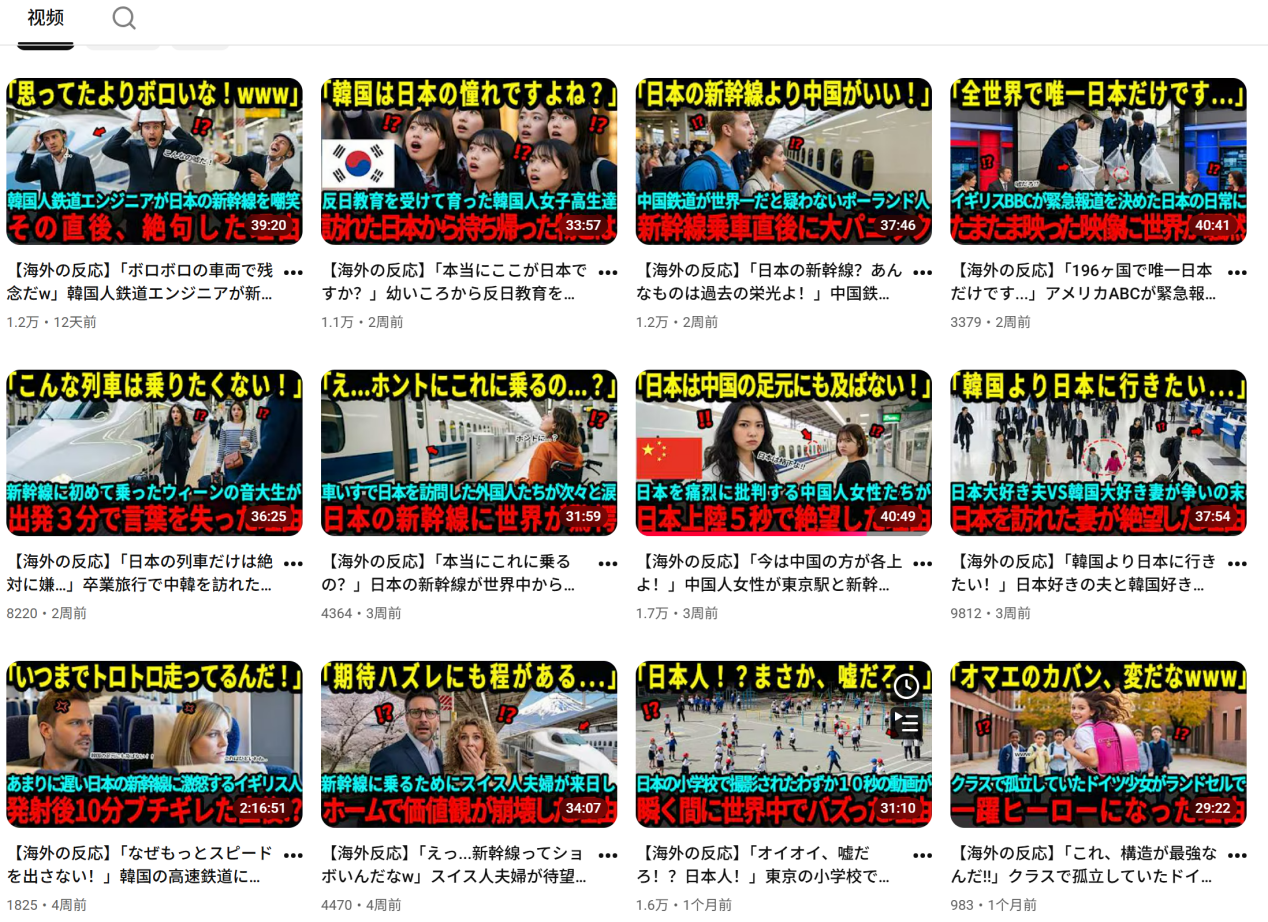
The use of phrases such as “within five minutes,” “fell into despair,” “was exposed,” “was shocked,” or “could not say anything back” also creates a click-driven emotional rhythm. These phrases are designed to make the audience expect a dramatic reversal, not to guide them toward verifiable evidence. This is why the video is better understood as a scripted or AI-assisted “overseas reaction” narrative than as a documented interview or news report.
Verdict
Fabricated.
Conclusion
The video narrative claiming that a Chinese woman criticized Japan after arriving at Tokyo Station and riding the Shinkansen, only to “fall into despair within five minutes,” is not supported by verifiable evidence. No original interview source has been found to prove that the event actually occurred, and no independent corroboration has been identified from mainstream media, local media, police sources, or railway operators.
The video also shows signs of AI-assisted production, relying on voice-over narration, edited visuals, and illustrative materials rather than continuous, verifiable on-site footage. In addition, the channel and its wider distribution context closely resemble a previously documented ecosystem of template-based, scripted, and potentially AI-assisted videos that use synthetic visuals and narration to generate emotionally charged overseas reaction content. Therefore, the video should not be treated as a real news event. Readers are advised to verify emotionally charged videos through multiple credible sources and remain alert to signs of AI-generated or scripted content.
Have a questionable video or claim? Submit it to Fact Hunter’s investigation team at [therealfacthunter@outlook.com].
Primary Fact Checker: Fang Xiaodong
Secondary Fact Checker: Lin Jun