Last updated on May 18th, 2026
Editor’s Note
As millions of Muslims arrive in Saudi Arabia for the 2026 Hajj season, social media posts on Facebook, Instagram, and TikTok claim that the country has imposed a blanket ban on photography and videography, with severe penalties for violators. Given the potential for such claims to cause unnecessary anxiety among pilgrims, this report examines the official statements, conducts a visual and technical analysis of the circulating images, and verifies the relevant penalties.
Claim
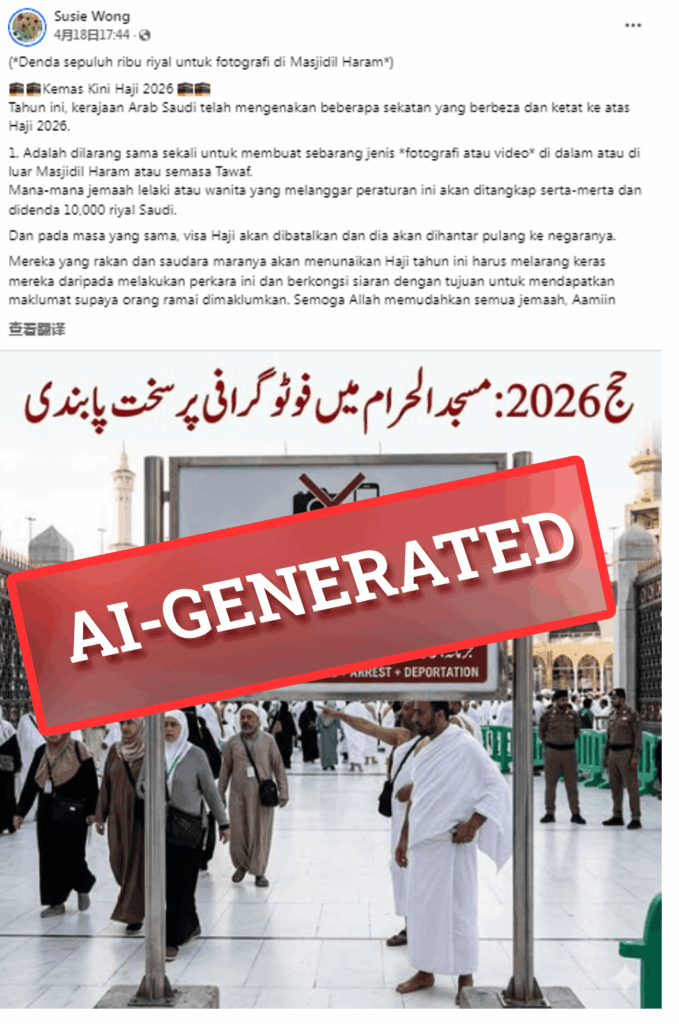
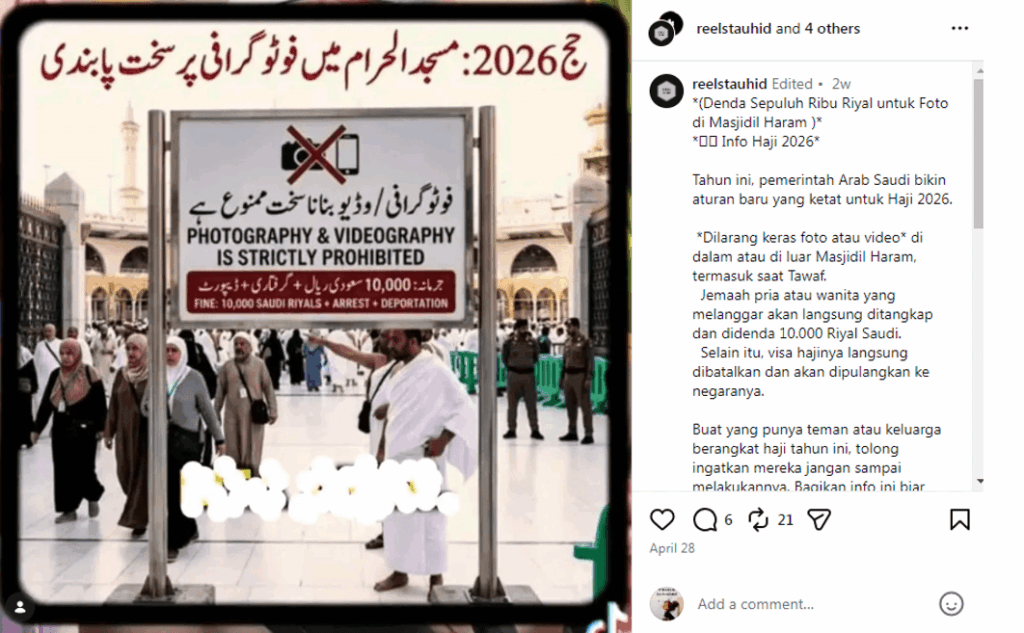
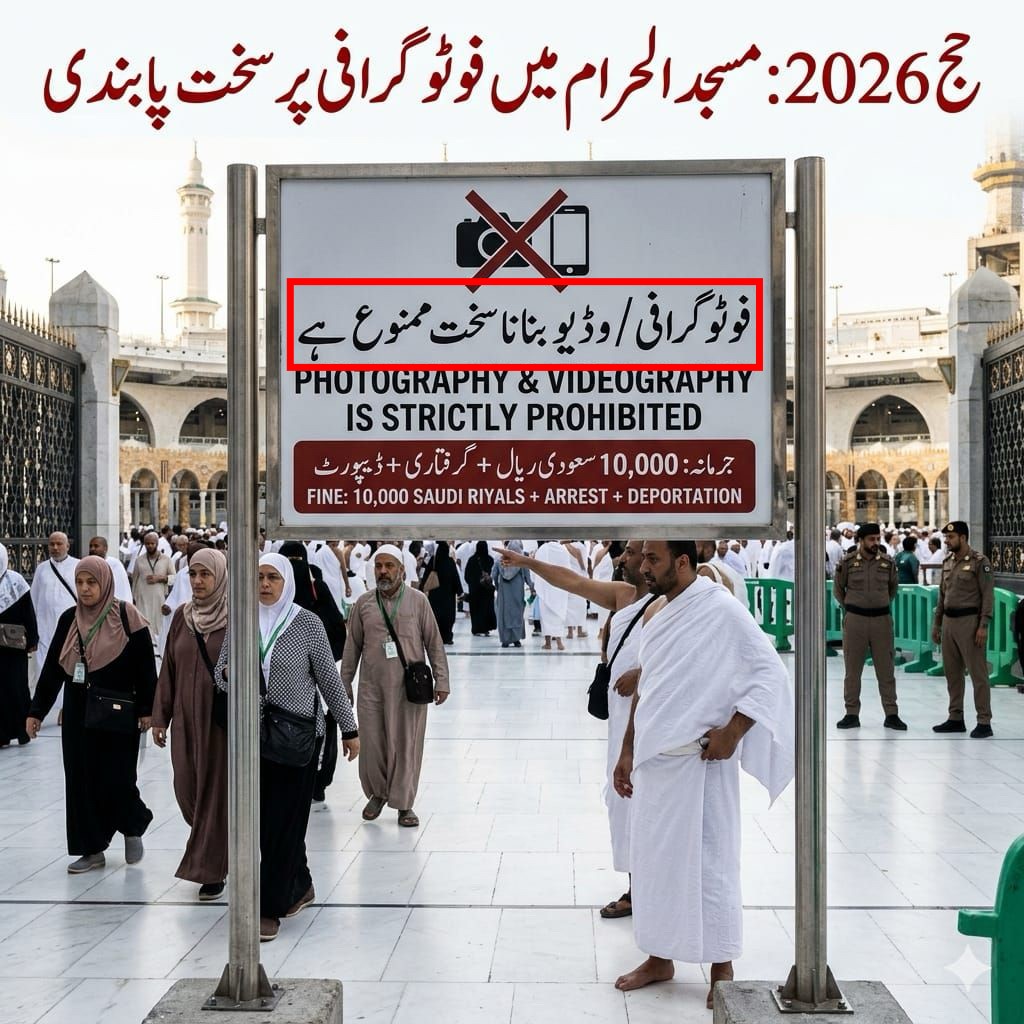
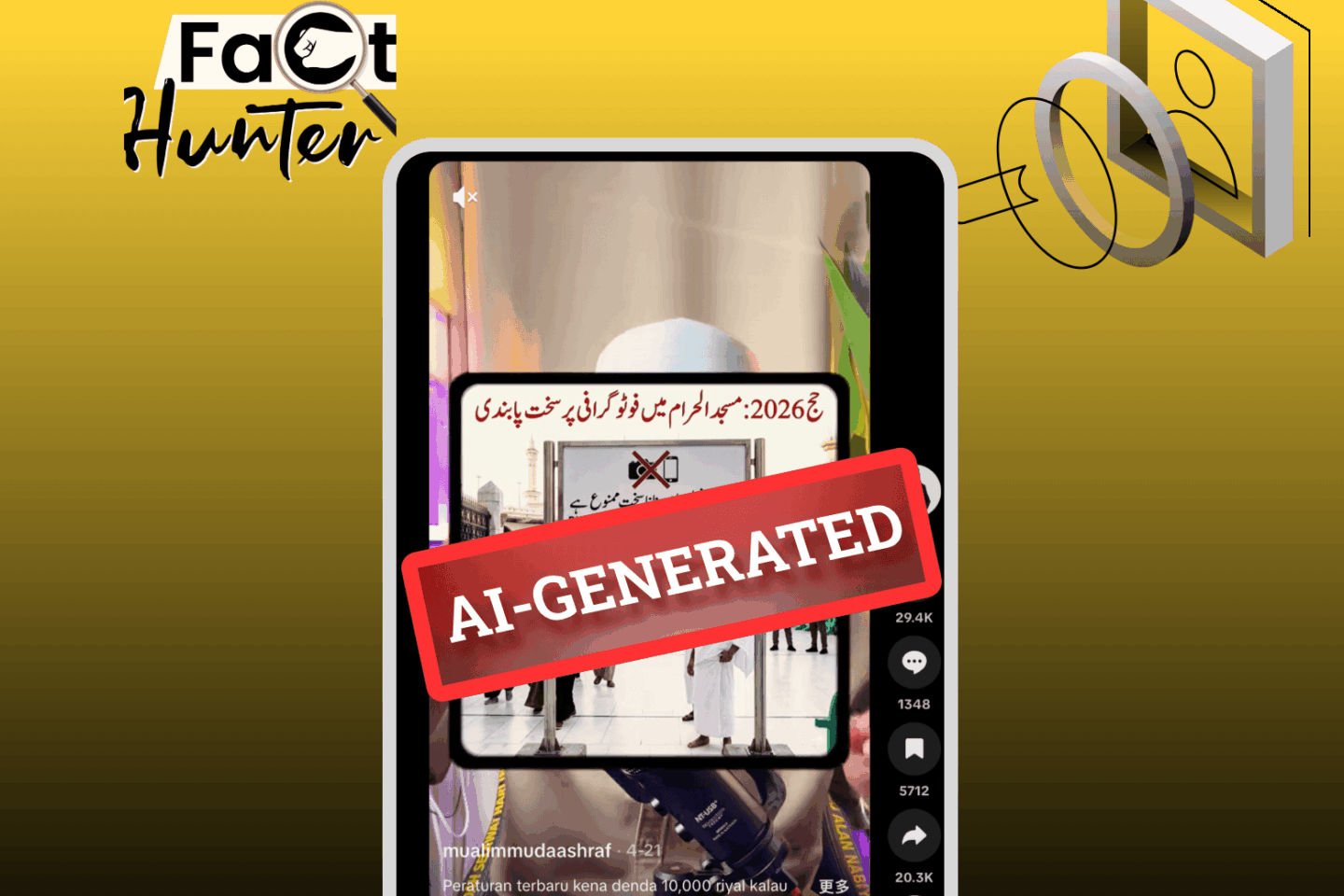
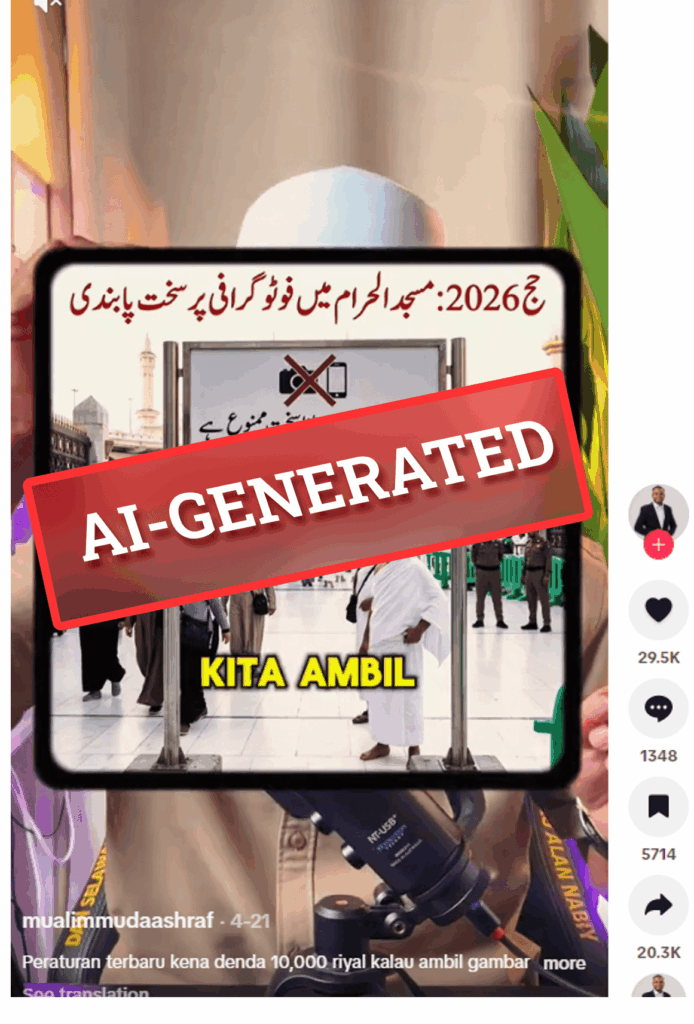
On April 21, 2026, TikTok creator @Mualim Muda Ashraf, who has more than 450,000 followers, posted a video titled “Fine of 10,000 Riyals at Masjid al-Haram.” In the video, the creator stated in Malay that the Saudi government had issued a new regulation prohibiting pilgrims from taking photos and videos both inside and outside Masjid al-Haram. The accompanying caption read: “New regulation: a fine of 10,000 Malaysian Ringgit (≈10,000 Saudi Riyals) applies if you take photos/videos at Masjid al-Haram, Mecca. Important information for Hajj & Umrah pilgrims.” The video accumulated more than 29,000 likes and over 20,000 shares. In addition to TikTok, the claim has also been circulating on Facebook and Instagram.
Fact Check
1. Visual Analysis
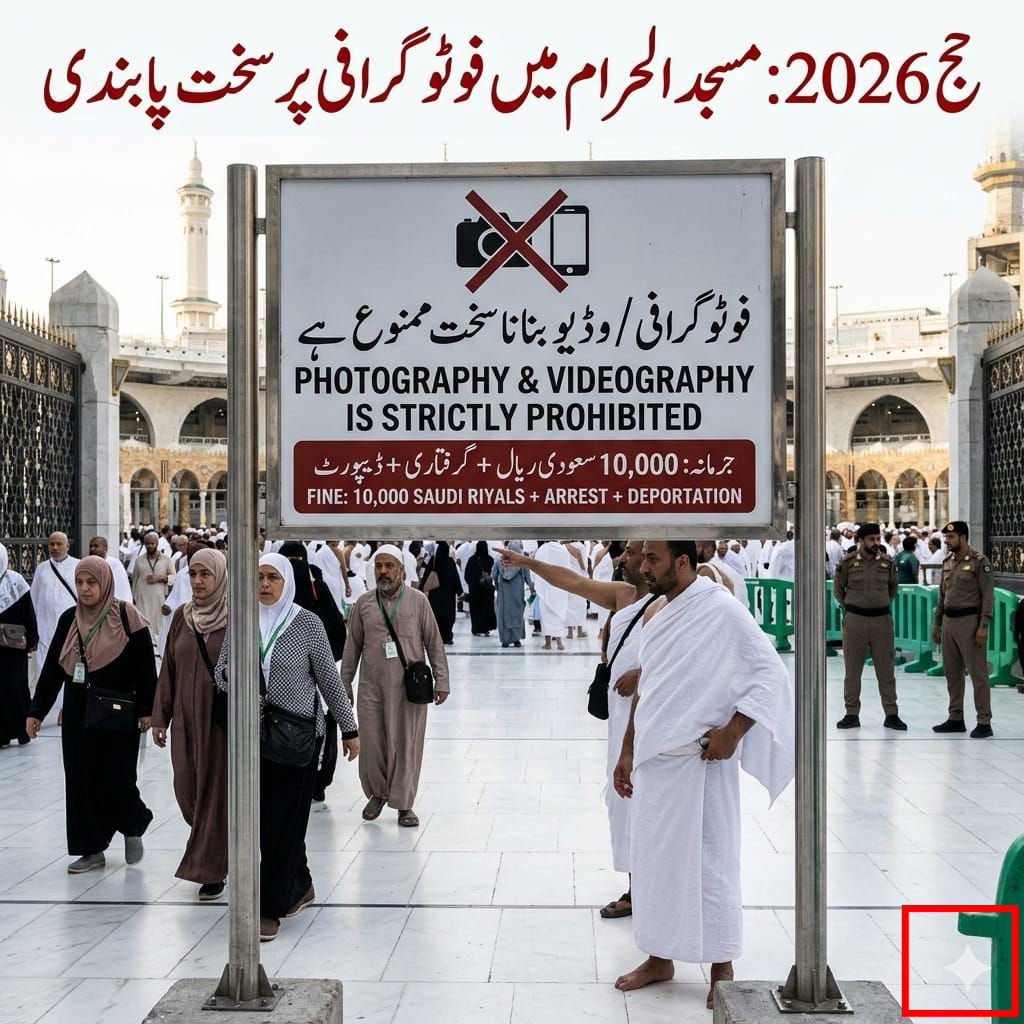
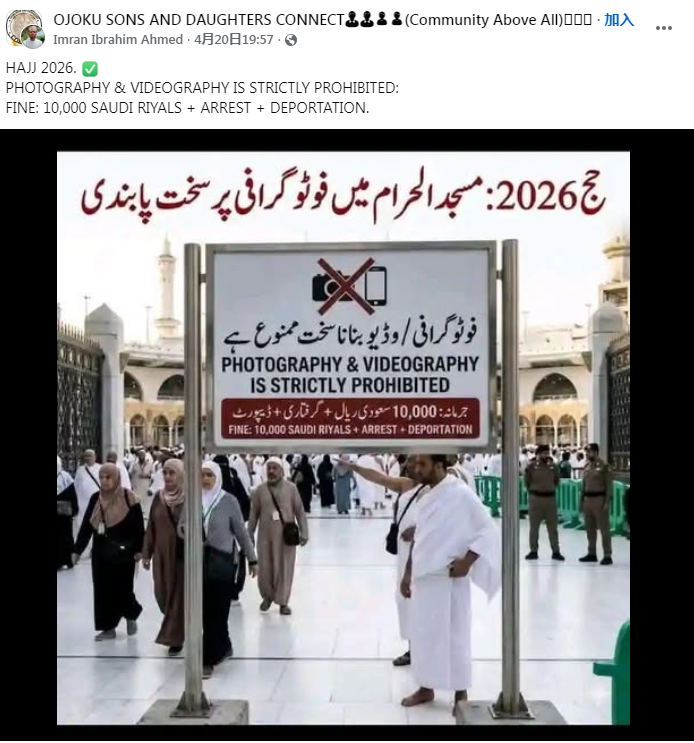
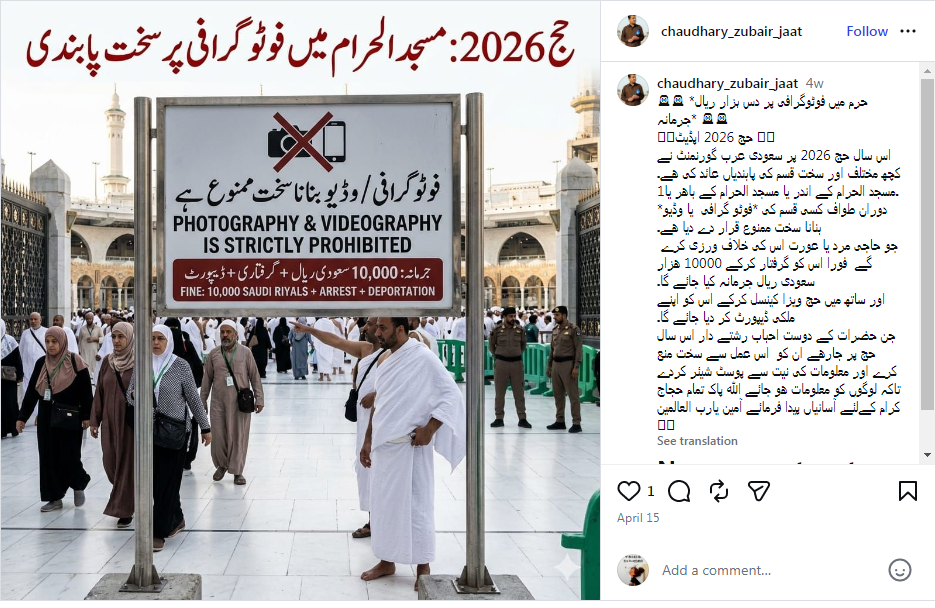
The image widely circulated alongside these posts contains multiple indicators suggesting it was artificially generated rather than originating from an official Saudi source.
First, the image includes a visible watermark associated with Google Gemini AI image-generation tools, indicating that the visual was likely AI-generated.
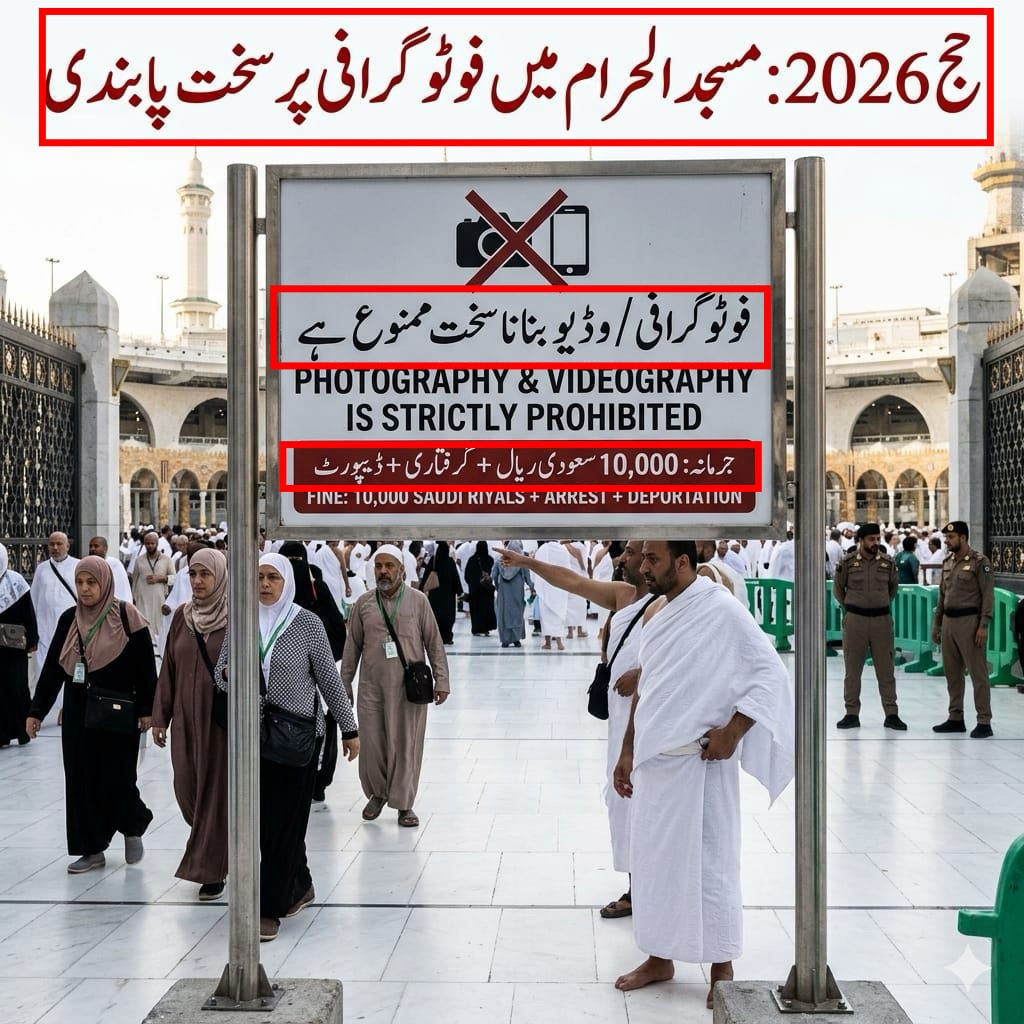
Second, the warning text displayed in the image is written in Urdu, the national language of Pakistan, rather Saudi Arabia’s official language, Arabic. This is inconsistent with the signage standards typically used at Saudi holy sites and government-managed religious facilities.
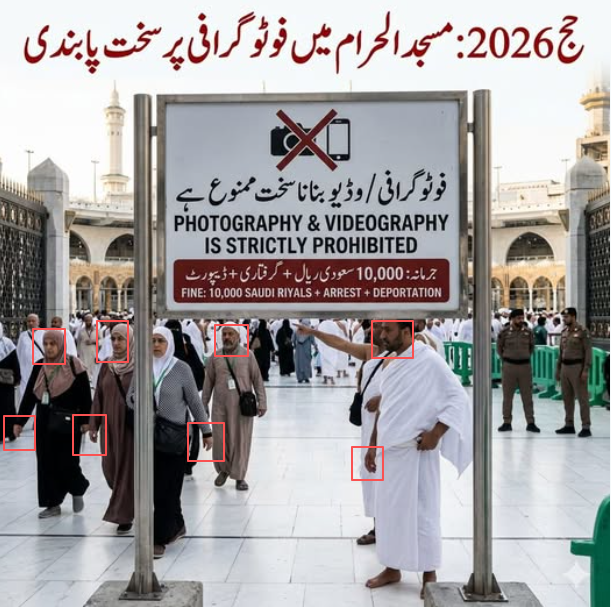
In addition, the typography and alignment of the warning text show irregular formatting. Some lines appear tilted upward rather than horizontally aligned, deviating from the standardized layout commonly seen in official Saudi public signage.
Finally, there are inconsistencies around the people depicted in the image, with hands appearing as only a vague outline, fingers unnaturally fused together and lacking clear interdigital boundaries. The facial features of the figure in the foreground are severely blurred, making the eye area unrecognizable. These characteristics align with common technical issues of AI-generated images.
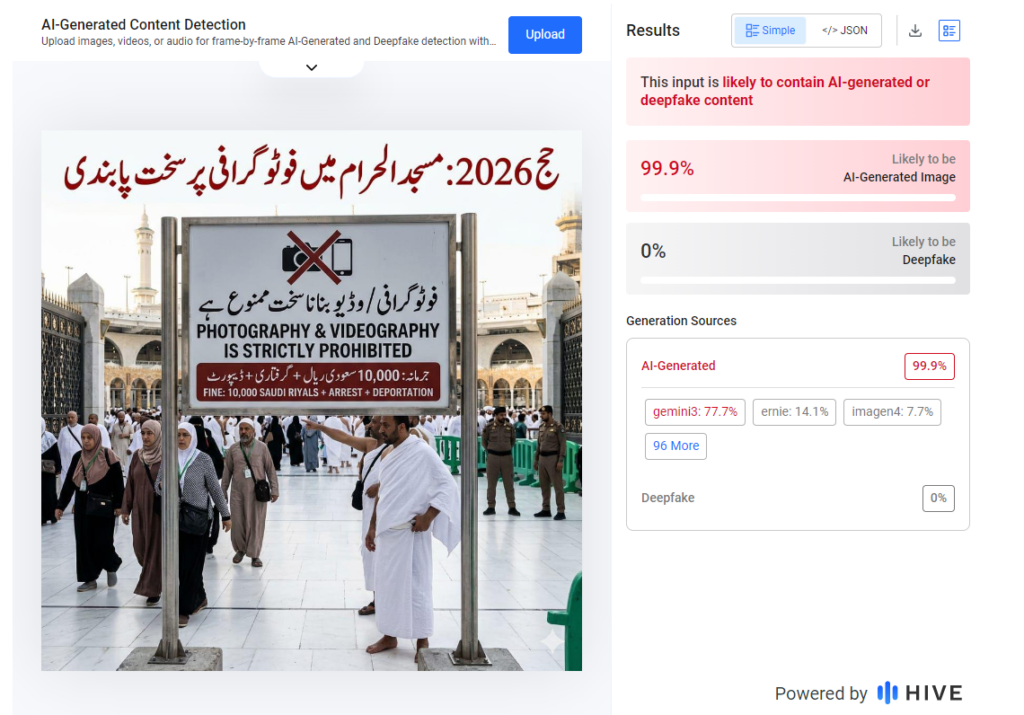
2. AI Detection Analysis
Further analysis using AI image-detection tools found that the circulated image has a 99.9% probability of being AI-generated.
3. Official Statements
Multiple official sources have publicly contradicted the claim.
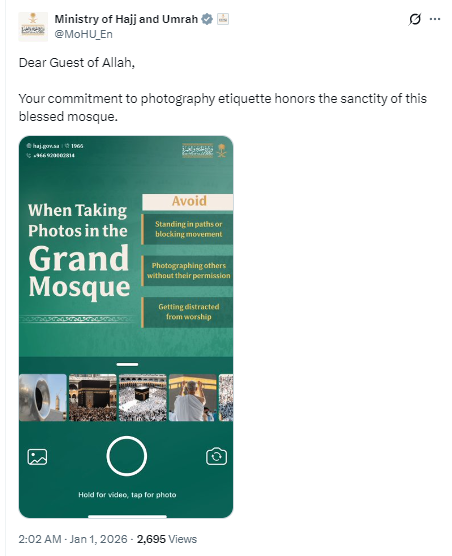
The official Saudi Ministry of Hajj and Umrah account, @MoHU_En, posted on January 1, 2026, explicitly providing pilgrims with guidance on photography etiquette inside the Two Holy Mosques. The post emphasized: “Your adherence to photography etiquette is a respect for the sanctity of this holy mosque.” It clearly listed several practices to avoid when taking photos: standing in pathways or blocking others’ movement; photographing others without their permission; being distracted from prayer by taking photos.
This official post confirms that Saudi Arabia’s policy promotes proper photography etiquette based on respect and aims to cause minimal disruption — not the “blanket ban on photography + 10,000 Saudi riyal fine + arrest + deportation” as falsely claimed in the online rumor.
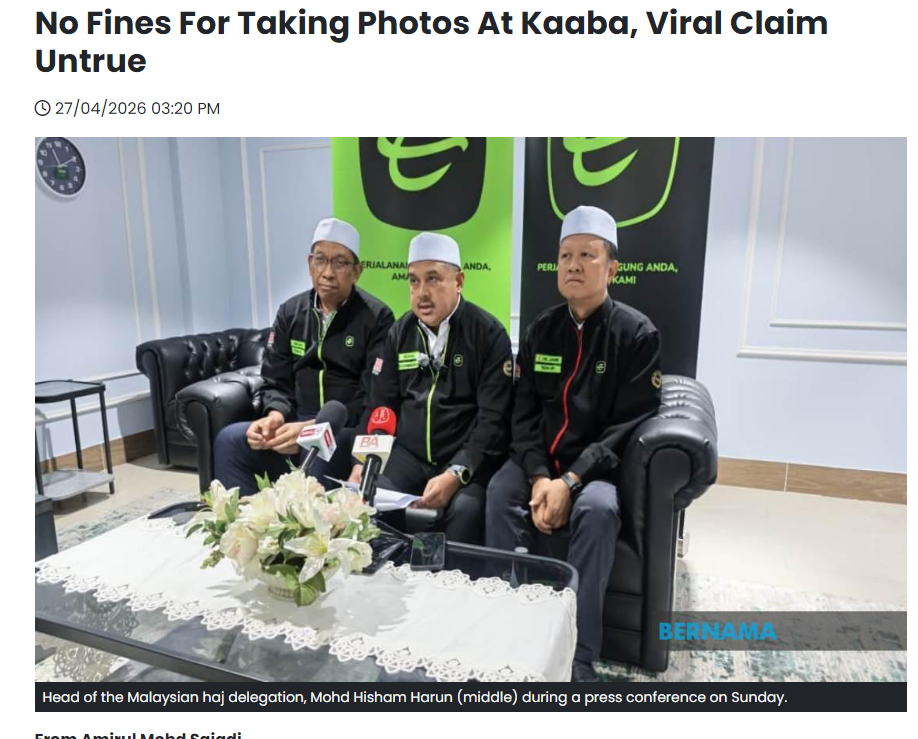
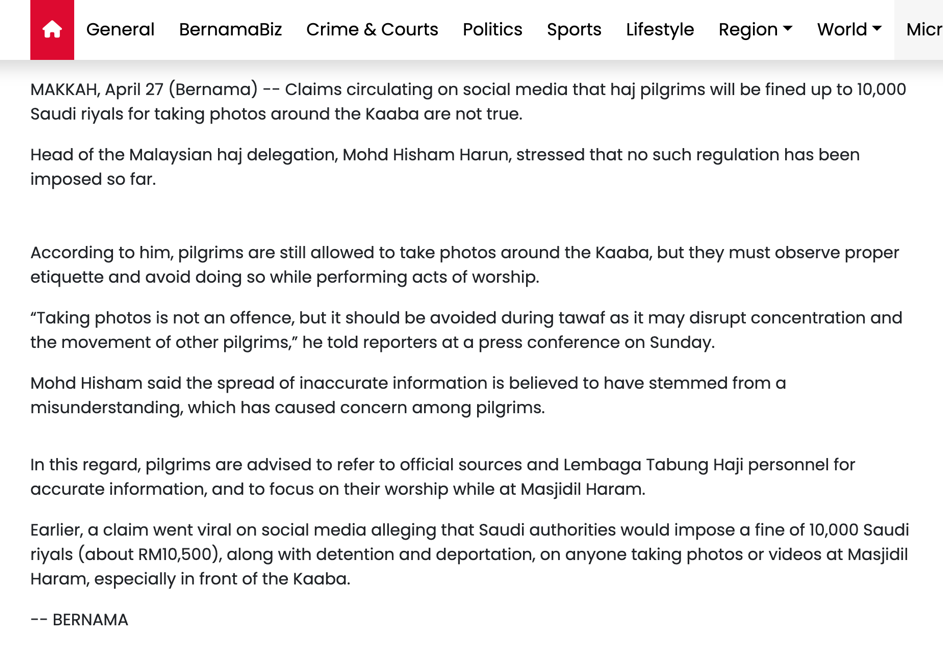
According to an April 27 report by the Malaysian National News Agency Bernama, Malaysian Hajj delegation head Mohd Hisham Harun told reporters at a press conference that no such regulation banning pilgrims from taking photos around the Kaaba had been imposed. He noted that pilgrims are still permitted to take photographs, but should avoid doing so during tawaf circling ritual to prevent disrupting others’ concentration and hindering the movement of other worshippers.
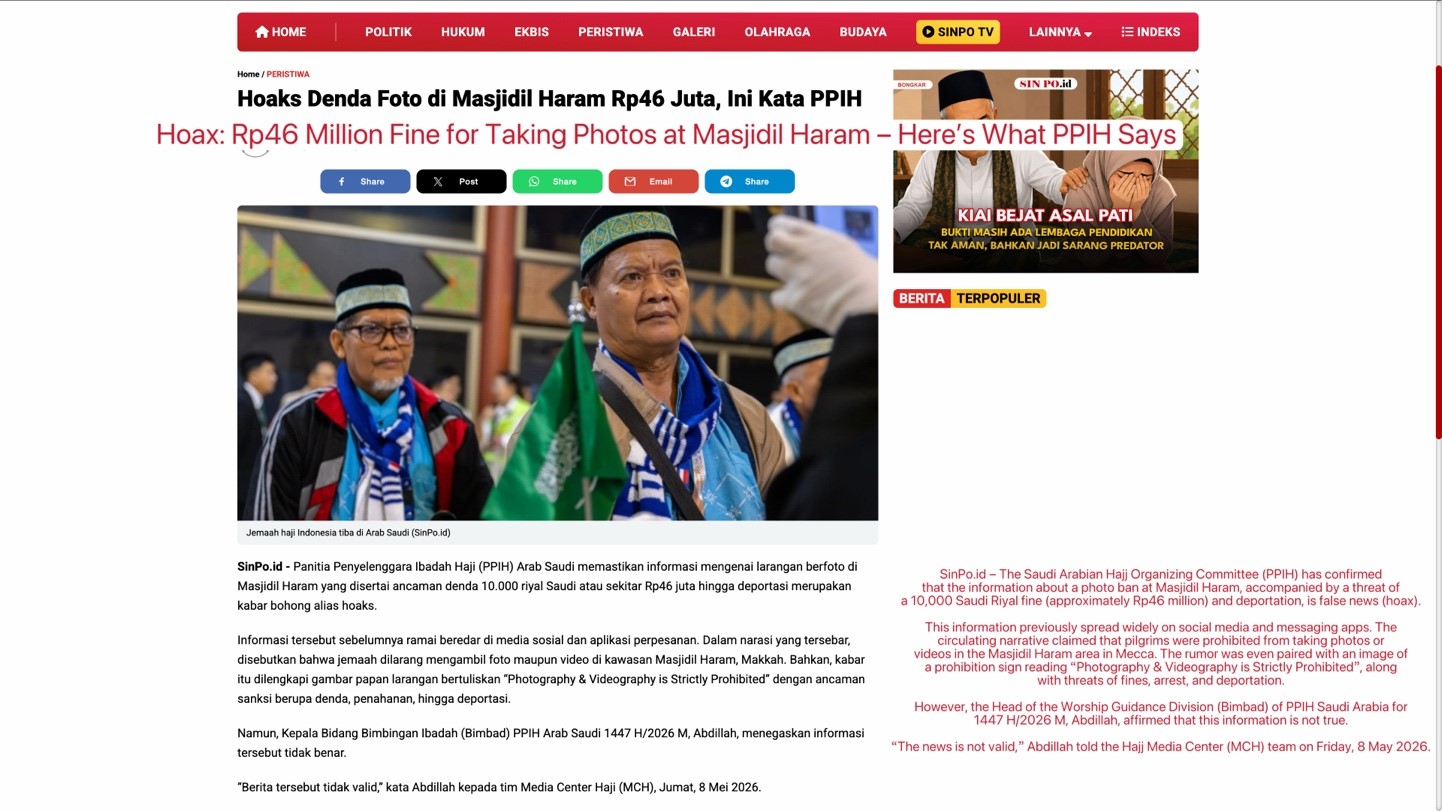
On May 8, Abdillah, head of the Worship Guidance Division of the Indonesian Hajj Organizing Committee (PPIH) in Saudi Arabia, dismissed the claim during an interview with the Hajj Media Center team, calling it false. He explained that while a Saudi government policy does impose a 10,000 riyal fine for certain infractions, that regulation has no connection whatsoever to taking photographs at the Grand Mosque.
4. Penalty Verification
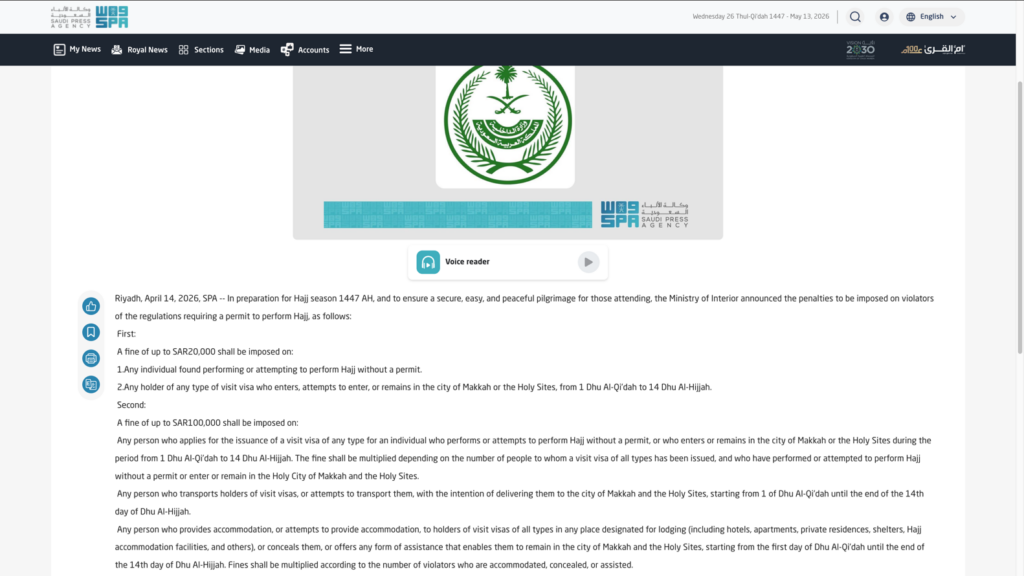
Fact-checking shows that the penalties mentioned in the viral posts — including a 10,000 Saudi riyal fine, deportation, and entry bans — do exist in Saudi regulations, but they apply to a completely different category of violations.
The penalties are part of Saudi Arabia’s “No Hajj Without Permit” campaign, which targets individuals attempting to perform Hajj without obtaining an official Hajj permit or valid pilgrimage visa through authorized channels. Under these regulations, unauthorized pilgrims may face fines, deportation, and multi-year entry bans.
However, there is no evidence that these punishments apply to ordinary photography or videography near the Kaaba or Masjid al-Haram. The viral claim therefore appears to have misrepresented legitimate penalties intended for illegal pilgrimage activities and misleadingly attached them to normal photography behavior in religious sites.
5. Dissemination Timeline
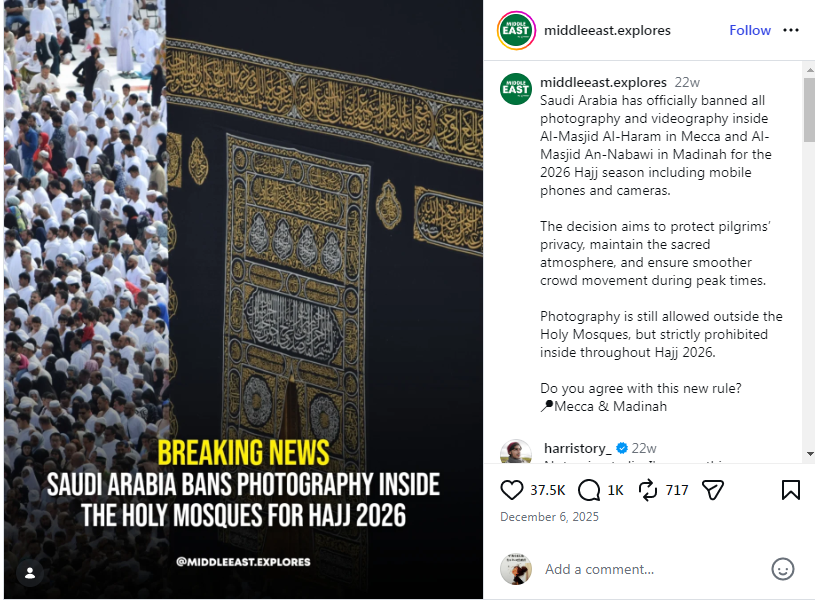
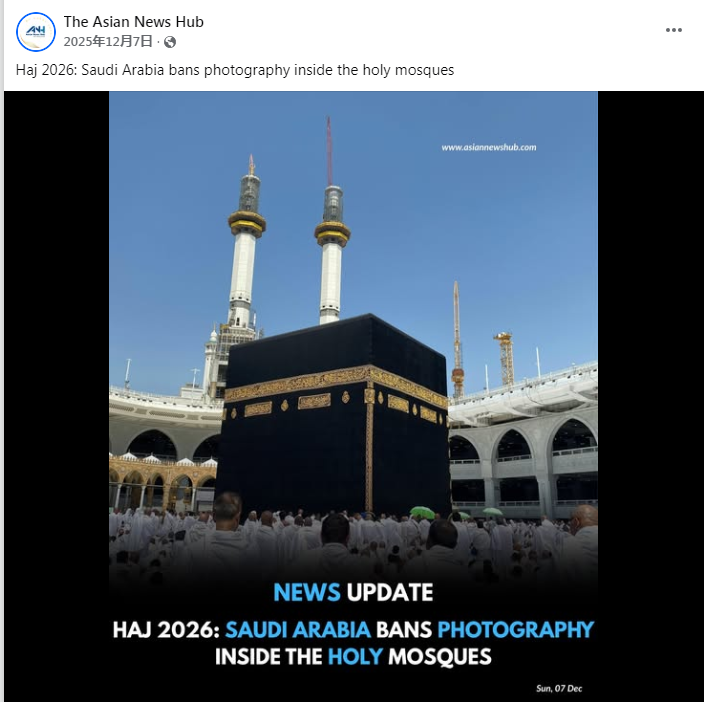
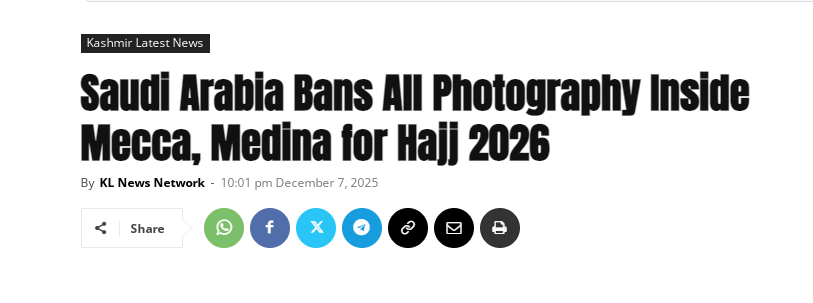
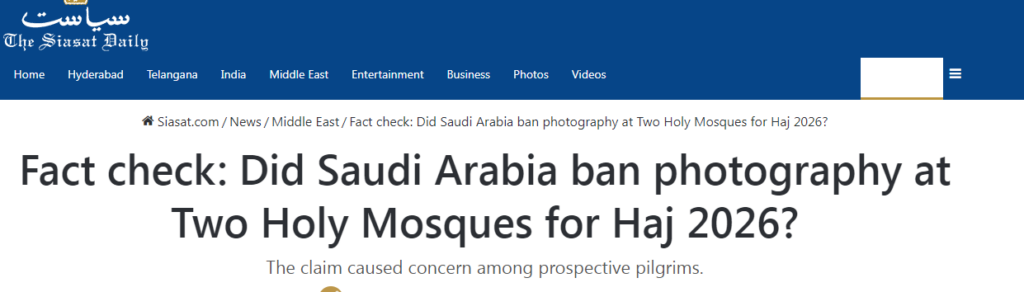
Upon verification, the narrative first appeared in early December. The initial spread came primarily from news pages and media accounts, featuring plain text with simple images (without the later AI-generated sign image). The core claim across several versions was consistent: “Saudi Arabia bans photography inside the holy mosques.” Despite fact-checking accounts pushing back as early as December 8, the narrative continued to circulate.
In mid-April 2026, which coincided with both the peak period for Hajj registration and preparation and the issuance of a Saudi official statement requiring official permits for Hajj 1447 AH, the AI-generated image version spread on a large scale. It became the main driver of viral spread, circulating primarily in Urdu and English under the title “Hajj 2026 Update.”
6. Account Analysis
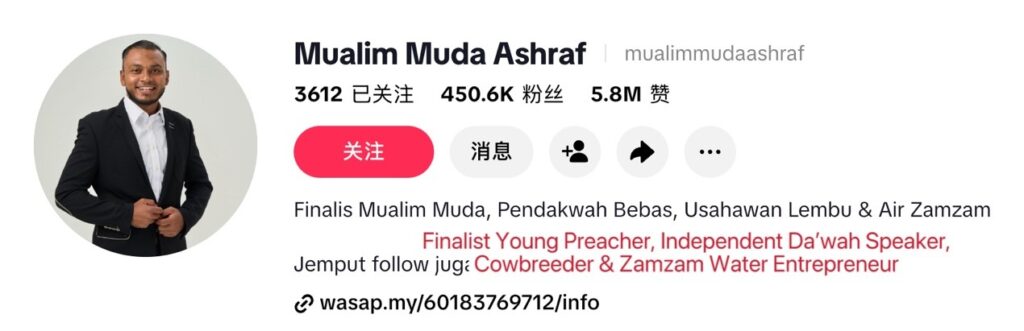
The TikTok account @mualimmudaashraf (display name: Mualim Muda Ashraf, meaning “Young Teacher Ashraf”) is a Malay/Indonesian-language religious social media creator primarily targeting Southeast Asian Muslim audiences. The account focuses on publishing practical information related to Hajj, Umrah, and the holy sites in Mecca, as well as Islamic religious teachings. It has no official blue verification mark and is operated by an individual, non-institutional content creator.
Background
As the 2026 Hajj season gets underway, pilgrims have been arriving in Saudi Arabia since mid-April, with the main rituals expected to take place in late May. As one of the Five Pillars of Islam, Hajj attracts millions of Muslims from around the world to the holy sites to perform their religious duties. Saudi authorities have established administrative and security protocols for the holy sites, including regulations on pilgrim behavior during the rituals.
Verdict
AI-generated
Conclusion
The claim that Saudi authorities have banned Muslims from taking photos and videos during Hajj — and that violators will face arrest, a 10,000 Saudi riyal fine, deportation, and visa cancellation — is not supported by facts.
Fact-checking shows that the image used to support the claim was almost certainly AI-generated and contains multiple inconsistencies, including non-Arabic warning text, irregular formatting, and the watermark of a major AI image generation service. Meanwhile, official Saudi-linked sources, Hajj authorities, and the Malaysian Hajj delegation have all publicly denied the existence of such a photography ban.
In addition, the penalties referenced in the viral posts were taken out of context. The cited punishments are linked to unauthorized participation in Hajj without valid permits, not to photography or videography at holy sites.
As misinformation spreads rapidly around major religious events, readers are strongly advised to verify viral claims through official government channels and trusted news sources before sharing or acting on them.
Have a questionable video or claim? Submit it to Fact Hunter’s investigation team at [therealfacthunter@outlook.com].
Primary Fact Checker: Han Yiming
Secondary Fact Checker: Lin Jun
Reference:
https://www.bernama.com/en/general/news.php?id=2549898
https://sinpo.id/detail/120060/hoaks-denda-foto-di-masjidil-haram-rp46-juta-ini-kata-ppih
https://www.spa.gov.sa/en/N2559888