Fact Check: 84.4% Cancer Clinical Benefit Claim for Ivermectin and Mebendazole Is Unsupported

Fact Check: 84.4% Cancer Clinical Benefit Claim for Ivermectin and Mebendazole Is Unsupported

Last updated on May 17th, 2026

Editor's note

A viral social media post claims that the combination of ivermectin and mebendazole yields an 84.4% clinical benefit rate for cancer patients. This type of misinformation poses a serious threat to public health order, as it may lead cancer patients to delay or forego evidence-based, standard treatments — thereby placing their lives at risk. This fact-check report systematically evaluates the original study’s credibility, conflicts of interest, methodological flaws, and the relevant clinical consensus.

Claim

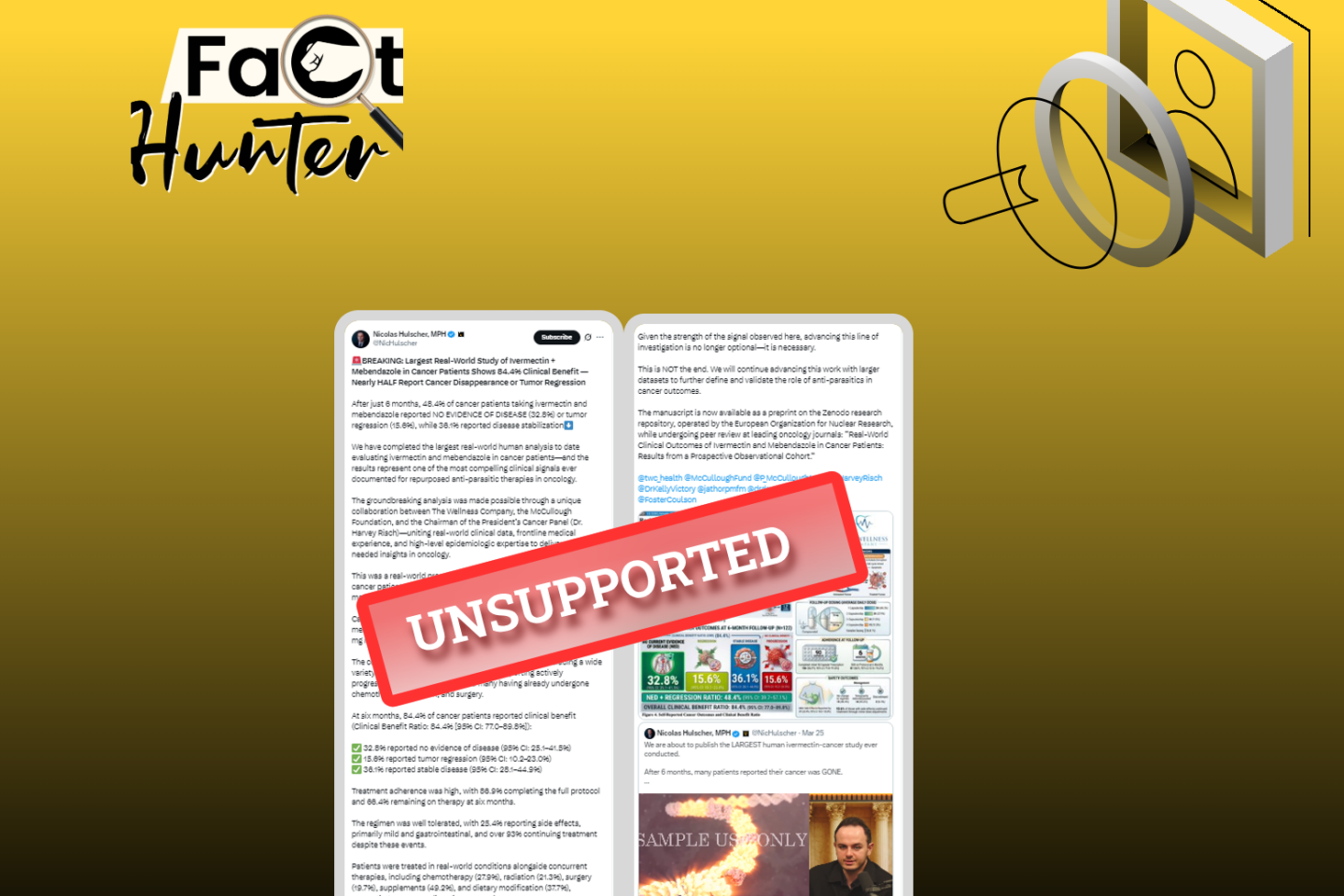
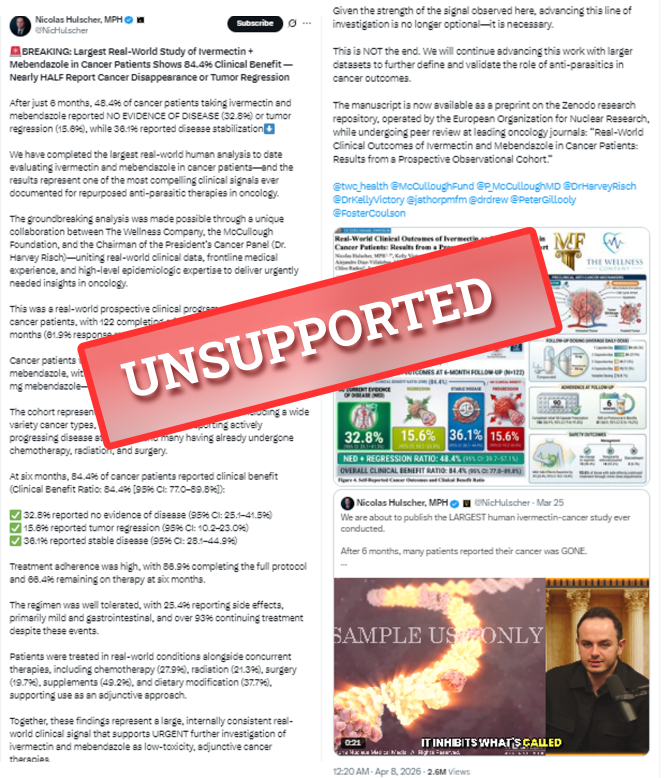
On 8 April 2026, X user @NicHulscher posted the following statement: “Largest Real-World Study of Ivermectin + Mebendazole in Cancer Patients Shows 84.4% Clinical Benefit — Nearly HALF Report Cancer Disappearance or Tumor Regression”. The post also enclosed relevant research results, altogether garnering 7.5k reposts, 15k likes and more than 2.6m views.

Streamlined Digital Workspace for Focus

Fact Check

1. Source tracing

The claim is primarily based on a preprint article published on Zenodo, an open repository for all scholarship rather than a peer-reviewed academic journal. The platform explicitly notes that such materials have not been peer-reviewed, and the main claims may not stand the test of scientific scrutiny. Therefore, the findings should be considered preliminary and require further validation through peer-reviewed research.

Source: Zenodo

2. Conflict of interest

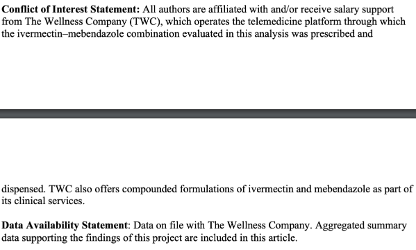
The research mentions that all authors are affiliated with and/or receive salary support from The Wellness Company (TWC), a commercial entity providing health-related products. Importantly, the ivermectin-mebendazole formulation evaluated in the study is compounded by the same company.

Source: Real-World Clinical Outcomes of Ivermectin and Mebendazole in Cancer Patients: Results from a Prospective Observational Cohort

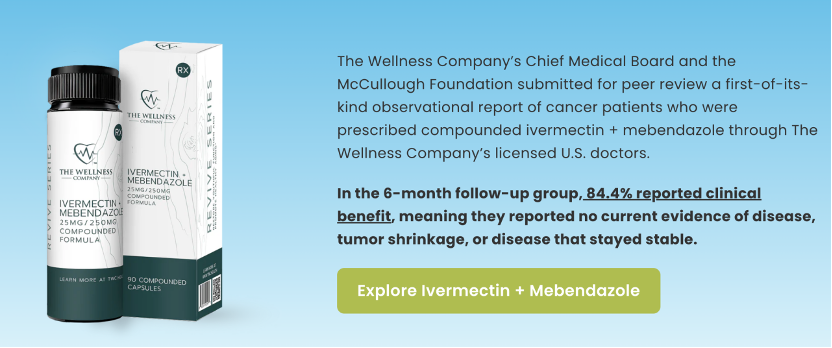
The study findings are also used in the company’s promotional materials, creating a potential conflict of interest.

Source: The Wellness Company

3. Study design represents a lower level of evidence

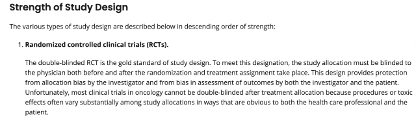
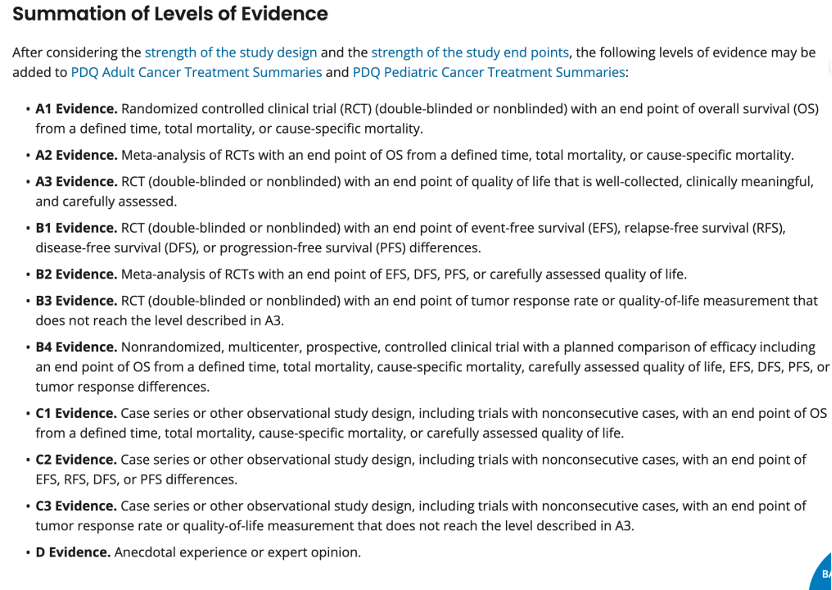
According to the Levels of Evidence for Adult and Pediatric Cancer Treatment Studies from the U.S. National Cancer Institute, double-blind randomized controlled clinical trials (RCTs) are considered the gold standard in evaluating cancer treatments, whereas case series and observational studies represent lower levels of evidence.

Source: U.S. National Cancer Institute

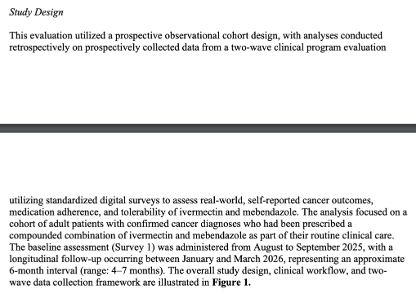
Although the post describes the study as representing “one of the most compelling clinical signals ever documented for repurposed anti-parasitic therapies in oncology,” the original paper specifies that it employed a prospective observational cohort design, and the outcomes were not clinically adjudicated or radiographically confirmed.

The study did not use randomized or controlled methods; instead, it analyzed prospectively collected data from a two-wave program evaluation using standardized digital surveys, which assessed self-reported cancer outcomes, medication adherence, and treatment tolerability.

As such, the study falls into the category of observational research, resulting in a low level of evidence.

Source: Real-World Clinical Outcomes of Ivermectin and Mebendazole in Cancer Patients: Results from a Prospective Observational Cohort

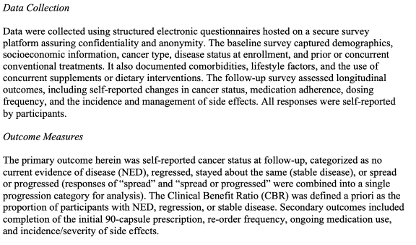
Furthermore, key outcomes mentioned in the post, such as disease disappearance, tumor regression and lesion reduction, were based on patient self-reports rather than objective clinical assessments. This approach may create selection bias and confounding.

Source: Real-World Clinical Outcomes of Ivermectin and Mebendazole in Cancer Patients: Results from a Prospective Observational Cohort

The study’s use of applied observational evidence only is insufficient to establish effectiveness for evaluating clinical efficacy. Its findings are insufficient to support claims about the effectiveness of this drug combination.

4. Small sample size and high rate of dropout

The post describes the analysis as “the largest real-world human analysis.” However, the study included only 197 cancer patients. By comparison, a review of 140 phase III cancer trials found a median sample size of 596, with a range from 50 to 40,000. This suggests the study is relatively small and directly contradicts the claim that it is the “largest.”

Source: Sample Size Calculation in Oncology Trials: Quality of Reporting and Implications for Clinical Cancer Research

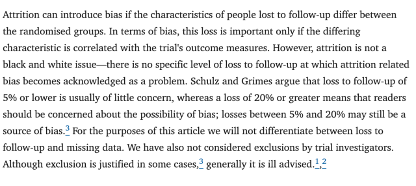
In addition, only 122 participants completed the 6-month follow-up, meaning about 38% were lost to follow-up. In clinical research, loss to follow-up of 5% or lower is generally considered acceptable, while rates above 20% are often associated with a higher risk of bias. The high dropout in this study may introduce uncertainty and weaken the reliability of the findings.

Source: Reporting attrition in randomised controlled trials

Together, the small sample combined with high dropout render the findings wholly insufficient to support broad claims about cancer treatment effectiveness.

5. Lack of control group and confounding factors

The post notes that “patients were treated in real-world conditions alongside concurrent therapies, including chemotherapy, radiation, surgery, supplements, and dietary modification, supporting use as an adjunctive approach.” However, the study did not isolate these variables, making it impossible to attribute any observed improvements specifically to ivermectin and mebendazole.

The original paper also states that no control group was included, and confounding variables from concurrent conventional therapies, supplements, and lifestyle changes cannot be excluded. Given these threats to validity, a therapeutic benefit cannot be inferred. The findings should therefore be regarded as not more than hypothesis-generating.

Source: Real-World Clinical Outcomes of Ivermectin and Mebendazole in Cancer Patients: Results from a Prospective Observational Cohort

6. Evidence from existing research

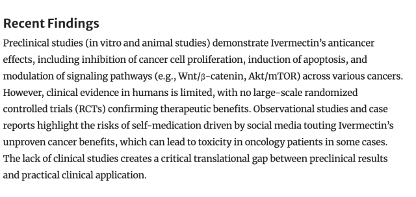
A review evaluating the scientific evidence for ivermectin’s potential anticancer properties reports that preclinical studies (in vitro and animal studies) demonstrate ivermectin’s anticancer effects. However, clinical evidence in humans is limited, with no large-scale RCTs confirming therapeutic benefits. Observational studies and case reports highlight the risks of self-medication driven by social media touting ivermectin’s unproven cancer benefits, which can lead to toxicity in oncology patients in some cases.

Source: Ivermectin in Cancer Treatment: Should Healthcare Providers Caution or Explore Its Therapeutic Potential?

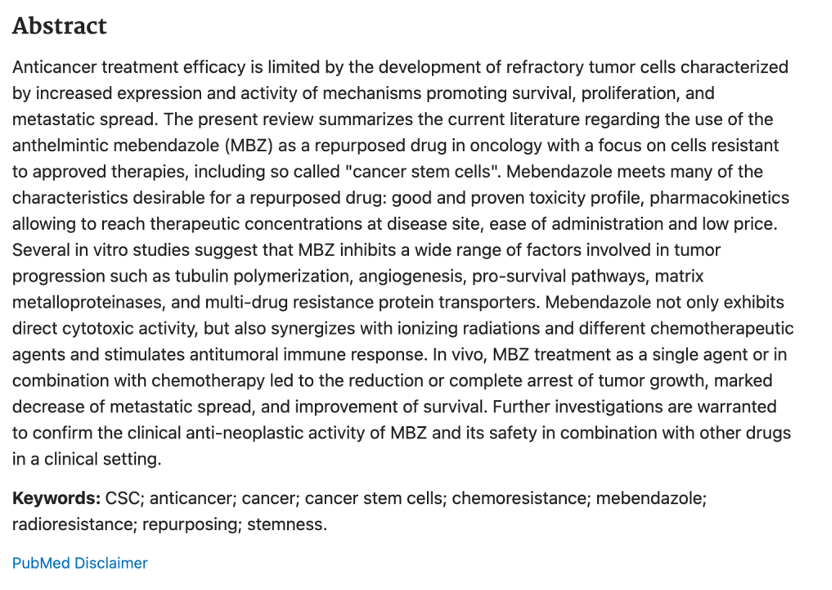
Another review reports that mebendazole (MBZ) as a single agent or in combination with chemotherapy leads to the reduction or complete arrest of tumor growth. However, further investigations are warranted to confirm the clinical anti-neoplastic activity of MBZ and its safety in combination with other drugs in a clinical setting.

Source: Mebendazole as a Candidate for Drug Repurposing in Oncology: An Extensive Review of Current Literature

At present, there is no robust clinical evidence demonstrating that the combination of ivermectin and mebendazole is effective for cancer treatment. Whether used alone or in combination, ivermectin and mebendazole lack sufficient clinical evidence in humans, and their effectiveness has not been established.

7. Account analysis

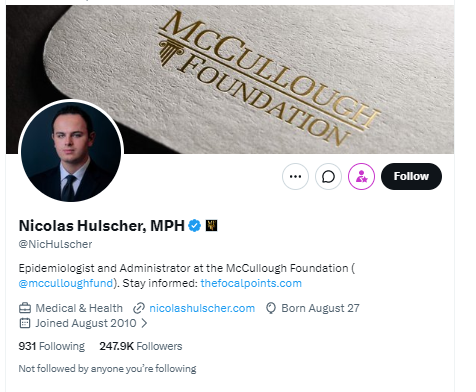
The X account @NicHulscher indicates in its bio that it is operated by an “Epidemiologist and Administrator at the McCullough Foundation,” with a link to the foundation’s information platform. The account holds a blue verification badge and had approximately 248,000 followers as of mid-May 2026. It has a direct affiliation with the McCullough Foundation, founded by Dr. Peter McCullough.

Background

Both ivermectin and mebendazole are classic prescription antiparasitic medicines approved only for parasitic infections, not for anti-cancer treatment. In recent years, certain social media accounts have repeatedly promoted the unproven anti-cancer effects of these antiparasitic drugs, misleading the public. Cancer treatment is highly specialized and carries significant clinical risks, requiring standardized, evidence-based therapeutic regimens. Unauthorized self-medication with these antiparasitic drugs may cause severe adverse effects and compromise regular cancer care.

Verdict

Unsupported

Conclusion

The claim that the “Largest Real-World Study of Ivermectin + Mebendazole in Cancer Patients Shows 84.4% Clinical Benefit — Nearly HALF Report Cancer Disappearance or Tumor Regression” originates from a study with limited clinical evidence, methodological limitations, no objective validation of outcomes, and is used for promotional purposes associated with commercial interests. The X user cited this finding but did not accurately represent the study’s methodological limitations. At present, there is no clinical evidence demonstrating the effectiveness of these two medicines in treating cancer in humans. Therefore, this claim cannot be used as a basis for cancer treatment. Readers are advised to consult qualified medical professionals and rely on evidence-based treatment options for cancer care.

Have a questionable video or claim? Submit it to Fact Hunter’s investigation team at [therealfacthunter@outlook.com].

Primary Fact Checker: Lin Jun 

Secondary Fact Checker: Tan Xinying

Show Comments (0) Hide Comments (0)
Leave a comment

Your email address will not be published. Required fields are marked *