Last updated on August 24th, 2026
Editor's Note
On August 10, 2026, a magnitude 7.4 earthquake struck western Colombia. Shortly thereafter, a dramatic video showing a high‑rise building collapsing rapidly spread across social media platforms, amassing tens of millions of views in multiple languages including English, Spanish, Portuguese, Arabic, and Chinese. Our investigation reveals that the video is a spliced composition: its first 10 seconds originate from a YouTube clip explicitly labeled “AI‑generated” and do not depict real earthquake footage; the remaining 33 seconds match authentic earthquake footage recorded during the same event. By presenting these two segments seamlessly as one “disaster scene” without any disclosure, the video led numerous viewers to mistake the AI‑generated collapse for an actual recording of the Colombia earthquake. Such misinformation can have two major consequences: first, the high‑impact AI imagery may exaggerate public perception of the disaster’s severity; second, the mixture of genuine and fabricated footage increases the difficulty for audiences to discern truth, undermining trust in authoritative disaster information. This report examines the fabrication techniques through source tracing, visual analysis, and dissemination patterns, aiming to provide a reference for identifying similar composite content in the future.
Claim
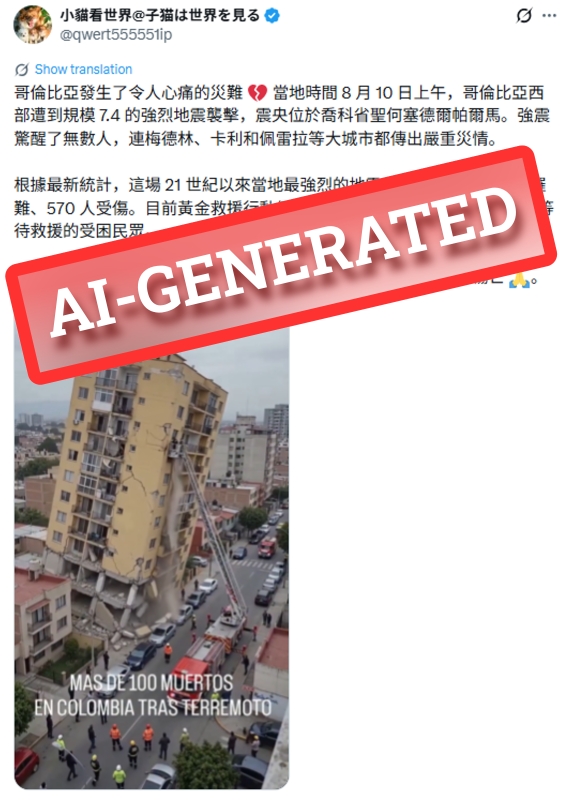
On August 11, 2026, X account @qwert555551ip posted a 43-second vertical video. The caption, written in Traditional Chinese, stated that a magnitude 7.4 earthquake struck western Colombia on the morning of August 10, with its epicenter located in San José del Palmar, a small town in Colombia’s Chocó department; that major cities including Medellín, Cali, and Pereira experienced severe damage; and that this was the strongest earthquake in the region since the start of the 21st century, having caused at least 132 deaths and 570 injuries to that point, with search and rescue efforts still ongoing. The post had garnered over 7.4 million views at the time of review.
Fact Check
1. The Earthquake Itself Is Real: Magnitude and Location Consistent with Authoritative Records
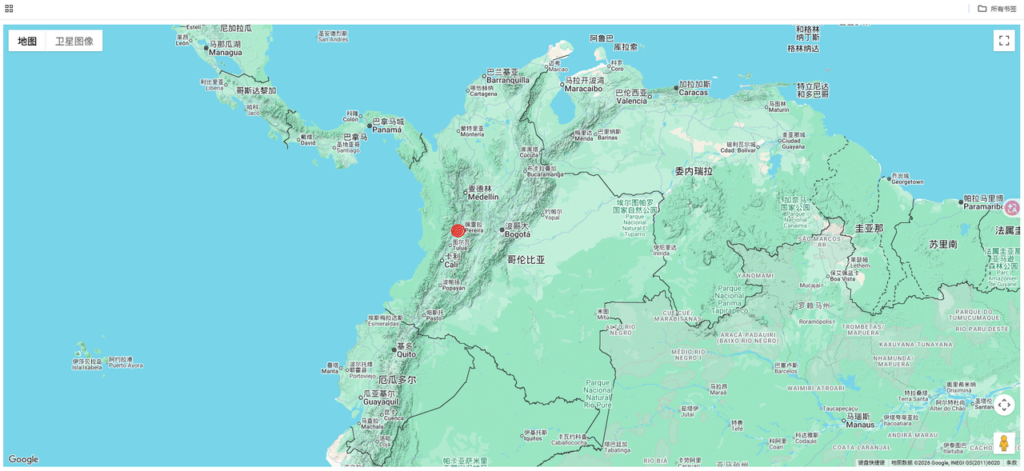
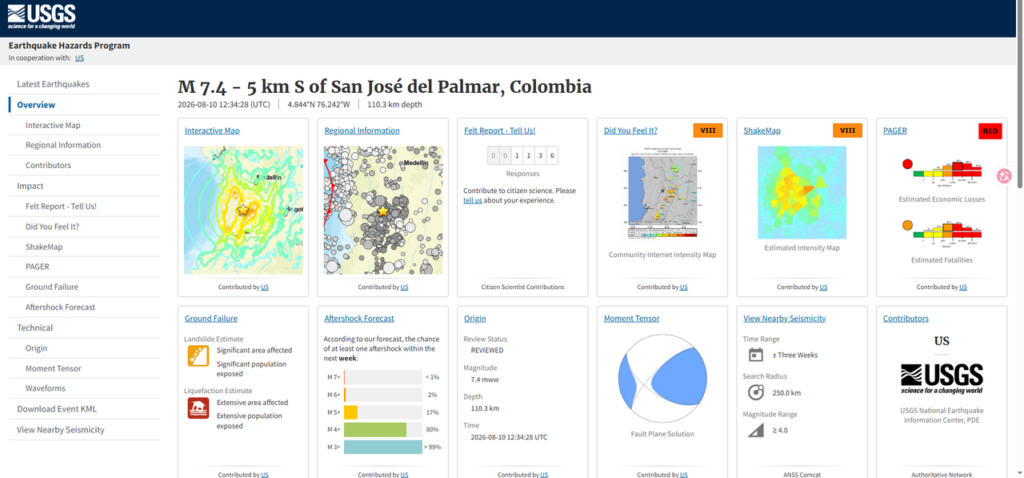
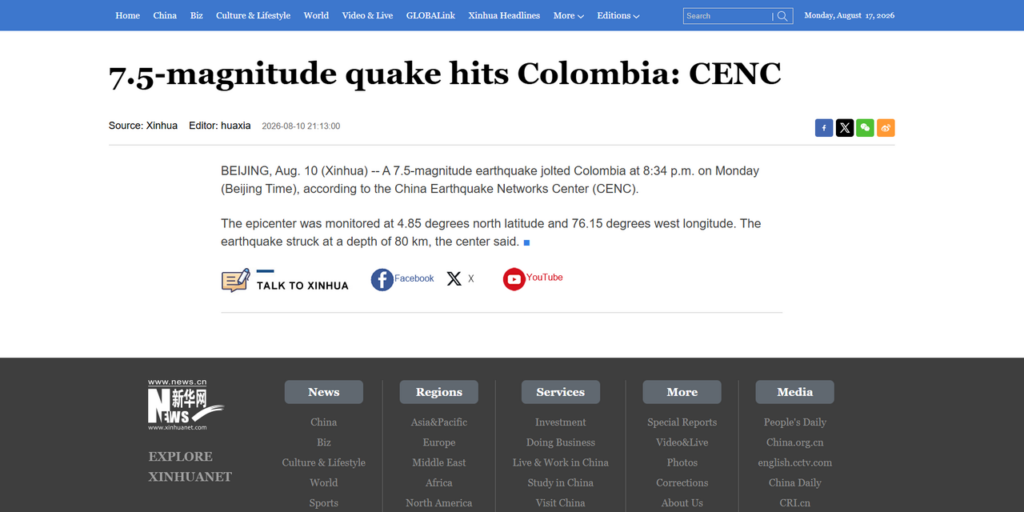
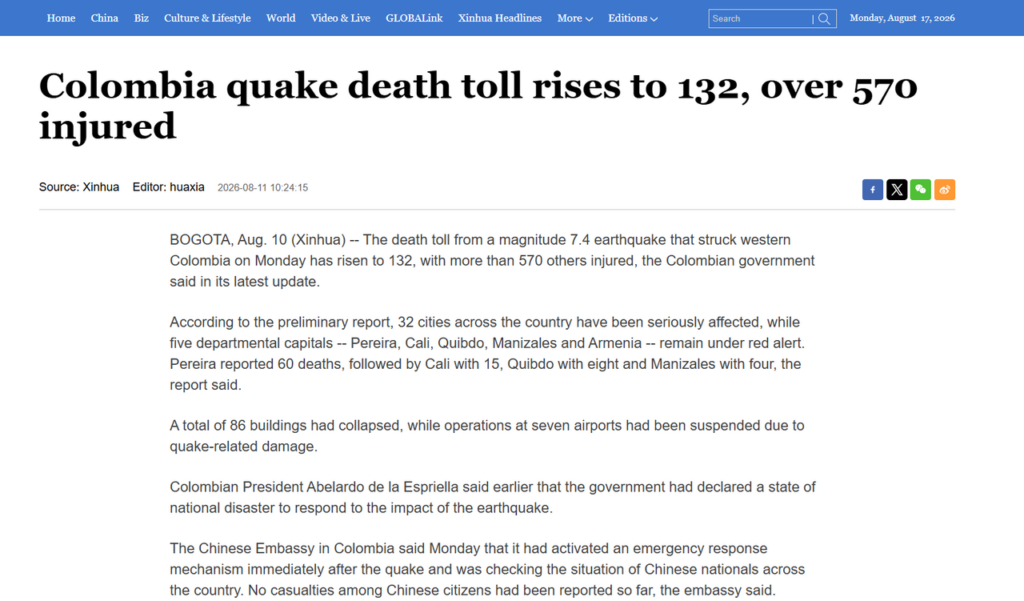
Our verification confirms that both the Colombian Geological Survey (SGC) and the U.S. Geological Survey (USGS) recorded this magnitude‑7.4 earthquake, with the epicenter and time of occurrence largely consistent with the claim. In addition, China’s Earthquake Network Center and Xinhua News Agency, among other media outlets, reported on the earthquake, confirming that the epicenter was near San José del Palmar, Chocó. The claim of “132 deaths and 570 injuries” matches the preliminary statistics that had emerged prior to the post’s publication. The casualty figures themselves are not fabricated, but their combination with AI‑generated imagery constitutes a misleading narrative.

2. The 0–10 Second Portion: AI Generated Content with the Label Cropped
(1) Source Analysis: The Platform Labels the Content as AI-Generated
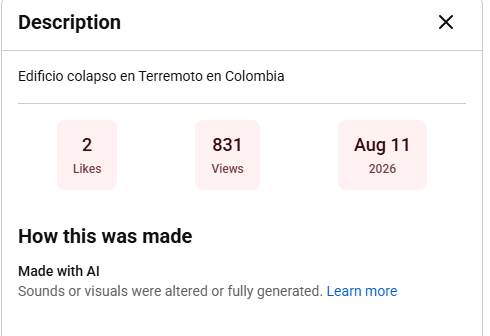
The first 10 seconds of the widely circulated video match the footage from a YouTube Shorts clip that is explicitly labeled “AI-generated.” The short, titled Edificio colapso en Terremoto en Colombia, was posted by account @srgenial987 on August 11, 2026, and is currently the earliest verifiable public source of this content.
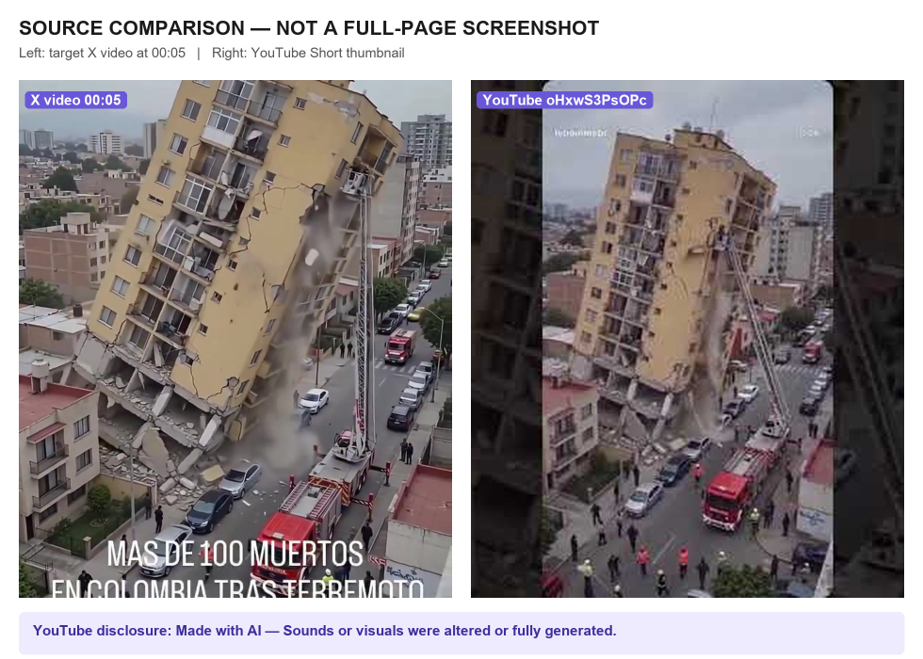
The original video page clearly displays the label: “Sounds or visuals were altered or fully generated.” The circulating spliced version, however, crops out this platform warning label, leaving viewers unaware of its AI origin and thus mistaking the AI-generated collapse footage for a real earthquake scene.
(2) Visual Analysis: Physical and Behavioral Anomalies Indicative of AI Generation
The opening segment exhibits multiple features that contradict real-world physics and defy common logic:
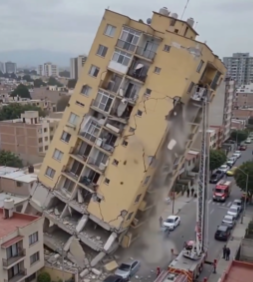
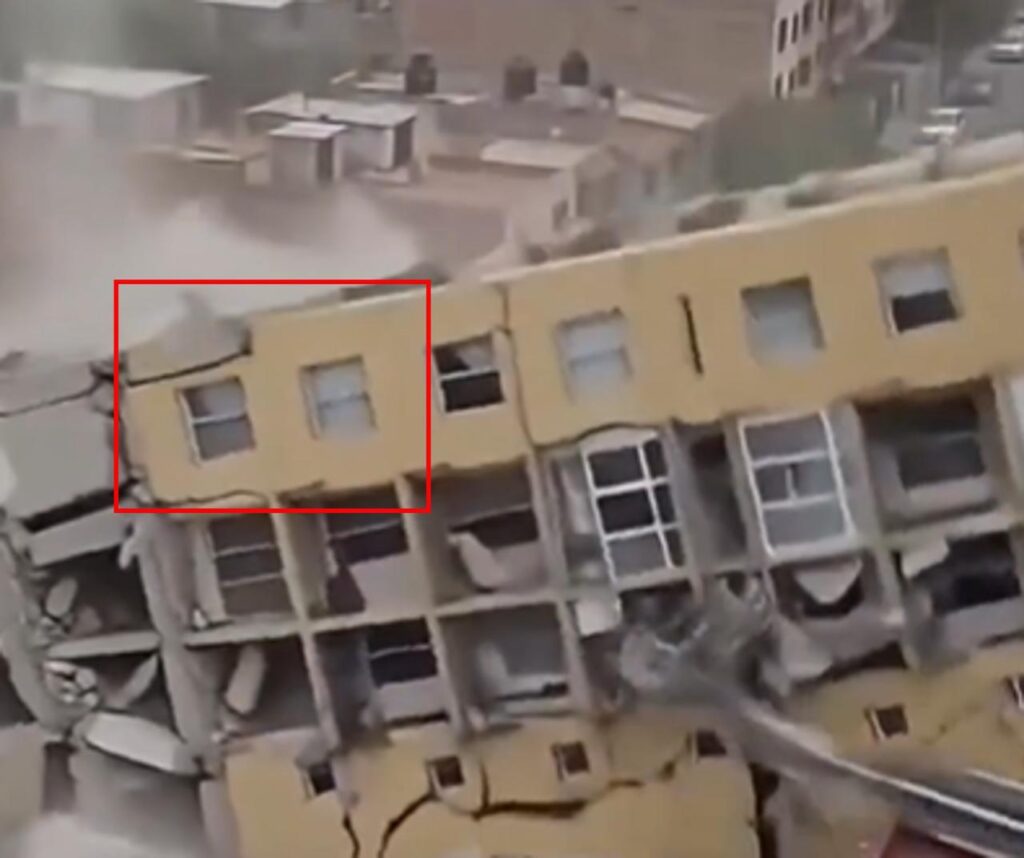
- Rigid-body tilt: The building tilts significantly as a near-rigid mass with the angle approaching or even exceeding 45 degrees. The overall outline of the upper structure remains intact, showing only minor cracking and localized dust ejection observable.
- Physical inconsistency: After the building collapses, the windowpanes remain completely undamaged, defying the basic principles of gravity and impact force.
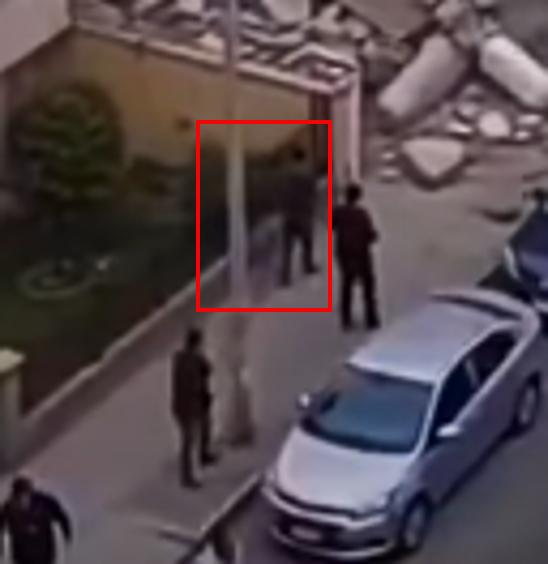
- Frame skip: At approximately the 2-second mark, the footage cuts abruptly and a person suddenly appears in the scene, indicating a temporal discontinuity.
- Abnormal human behavior: The individuals appearing in the footage do not take any reasonable evasive actions, nor do they display instinctive avoidance or escape responses.


Source: @qwert555551ip(X)
(3) AI Detection Tool Analysis
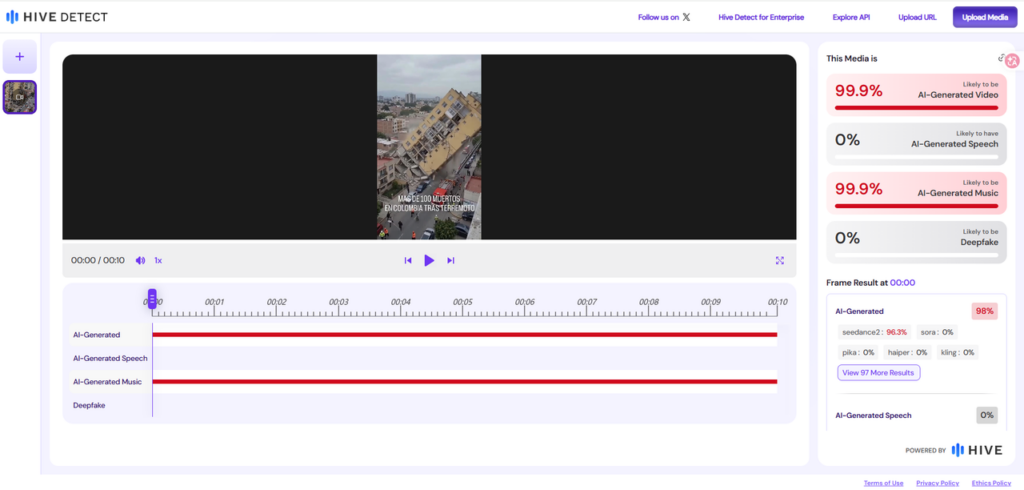
The video was submitted to Hive Detect and the Zhuque AI detection tool, which returned AI-generated probability scores of 99.9 percent and 93.54 percent, respectively.

3. The 11–43 Second Portion: Verified as Real Earthquake Footage
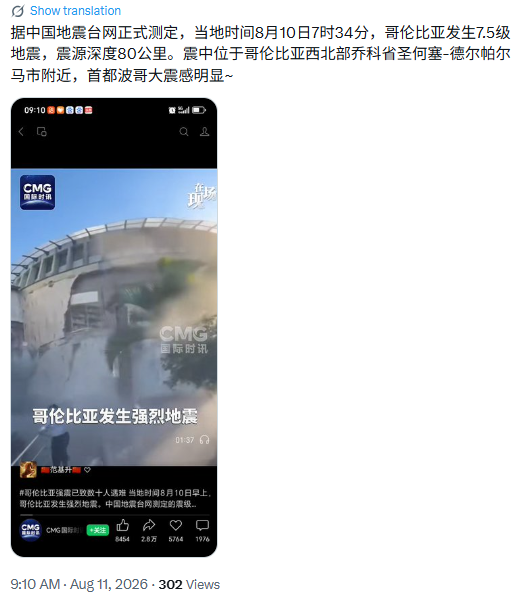
Reverse image searches revealed that the footage from the 11‑second to 34‑second mark matches scenes used by China Central Television (CCTV) programs CCTV News and International Times in their coverage of the August 2026 Colombia earthquake.

The footage from the 35‑second to 43‑second mark was matched via reverse image search to a video posted by Facebook account “Voces Puntanas San Luis.” Although this Facebook version shows the same area, the camera angles differ: the Facebook clip pans from right to left, while the circulated version shows the same scene from left to right. Despite these differences in perspective and camera movement, key elements such as trees, a bus, and trash bins are highly consistent across both videos, confirming they were shot at the same location during the same event.
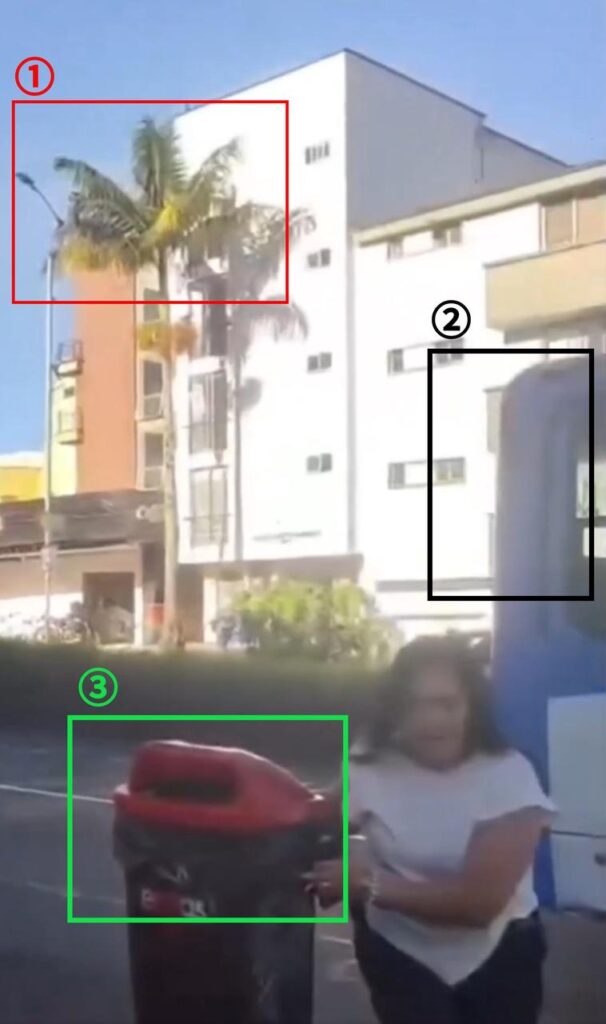
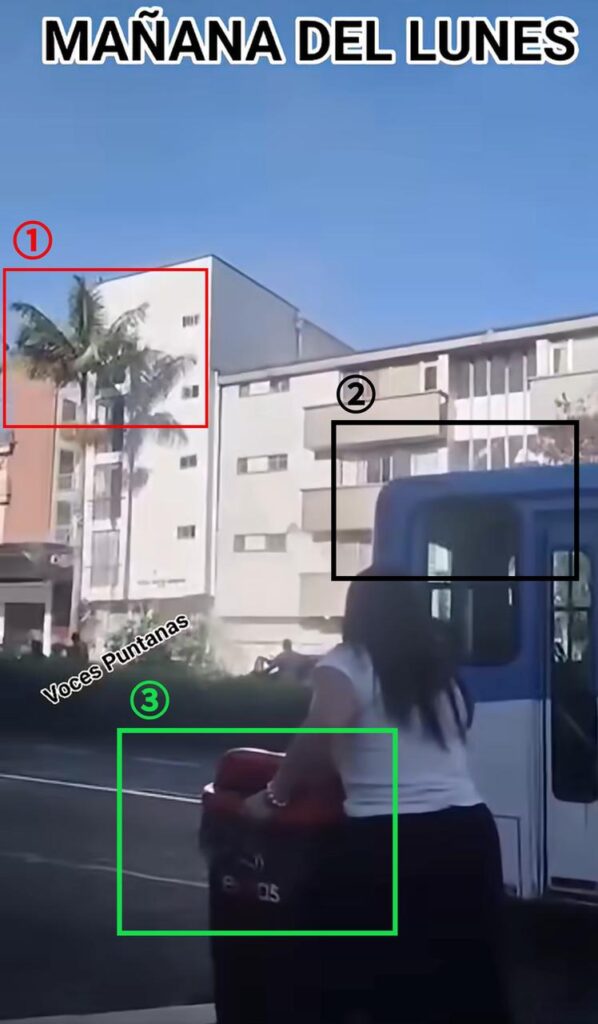
Left: Viral post; Right: Same‑source earthquake video from Facebook
Manizales journalist Adriana Villegas Botero, in a contemporaneous report for El País, described a widely shared video filmed at the entrance of the Catholic University of Manizales. The sequence she reported is very specific: a bus shaking; objects falling from a roof; a construction structure collapsing. The 35‑ to 43‑second segment of the viral video presents these same elements in the same order.
Furthermore, the blue bus in the footage bears the lettering “SOCOBUSES S.A.” Our investigation confirms that its full name is “Sociedad Coordinadora de Buses Urbanos de Manizales S.A.” – the public transport operator in Manizales. This logo, together with the journalist’s account, corroborates that the footage was filmed in that city.

4. Account Analysis
The X user @qwert555551ip registered on June 14, 2026, and currently has approximately 5,884 followers. Their profile, written in Chinese, English, and Japanese, describes themselves as a “truth revealer.” Reviewing their post history shows that the account primarily focuses on animal welfare issues; it is not a professional media outlet, nor is there any indication that they possess expertise or access to credible sources in the field of earthquakes or disaster reporting.

5. Dissemination Analysis
(1) Initial Generation and Early Spread
Approximately 13 hours after the earthquake, the earliest verifiable public source – YouTube channel @srgenial987 – posted the 10‑second building‑collapse clip on August 11, 2026. Though the page itself carried an “AI‑generated” label, the title explicitly anchored the content to the earthquake event. While this original post had limited reach, its combination of “AI‑generated imagery + real‑earthquake event title” provided a narrative framework for subsequent re‑posting and served as the initial template for this wave of disinformation.
About 19 hours later, X account @k_gauravs posted an unedited English‑language version of the video; roughly 21 hours after that, account @qwert555551ip released a 43‑second montage with a Chinese‑language caption. This post represents a “repackaged” type of misinformation: it spliced AI‑generated material with other footage and attached the actual timing and location details of the real earthquake. As of the time of verification, the post had garnered over 7.4 million views.
(2) Cross Platform and Multilingual Dissemination
Between August 11 and 13, the spliced video entered a phase of rapid proliferation, with multiple million‑view nodes emerging: an English‑language version from X account @GustBrian reached 2.4 million views and over 900 retweets; a Spanish‑language version on Threads from @elshowdearielcr garnered 2 million views; a Portuguese‑language Instagram post received 880,000 views. The video itself retained the Spanish text “MÁS DE 100 MUERTOS EN COLOMBIA TRAS TERREMOTO” (More than 100 dead in Colombia after earthquake), while captions were successively presented in English, Portuguese, Arabic, and Traditional Chinese – a tactic of “original‑language visuals + multilingual captions.” The Traditional Chinese caption was subsequently re‑posted to Facebook and Threads unchanged.
(3) Continued Spread After Debunks
Brazilian fact‑checking organization Aos Fatos published a verification report on August 11. However, about 1 hour and 14 minutes later, the English‑language misinformation (from X account @GustBrian) was still posted and amassed over 2.4 million views and more than 1,100 retweets. The following day, a Portuguese‑language Instagram post still received 880,000 views. As of August 17, the total observable playback/view events related to this core AI footage exceeded 12 million, indicating that debunking efforts had failed to effectively curb its spread.
Verdict
AI Generated.
Conclusion
Our investigation confirms that the viral video is a composite of genuine and AI-generated material. The opening segment (roughly the first 10 seconds) comes from a YouTube clip that was explicitly labeled “AI‑generated” on its source platform, but this warning label was cropped out in the circulated version. The later segment (from 11 to 43 seconds) is verified as genuine earthquake footage, which had been used by CCTV and other media outlets in their coverage of the Colombia earthquake; key visual elements such as the blue bus, trees, and buildings corroborate with contemporaneous journalism and on‑site images, placing the location near the entrance of the Catholic University of Manizales. The earthquake occurrence and casualty figures are consistent with records from the Colombian Geological Survey (SGC), the U.S. Geological Survey (USGS), and multiple authoritative media reports. In this disinformation package, AI‑generated content provides the high‑impact visuals, while real earthquake information supplies credibility; their splicing, combined with the removal of platform AI labels and the repackaging into multilingual captions, constitutes an integrated fabrication chain. In terms of dissemination, the spliced video spread across X, Threads, Instagram, Facebook, and other platforms in multiple languages. Even after Brazilian fact‑checking organization Aos Fatos published its report on August 11, various versions continued to circulate on these platforms.
We advise the public, when encountering disaster‑related information, to prioritize official seismic agencies and authoritative media outlets, remain cautious of videos from unverified sources or with visually implausible content , and refrain from sharing unconfirmed disaster footage.
Have a questionable video or claim? Submit it to Fact Hunter’s investigation team at [therealfacthunter@outlook.com].
Primary Fact Checker: Wu Yixuan
Secondary Fact Checker: Lei Ting
References
- https://bdrsnc.sgc.gov.co/paginas1/catalogo/Consulta_Experta_Seiscomp/mapa.php?lat=4.99093472&lon=-76.29174107&fc=2026-08-10_12:34:27&pf=103.4093192&mg=7.4&dm=San_Jose_del_Palmar_-_Choco,_Colombia
- https://earthquake.usgs.gov/earthquakes/eventpage/us6000tjl2/executive
- https://english.news.cn/20260810/0a513fbcd29c40abb0f48d18d048f0ba/c.html
- https://english.news.cn/20260811/40e238060d904c4f82467eefb5aae17a/c.html
- https://www.youtube.com/shorts/oHxwS3PsOPc
- https://www.facebook.com/voces.puntanas.san.luis/videos/colombia-el-epicentro-fue-en-el-oeste-del-pa%C3%ADs-un-terremoto-de-74-sacudi%C3%B3-colomb/1076383695082556/
- https://elpais.com/america-colombia/2026-08-11/los-carros-bailaron-y-la-tierra-rugio.html
- https://www.socobuses.com/
- https://x.com/k_gauravs/status/2087074704310014104
- https://x.com/GustBrian/status/2087296074935673340
- https://www.threads.com/@elshowdearielcr/post/Db4Jd69lrQ3
- https://www.instagram.com/reels/Db4Rcd8N5za/
- https://www.instagram.com/reel/Db8tJ6rRk9w/
- https://www.facebook.com/yuhui.lin1/videos/1024593283747844/
- https://www.threads.com/@fo.rest4384/video/Db6DWOVGtVG