Last updated on August 9th, 2026
Editor's Note
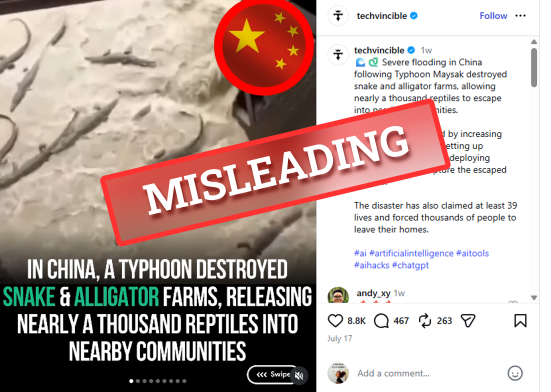
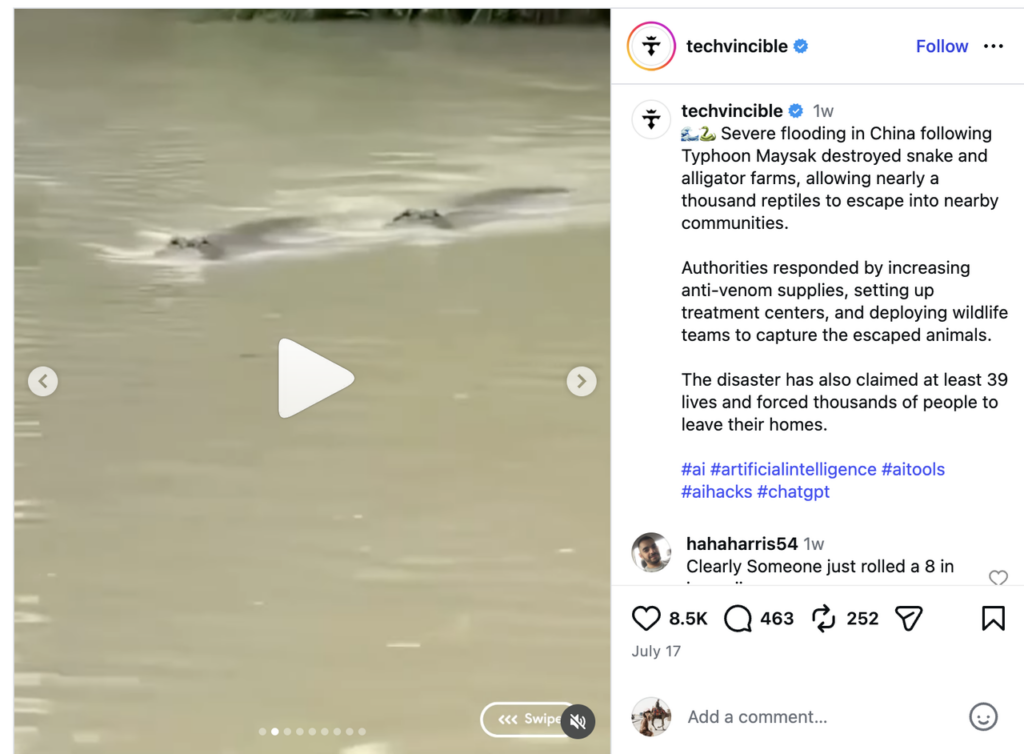
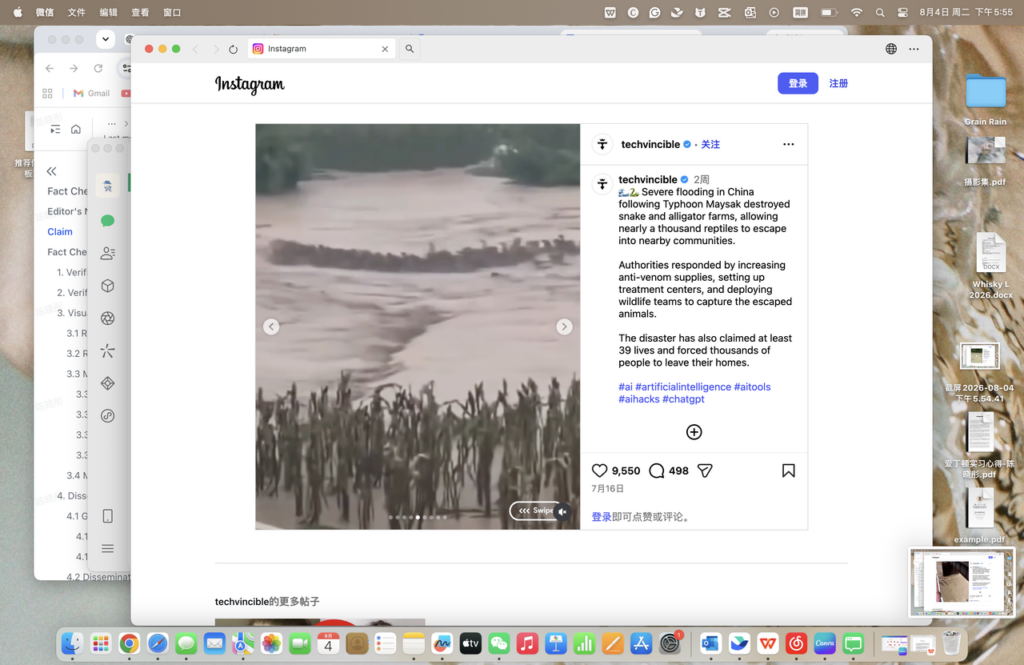
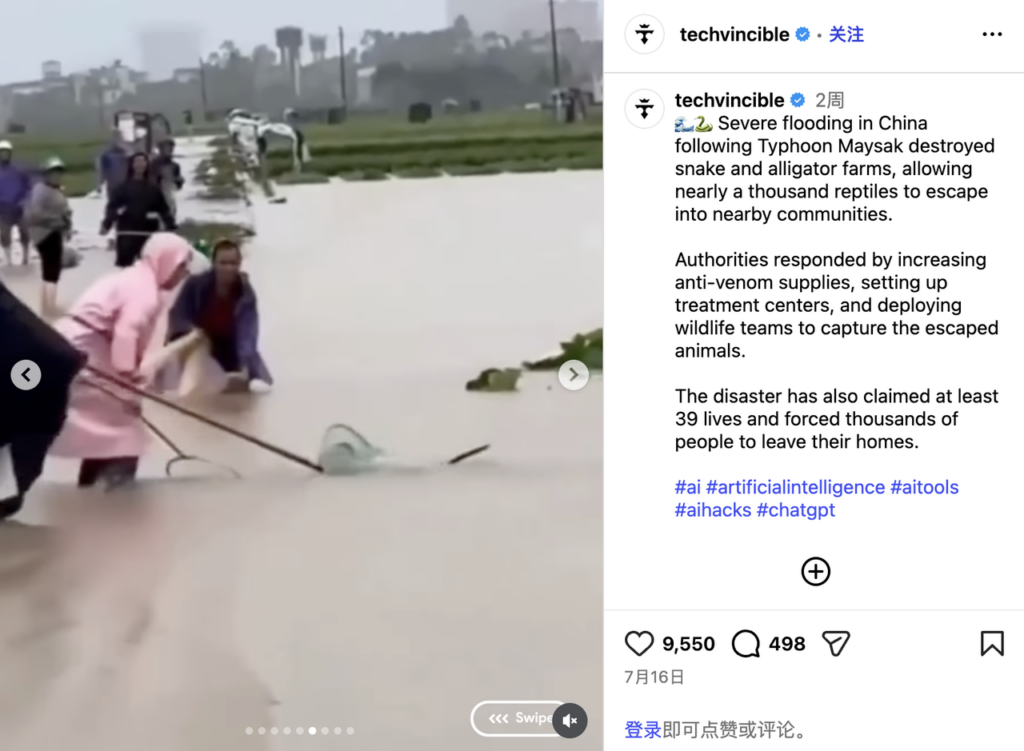
During the spate of severe flooding in south China’s Guangxi Zhuang Autonomous Region in July 2026, multiple posts claiming that “floods caused farmed reptiles to escape” circulated on social media. A video compilation posted on Instagram on July 17 contained nine sub-clips, claiming that floods had damaged snake and crocodile farms and resulted in the escape of large numbers of reptiles. After verification, it was found that while some snakes did escape from flood-damaged farms, there was no evidence supporting claims of any crocodile escapes. Several clips in the compilation involved AI-generated footage, recycled footage from unrelated locations or events, and misidentified animals or scenes. The content was redistributed, combining authentic disaster footage with misleading visuals, which could affect public understanding of the actual situation in the affected areas. This report examines each clip by analyzing its source, visual characteristics, and dissemination pathways.
Claim
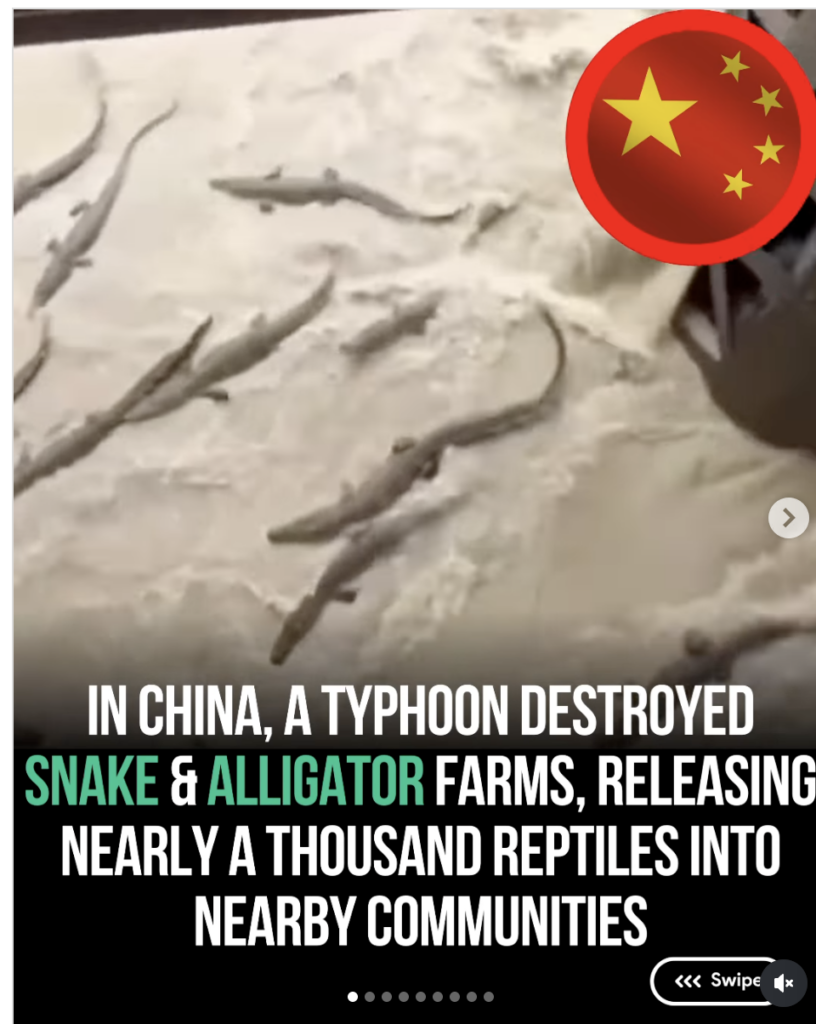
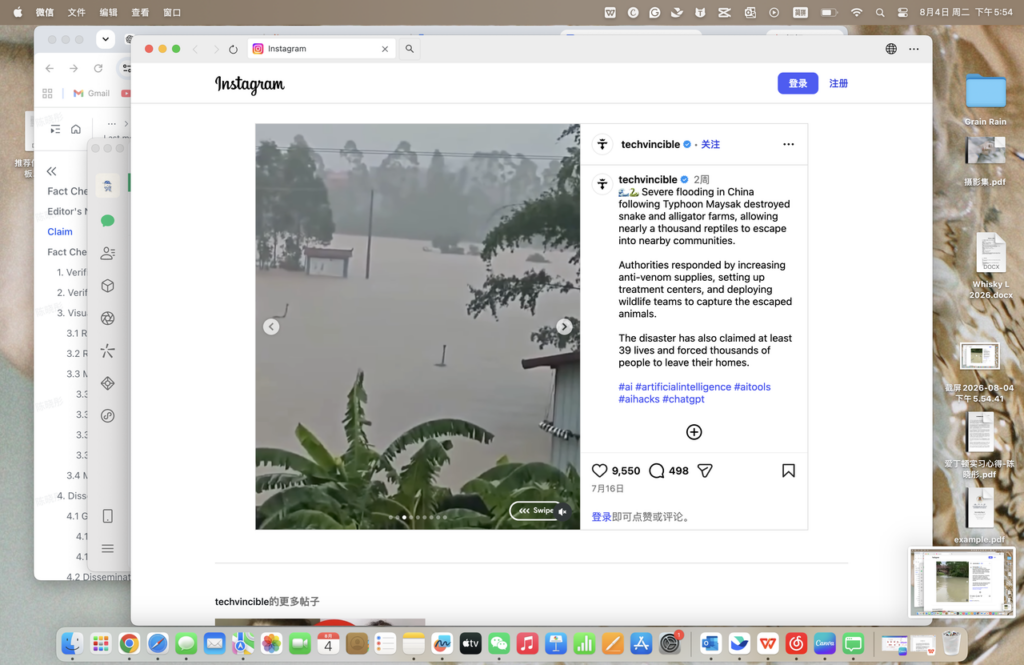
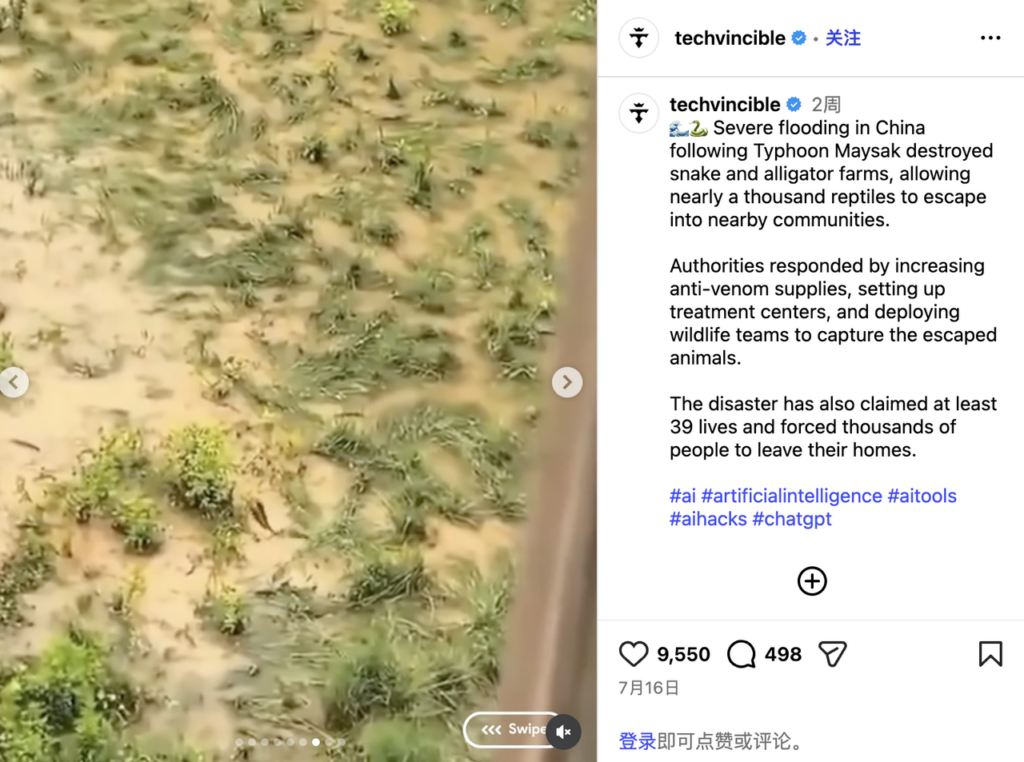
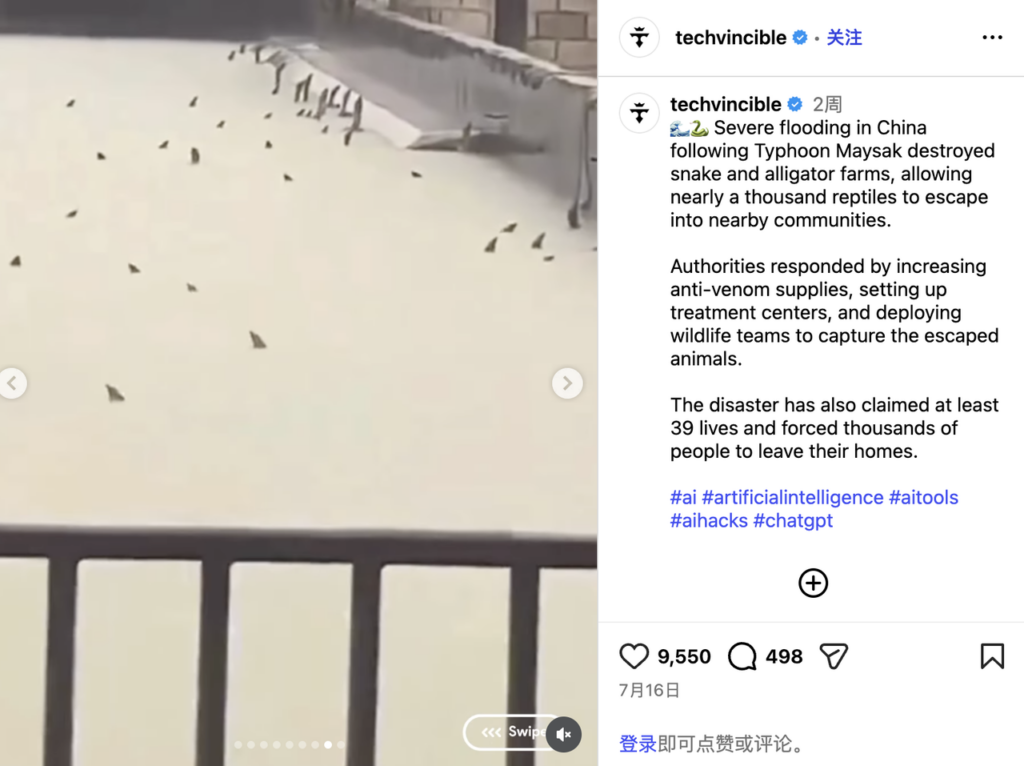
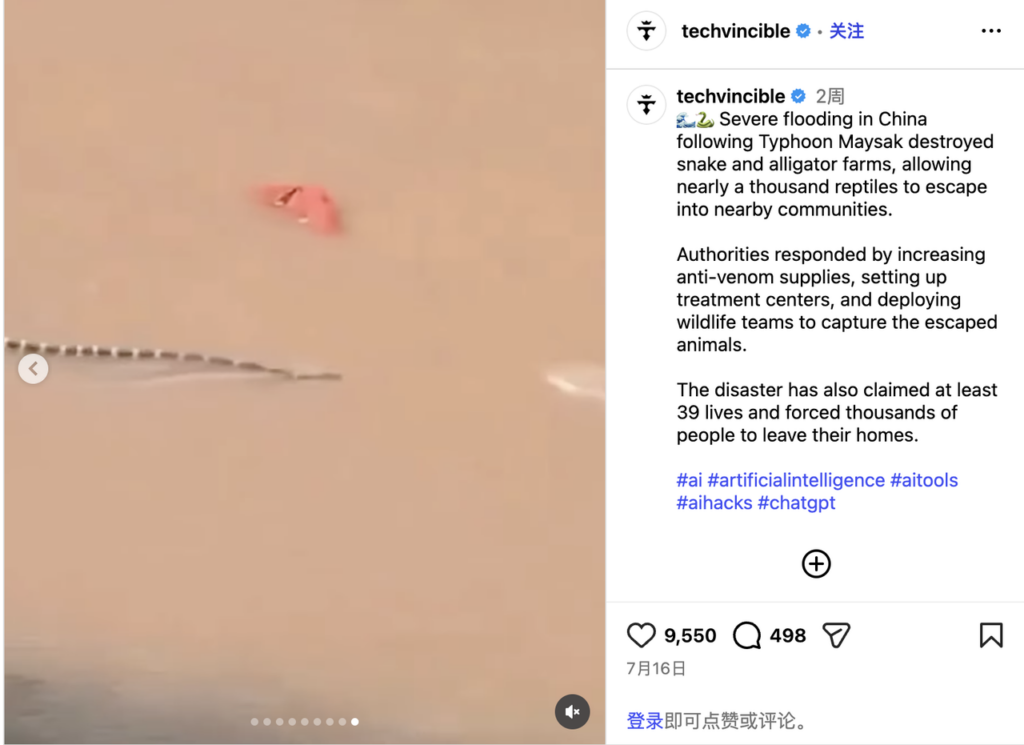
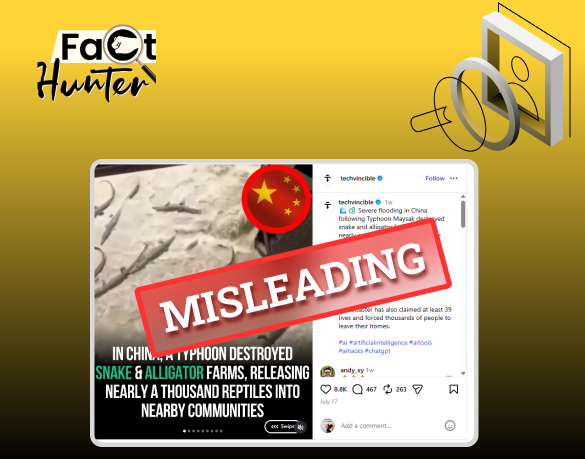
On July 17, 2026, Instagram user @techvincible posted a video compilation claiming that the Guangxi floods had damaged animal farms, including snakes and crocodiles. The post included nine sub-clips and presented two main claims: first, that floods destroyed snake farms and resulted in large numbers of farmed snakes escaping into floodwaters; second, that flood damage to crocodile farms caused crocodiles to escape into surrounding areas.
Fact Check
1. Verification of the Death Toll
According to a press conference on flood prevention and disaster relief held in the regional capital Nanning on July 9, 2026, the floods across Guangxi resulted in 39 fatalities and 9 people reported missing as of that date. This figure represents the cumulative number of fatalities across the entire region and should not be attributed to a single cause. Records released by emergency management authorities in Nanning and in the hard-hit city of Hengzhou confirmed that one local villager died after being bitten by a cobra which was swept into the area by floodwaters.
However, the Instagram post presented the overall flood-related death toll of 39 in the same context as the animal escape claims, a juxtaposition that may lead readers to attribute these fatalities to animal-related incidents without clear distinction.
2. Verification of Snake and Crocodile Escape Incidents
1) Snake Escape
Verification found that a snake farm in Yunbiao Town of Hengzhou City was damaged by flooding on July 6. Some captive cobras, rat snakes, and water snakes escaped. Local village committees estimated that approximately 800 to 900 snakes escaped, most of which were non-venomous water snakes, while venomous cobras accounted for a relatively small proportion.
To address the need for snakebite treatment, the Hengzhou government expanded anti-venom supplies at the city’s People’s Hospital and arranged medical experts from across the Guangxi Zhuang Autonomous Region and the capital Nanning City to provide on-site support. Temporary medical stations were established in affected areas, including Yunbiao Town, and emergency transport channels for snakebite victims were opened. On July 8, the Xinhua news agency cited a statement from local authorities that anti-venom supplies were sufficient for clinical treatment.
2) Crocodile Escape
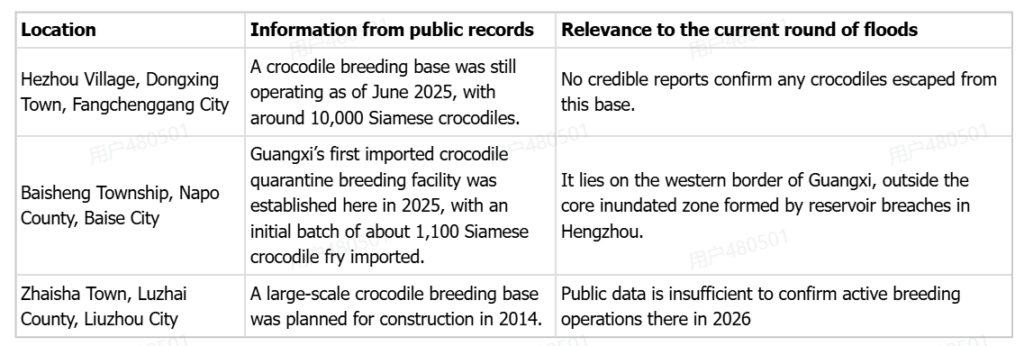
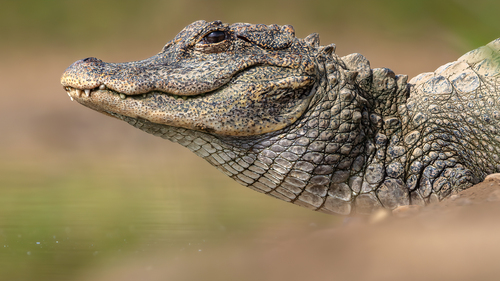
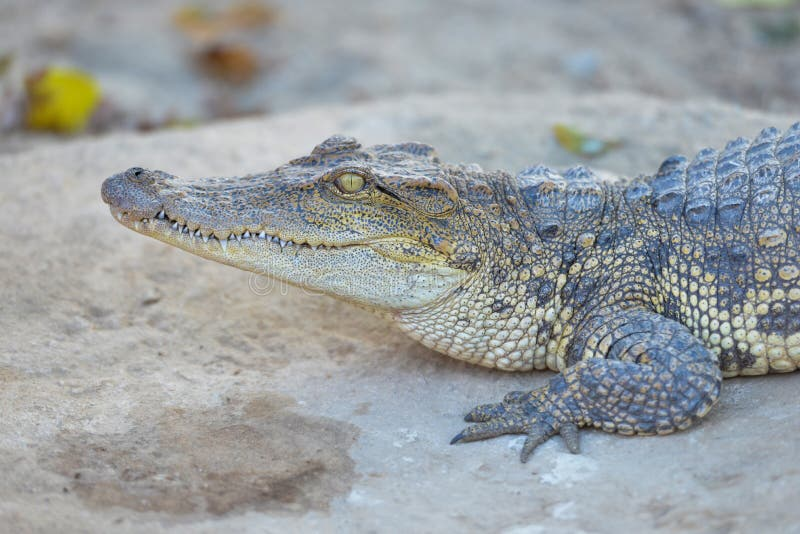
Siamese crocodiles are the primary farmed crocodile species in Guangxi and are classified as nationally protected aquatic wildlife in China. Licenses are required for crocodile breeding and commercial use. Public records show that Guangxi’s major crocodile farms are located in Fangchenggang and Baise, with another planned site in Liuzhou. No publicly available records indicate the presence of any crocodile farms in the severely flooded towns of Hengzhou, and no credible reports of damaged enclosures or crocodile escapes were identified.
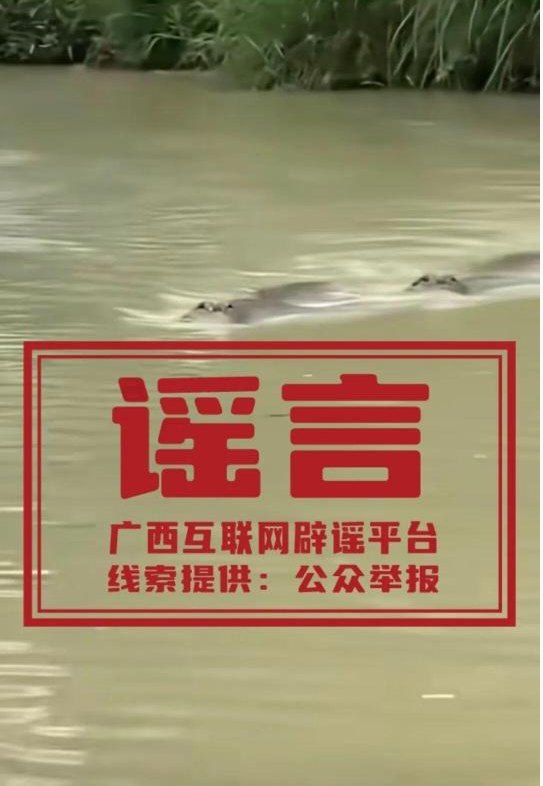
On July 8, the official account Guangxi Online Reporting, operated under the Cyberspace Administration Office of Guangxi, released a clarification notice stating that viral videos claiming crocodile escapes had used recycled footage from other locations and were unrelated to the current floods in Guangxi. No reports indicated that crocodile farms in Guangxi experienced damaged enclosures or crocodile escapes due to flooding.
3. Visual Content Analysis
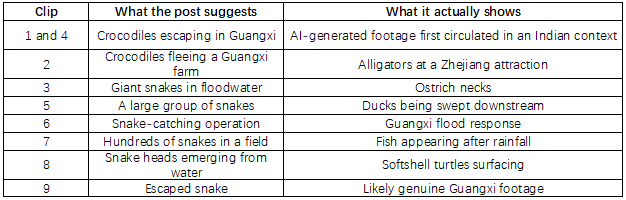
The visual verification section of this report covers nine sub-clips collected from different sources. Item-by-item verification based on their origins and visual characteristics is provided below:
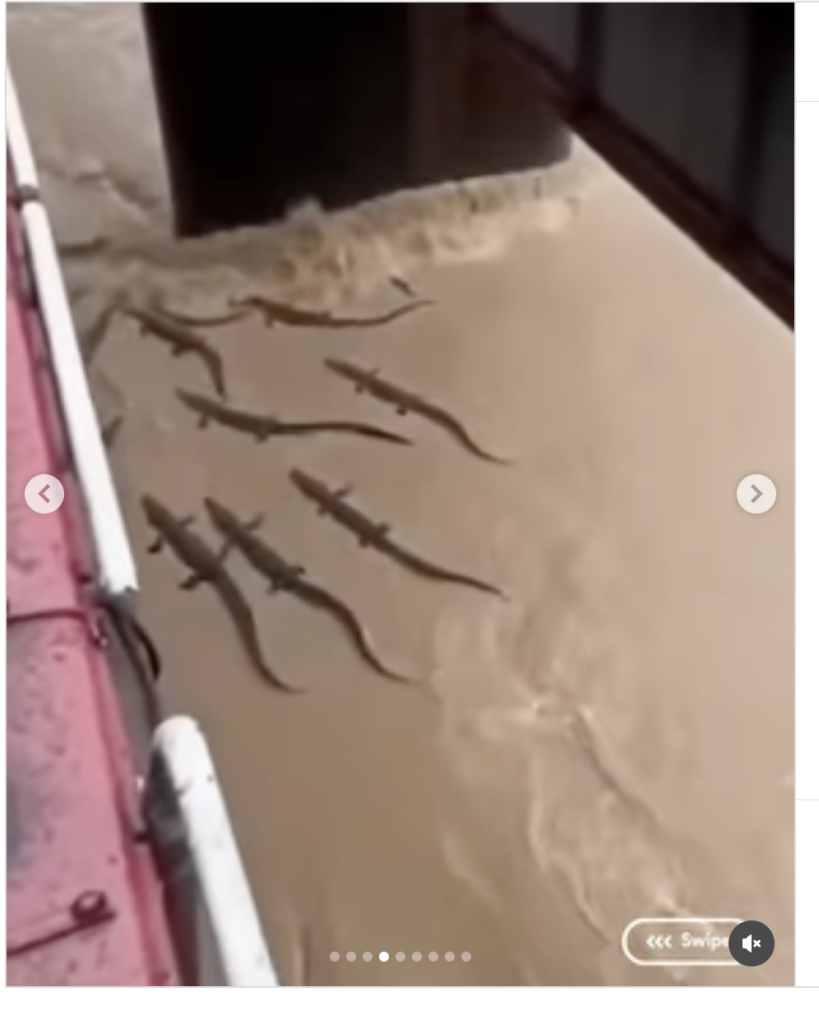
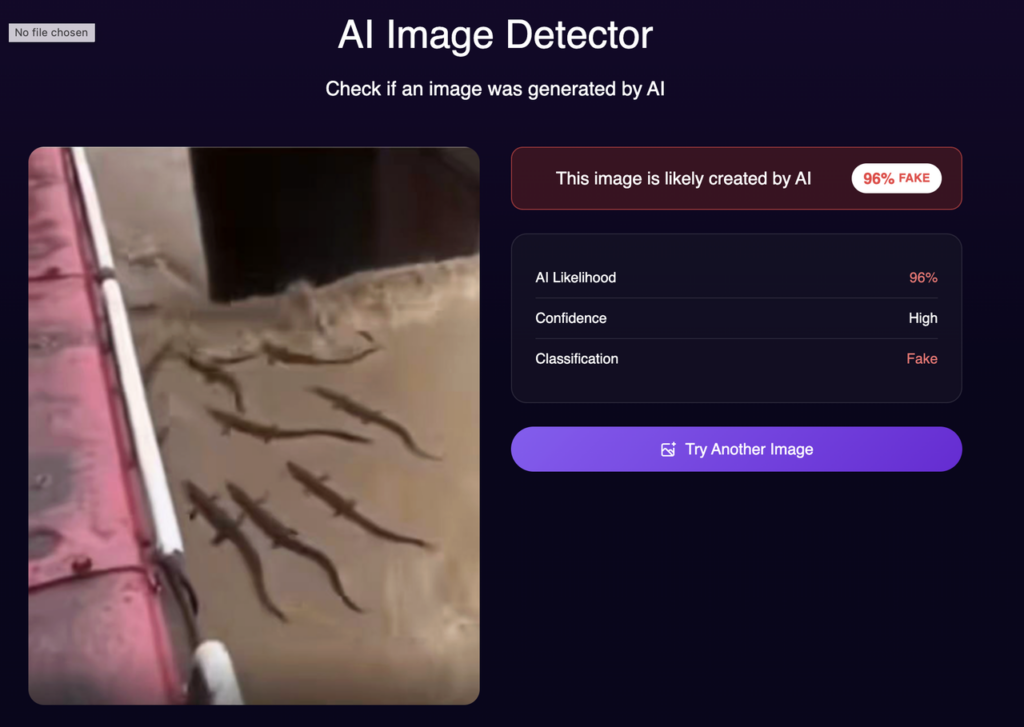
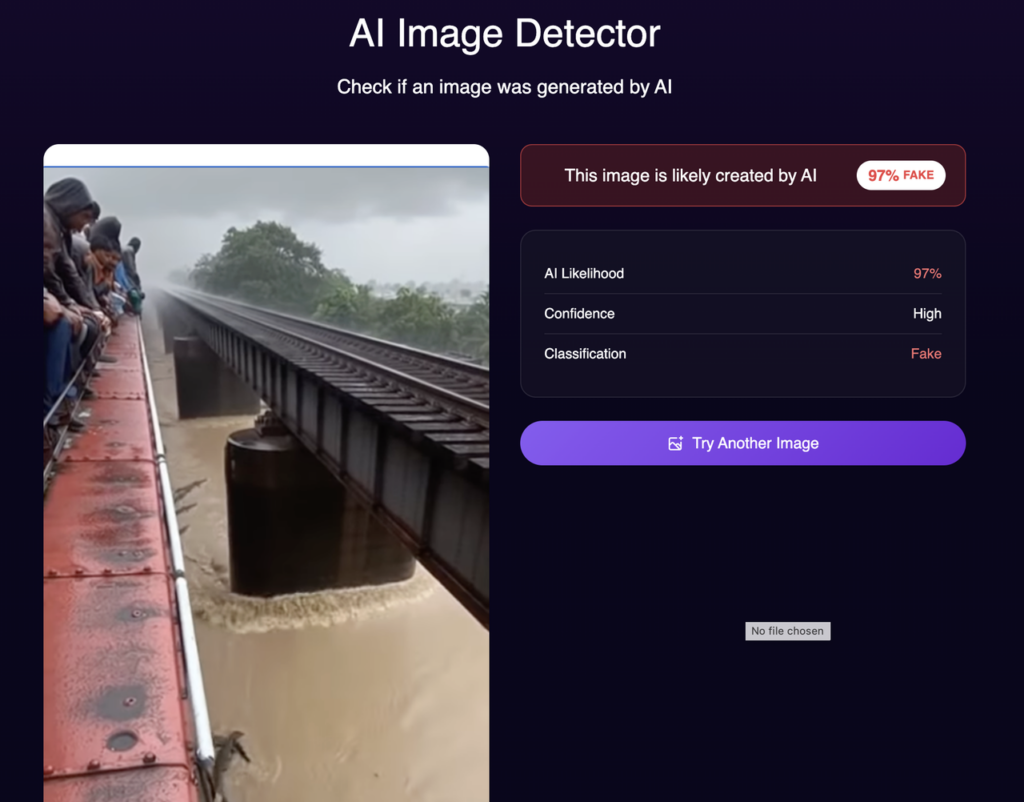
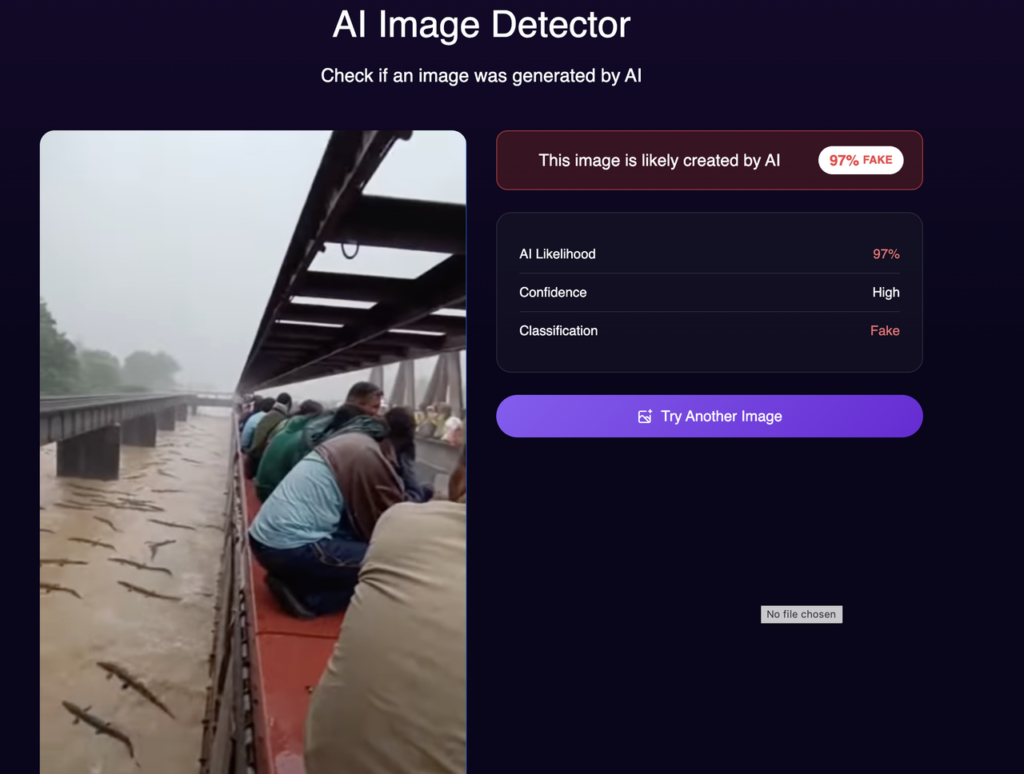
3.1 Repurposed Footage from Other Locations and AI-Generated Content: Crocodiles in River (Clip 1, Clip 4)
Source Analysis
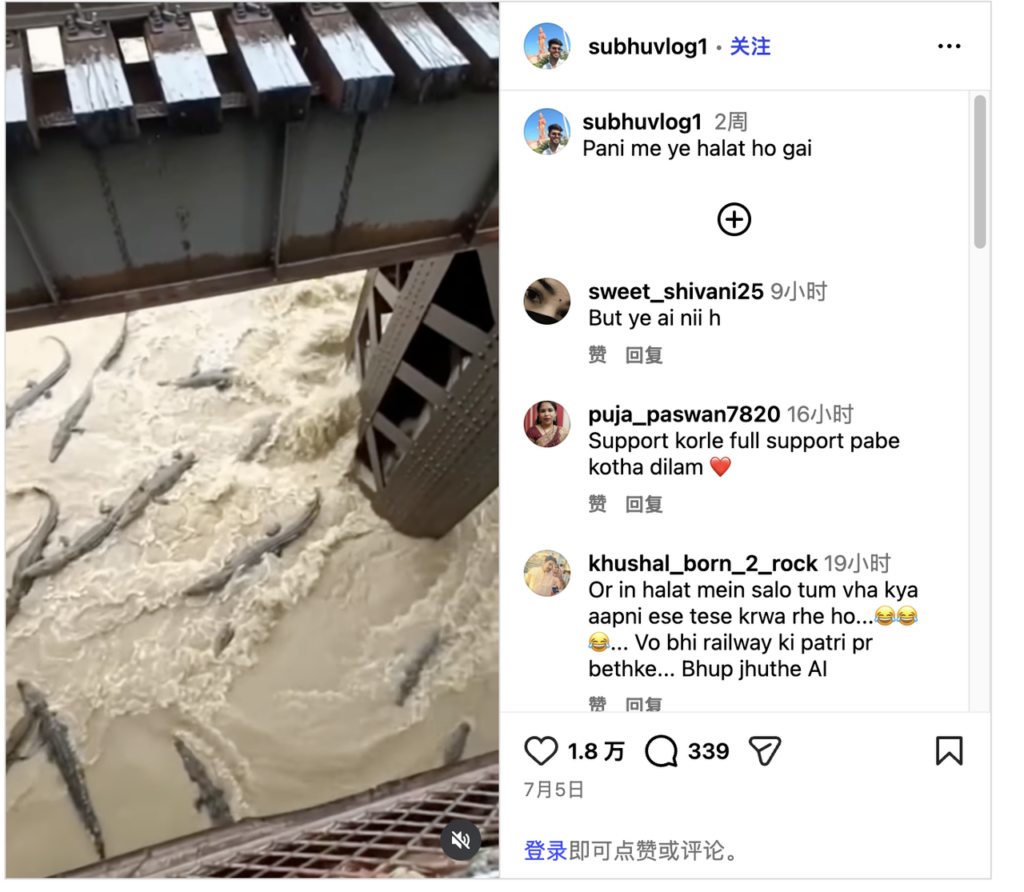
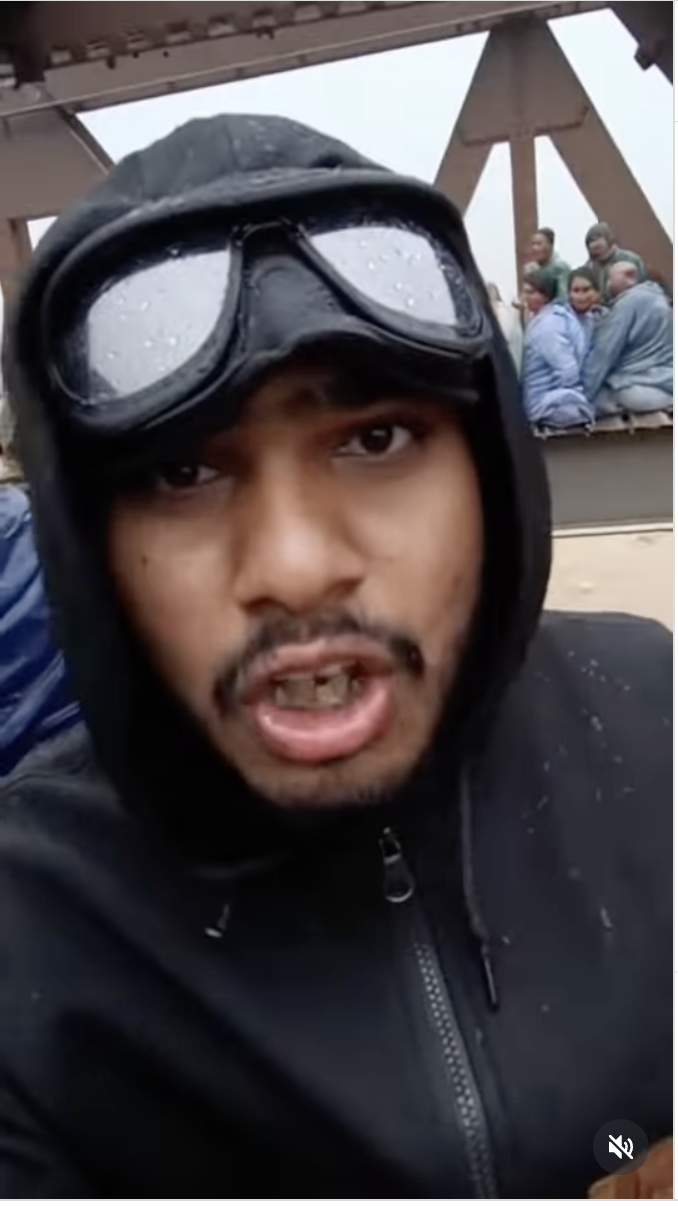
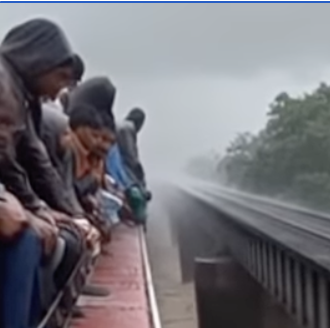
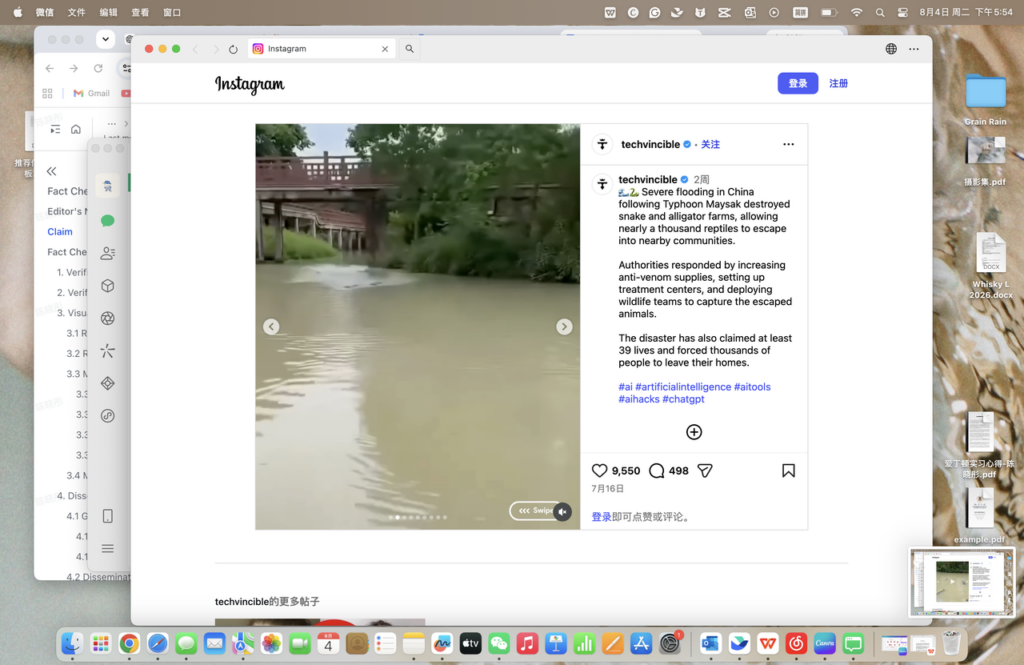
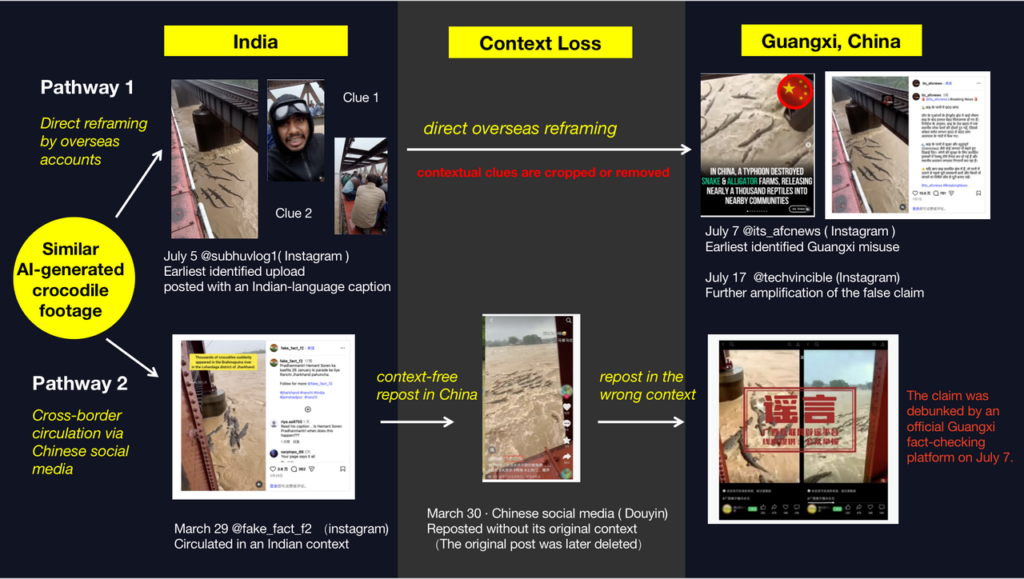
Frame comparison and source tracing confirm that the cover clip (Clip 1) and Clip 4 share identical raw footage. The earliest traceable original reel was posted to Instagram on July 5 by user @subhuvlog1. The circulated version only retains the segment showing swimming crocodiles, cutting out dialogue, people on the bridge, and other visual cues that could identify the location and reveal its local language context.
Visual Analysis
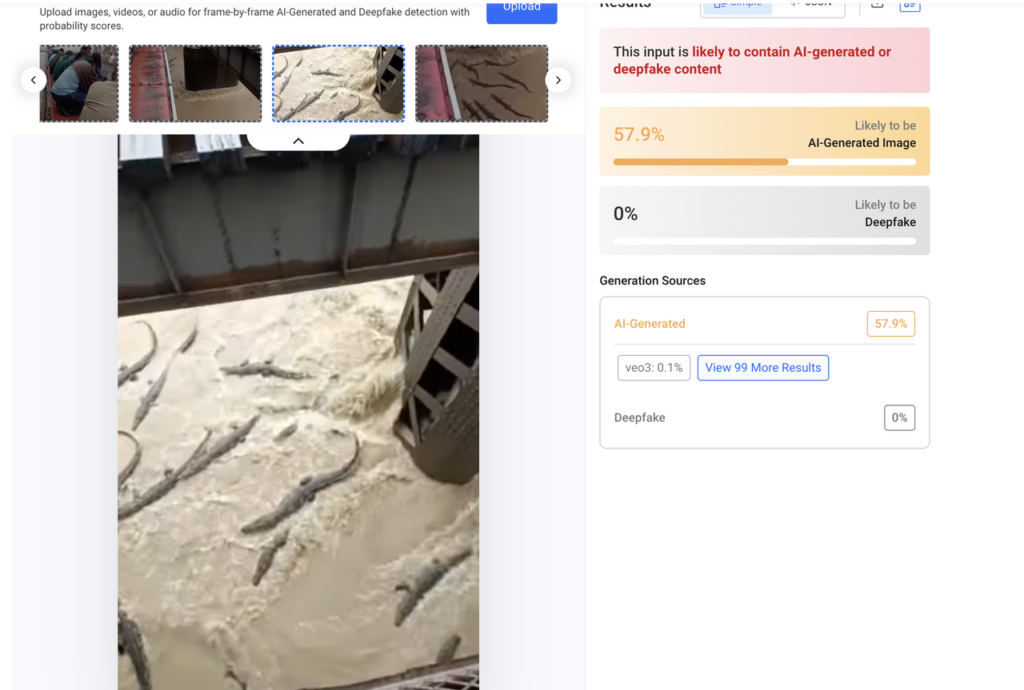
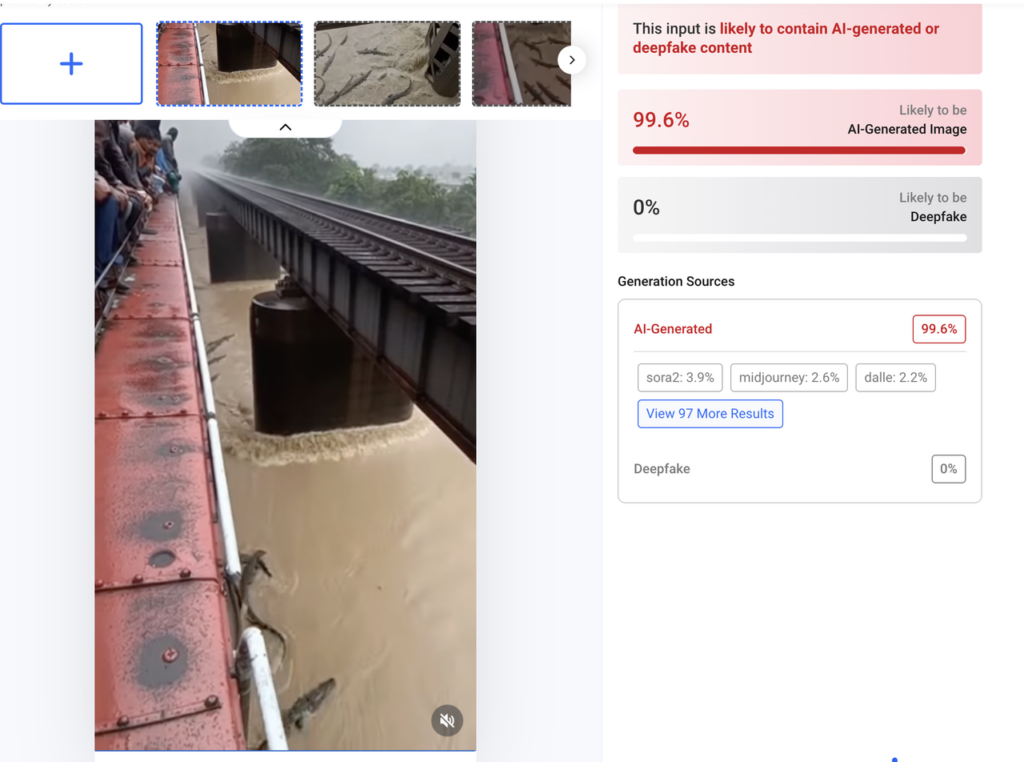
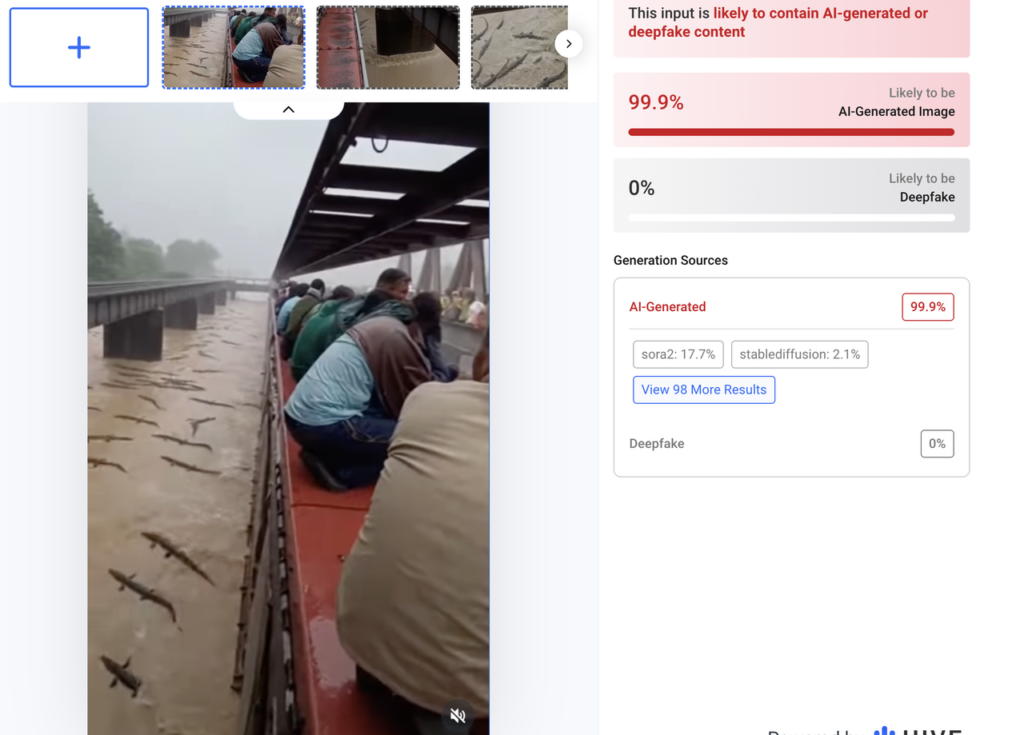
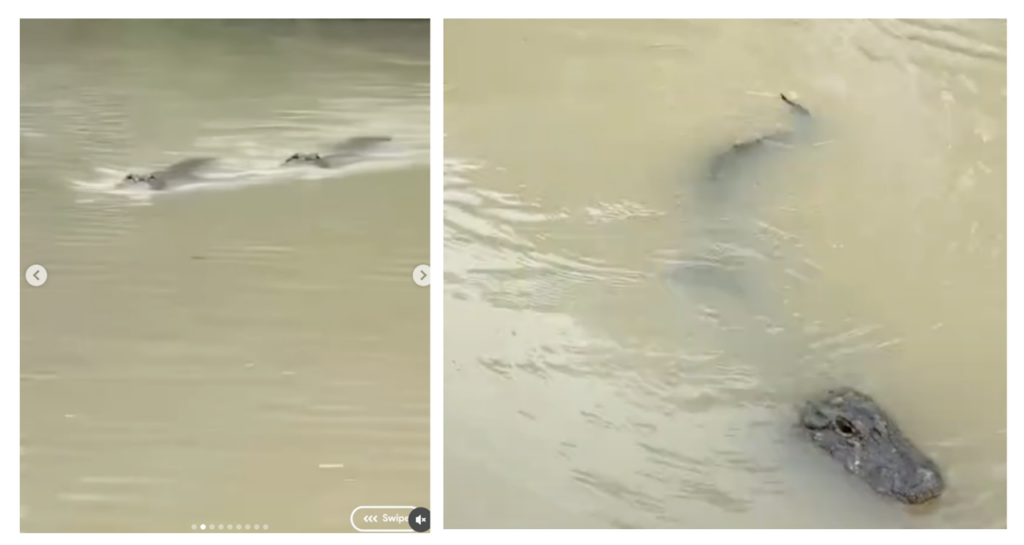
Crocodiles in the footage show highly similar body sizes, postures, and orientations. Many individual crocodiles appear nearly identical, lacking natural physical differences and the random movements typically observed in real animal groups. Distant figures, bridge structures, and riverbank details appear blurred. Some object edges and spatial relationships show unnatural blurring or distortion, which is inconsistent with normal camera imaging.
AI Detection Results
Key frames and full clips were scanned using two AI detection tools: Hive Moderation and DeepAI AI Image Detector. Both indicated a high likelihood that the video was AI-generated.
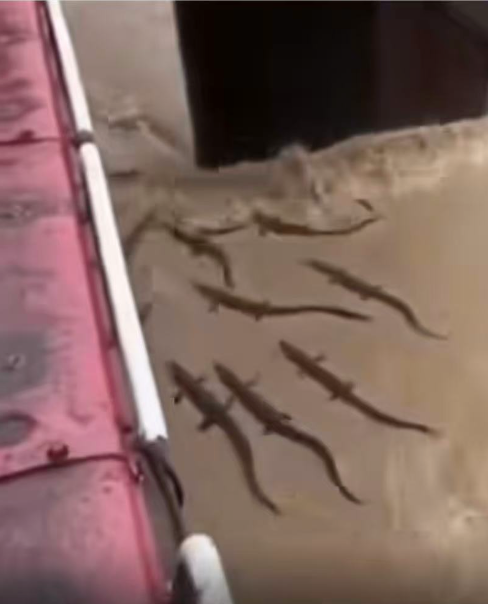
3.2 Repurposed Real Footage from Other Locations: Swimming Chinese Alligators (Clip 2)
Source Analysis
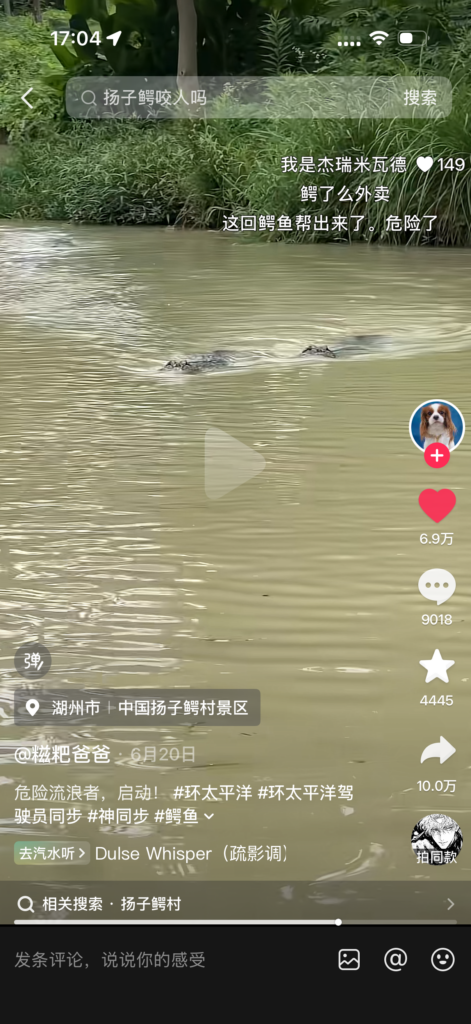
Reverse image search traced the clip to a Douyin user @Ciba Baba (@糍粑爸爸), who published it back on June 20, with the title “Wanderer, activate!”. The clip was filmed at the Chinese Alligator Village scenic area in Huzhou of east China’s Zhejiang Province, more than 1,800 kilometers away.
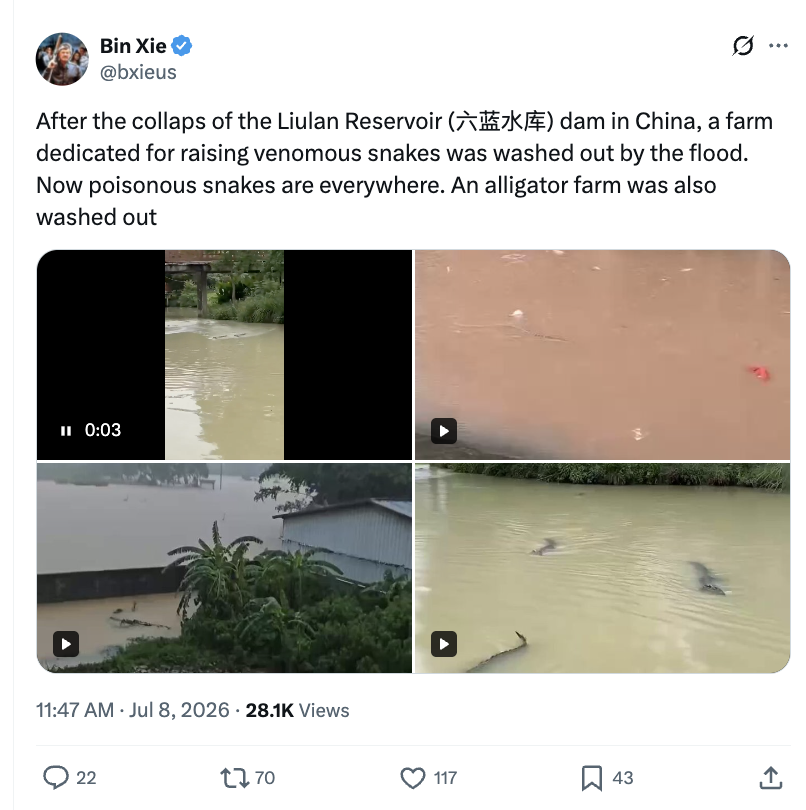
The earliest traceable repost was published on X by account @bxieus on July 8. Its caption linked the clip to the Guangxi floods and said: “an alligator farm was also washed out”.
Visual Analysis
The animals in the clip have short, broad, and rounded snouts, with visual characteristics resembling alligators. However, Siamese crocodiles are the primary farmed crocodile species in Guangxi, and no credible records confirm crocodile escapes during the floods.
3.3 Misidentified Animal Species (Clip 3, 5, 7, 8)
3.3.1 Flooded Ostriches Misidentified as Snakes
Source Analysis
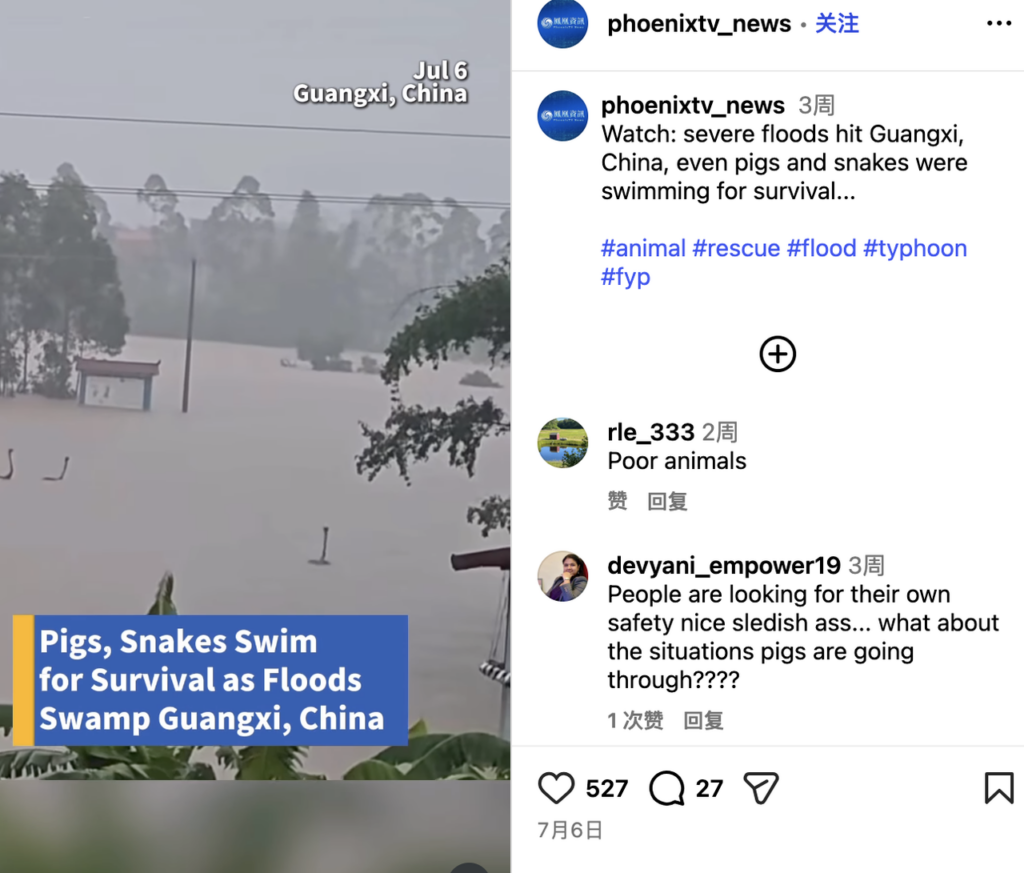
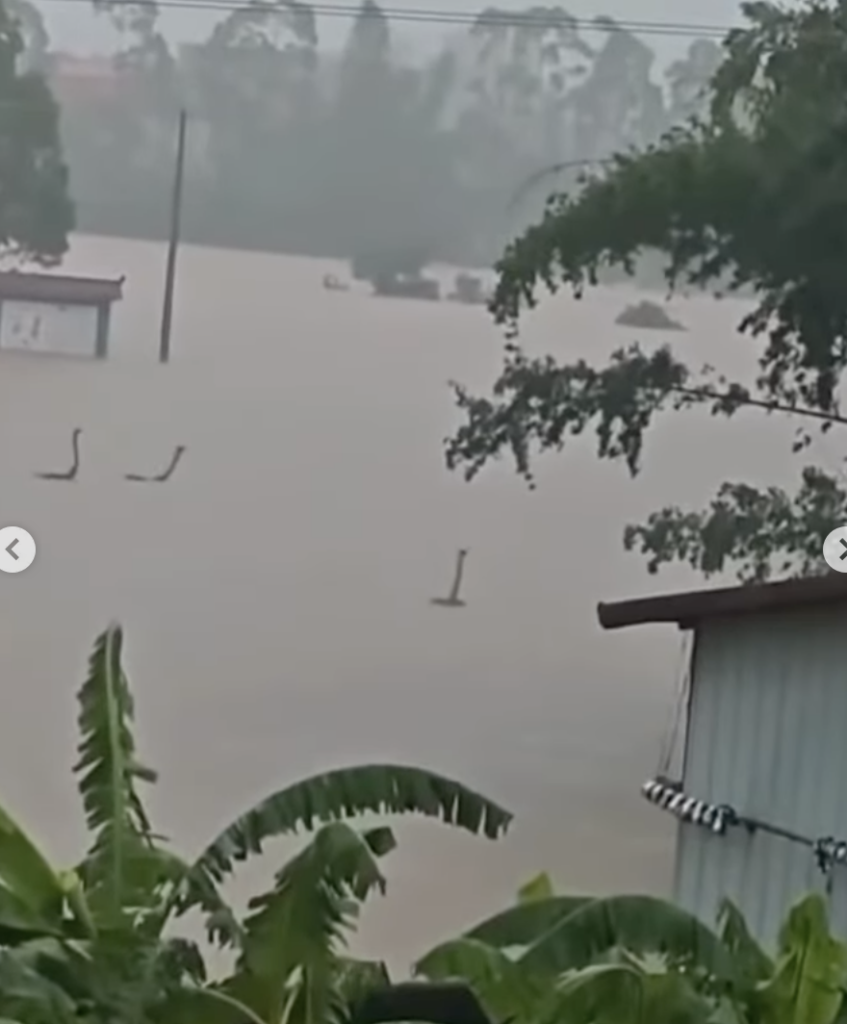
The earliest traceable version of this clip was posted by @phoenixtv_news on Instagram on July 6. The post claimed that the Guangxi floods had left snakes swimming for survival.
Visual Analysis
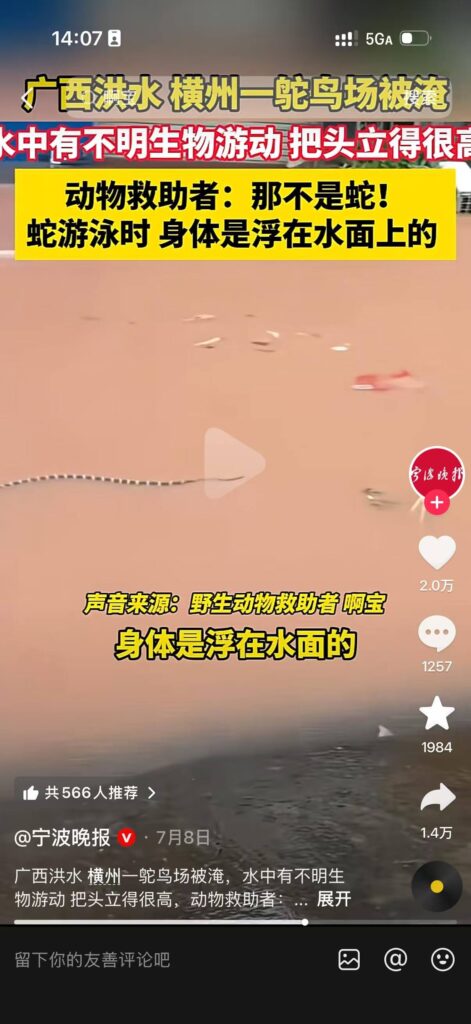
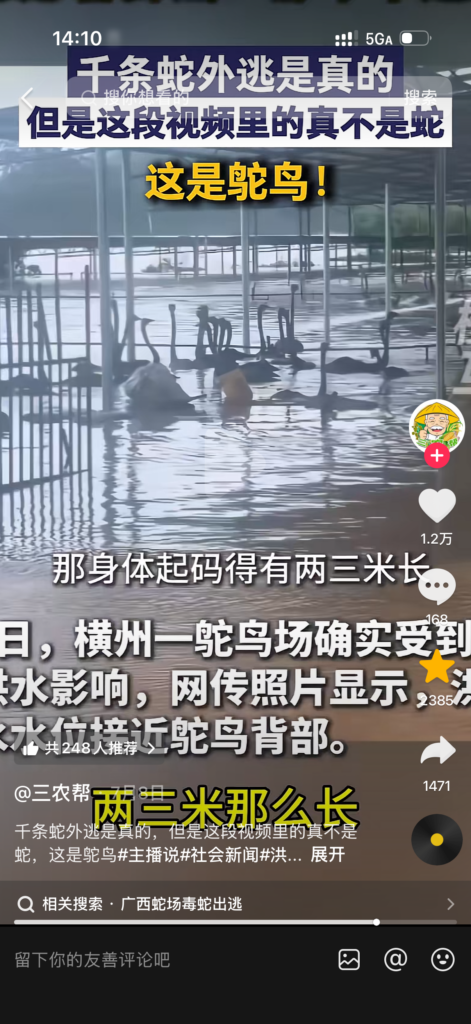
Snakes swim through lateral undulation, with their heads usually close to the water surface rather than held vertically for extended periods. The animals in the viral clip have long, thin necks extending nearly vertically above the water, which is more consistent with ostriches stretching their necks above water to breathe.
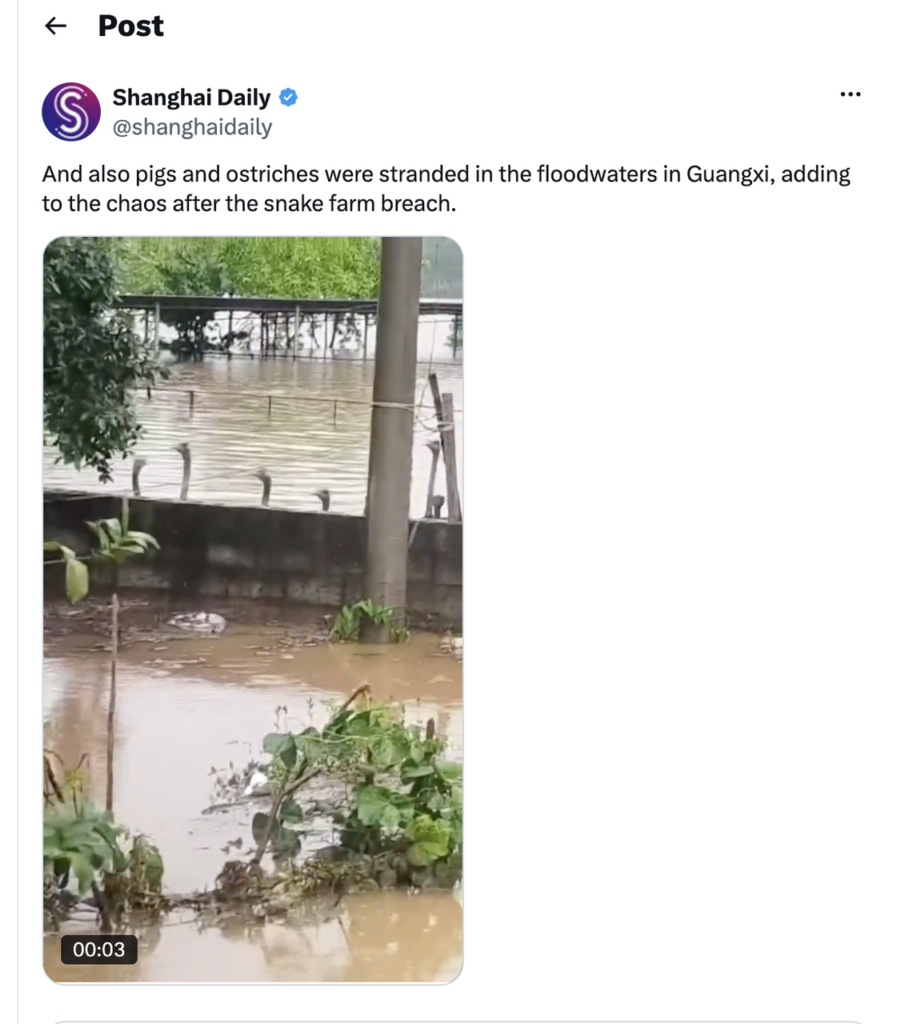
On July 7, Shanghai Daily shared a clip of a flooded ostrich farm on its X account. The ostriches in the footage held their necks upright above the water to breathe, with postures similar to those shown in the viral clip.
On July 8, multiple media outlets verified the viral clip while preserving the relevant footage. Sing Tao Daily cited local volunteers stating: “These are definitely ostriches. Snakes swimming in water would not hold their heads this high.” This assessment is consistent with the animal behavior analysis above, indicating that the footage shows stranded ostriches rather than escaped snakes.
3.3.2 Flooded Ducks Misidentified as Snakes (Clip 5)
Source Analysis
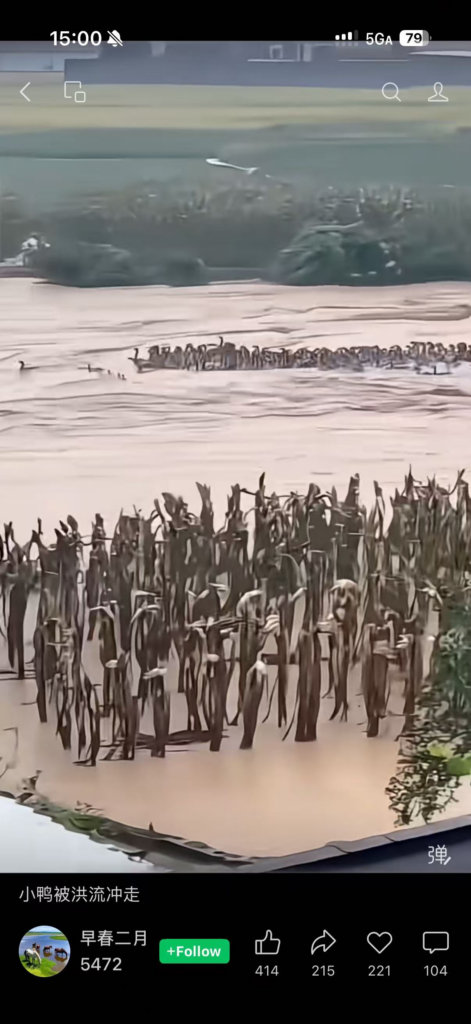
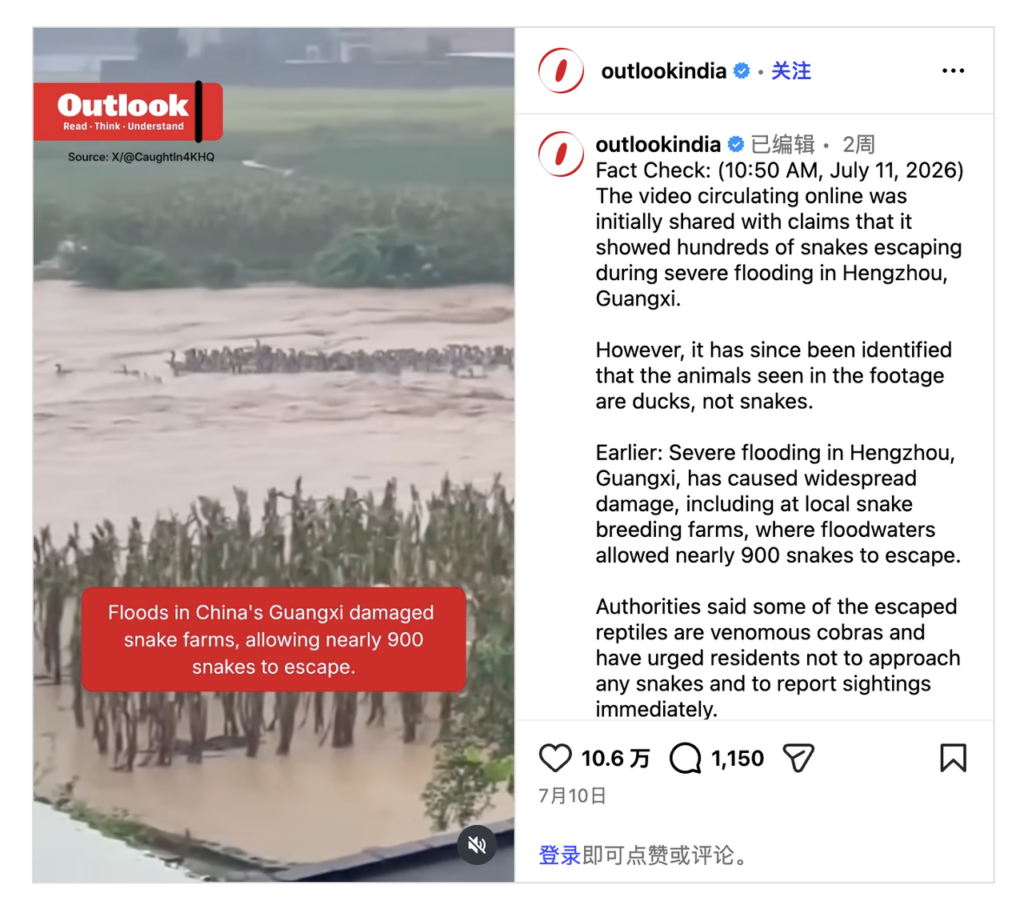
Tracing analysis identified the earliest available source of this clip as a WeChat Channels post published on July 8. The original caption stated “Ducklings swept away by floodwaters,” indicating that the animals shown were floating ducks.
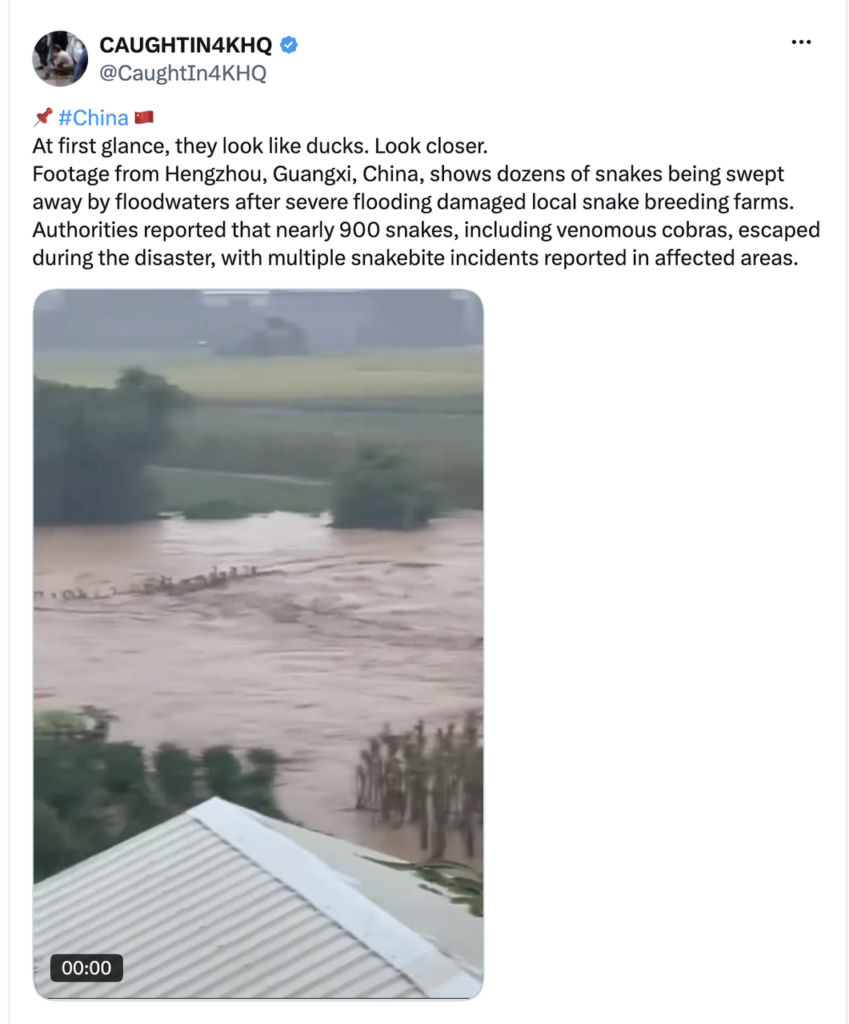
On July 10, X account @CaughtIn4KHQ reposted the same clip with the caption: “At first glance, they look like ducks. Look closer. Footage from Hengzhou, Guangxi, China, shows dozens of snakes being swept away by floodwaters…” Although the two clips used identical footage, the X post portrayed the scene as escaped snakes without providing supporting evidence.
Visual Analysis
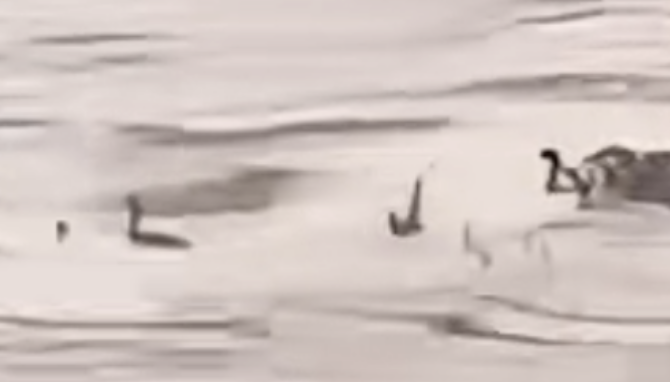
Frame-by-frame inspection reveals distinct heads, necks and bodies of the animals. Many have broad torsos with heads protruding above the water, drifting with currents in shapes consistent with swimming ducks. The group moves uniformly in one direction, with heads forward and wide bodies trailing, matching a flock of swept-away ducks rather than swimming snakes. On July 10, an Instagram account also clarified that the footage showed ducks.
Verbal Content Analysis
The videographer can be heard speaking in a Chinese dialect in the viral clip, saying, “Look, there are so many ducks over there.” This audio evidence further supports that the animals shown are ducks rather than snakes.
3.3.3 Fish in Paddy Fields Misidentified as Snakes (Clip 7)
Source Analysis
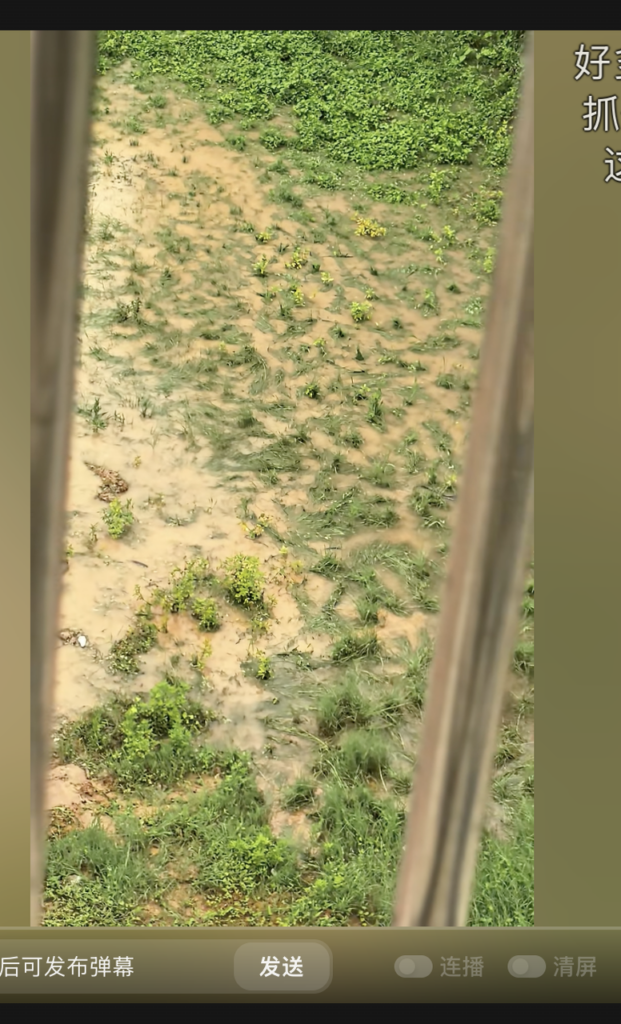
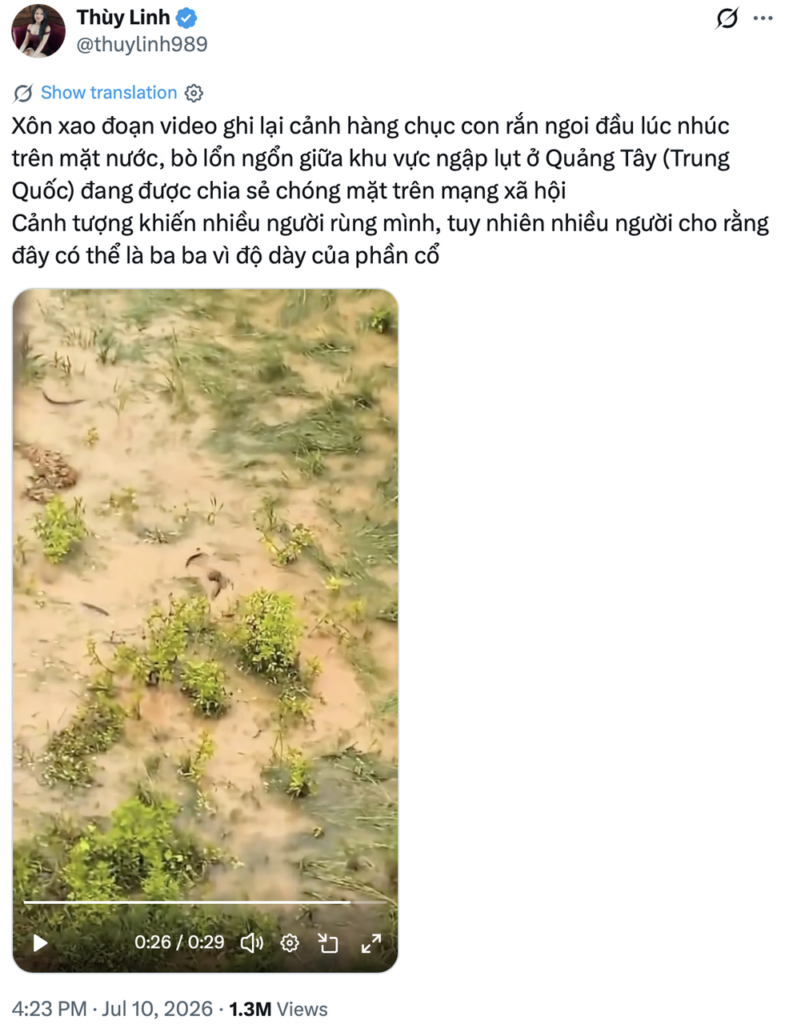
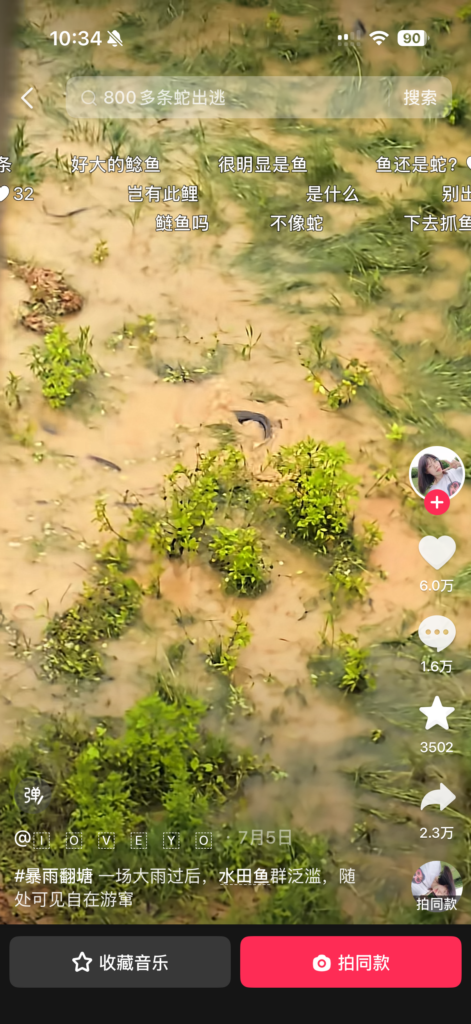
Source tracing identified the earliest available upload of this clip on Douyin, posted on July 5. The original caption stated, “After heavy rain, paddy fields are full of fish everywhere,” with hashtags such as “pond overflow after rain,” indicating that the moving objects were fish appearing in flooded fields after heavy rainfall.
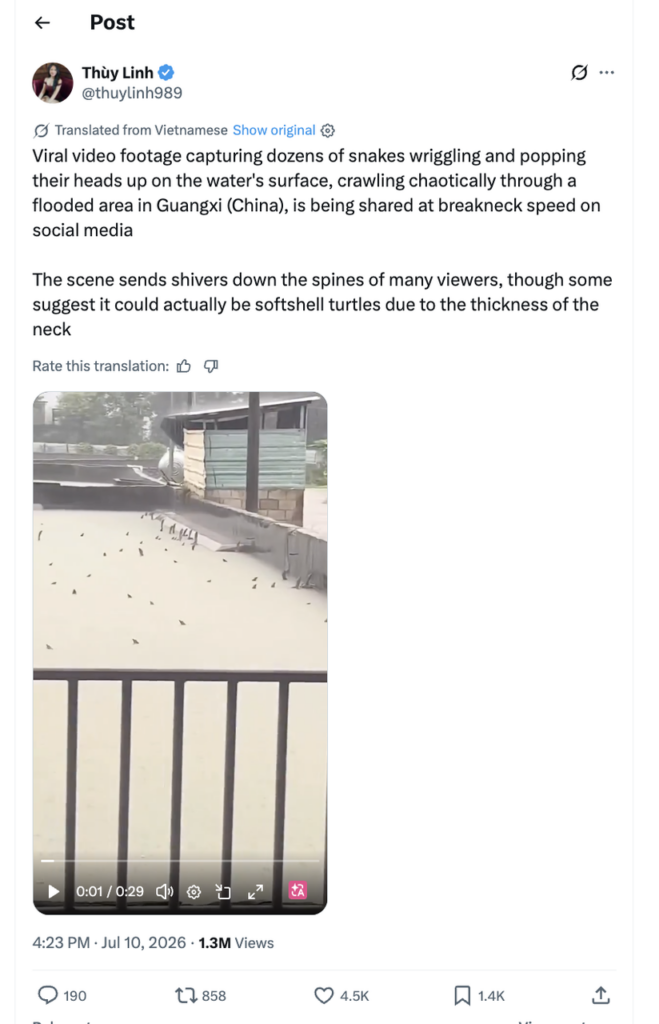
On July 10, X account @thuylinh989 reposted the clip and claimed it showed snakes “wriggling and popping their heads up on the water’s surface, crawling chaotically through flooded areas in Guangxi”. The account linked the clip to the Guangxi floods and alleged snake farm escapes.
Visual Analysis
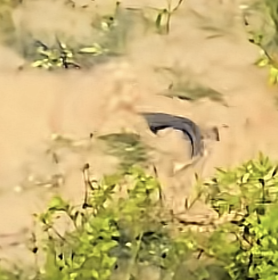
Frame-by-frame inspection shows that the aquatic animals have broad bodies that gradually taper toward the tail. Many appeared to have wider abdominal areas than tails, forming spindle-shaped bodies more consistent with fish than snakes. This differs from the long, uniformly narrow body shape observed in snakes.
Figure 36-37: Animals in the Clip (Douyin: @jingbaby_1118)
3.3.4 Soft-shelled Turtles Surfacing to Breathe Misidentified as Snakes (Clip 8)
Source Analysis
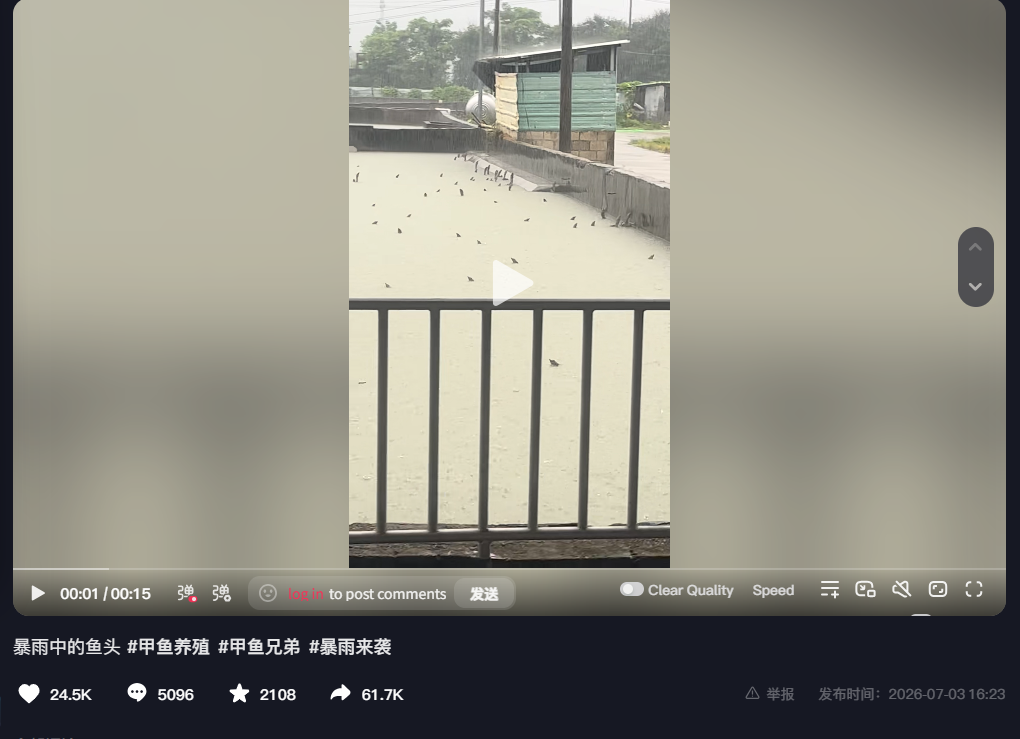
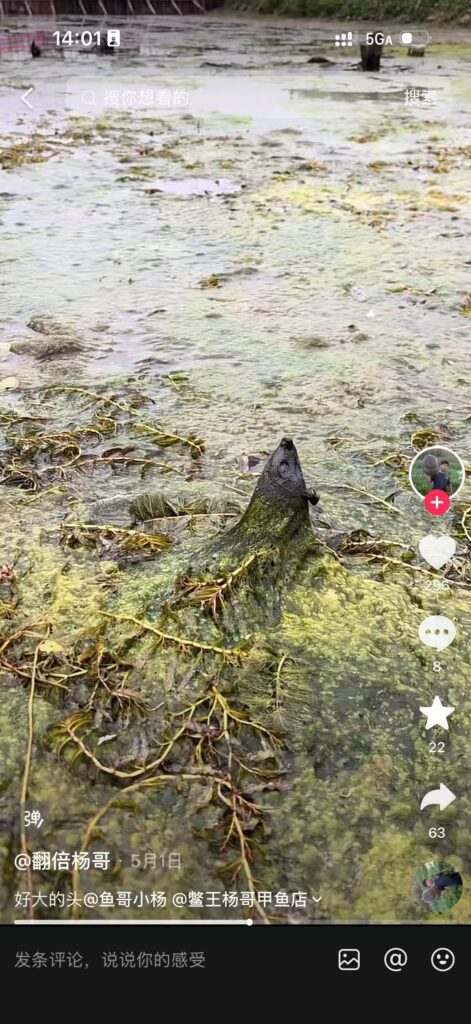
Verification confirmed that the original video was posted on Douyin on July 3 by user @甲鱼兄弟生态养殖场. Titled “Fish heads in the heavy rain,” the post included hashtags such as #SoftshellTurtleFarming and #HeavyRainAlert. The original caption indicated that the footage showed farmed soft-shelled turtles during heavy rainfall.
The earliest traceable repost appeared on X on July 10 via the account @thuylinh989, which linked the footage to a narrative of escaped flood snakes.
Visual Analysis
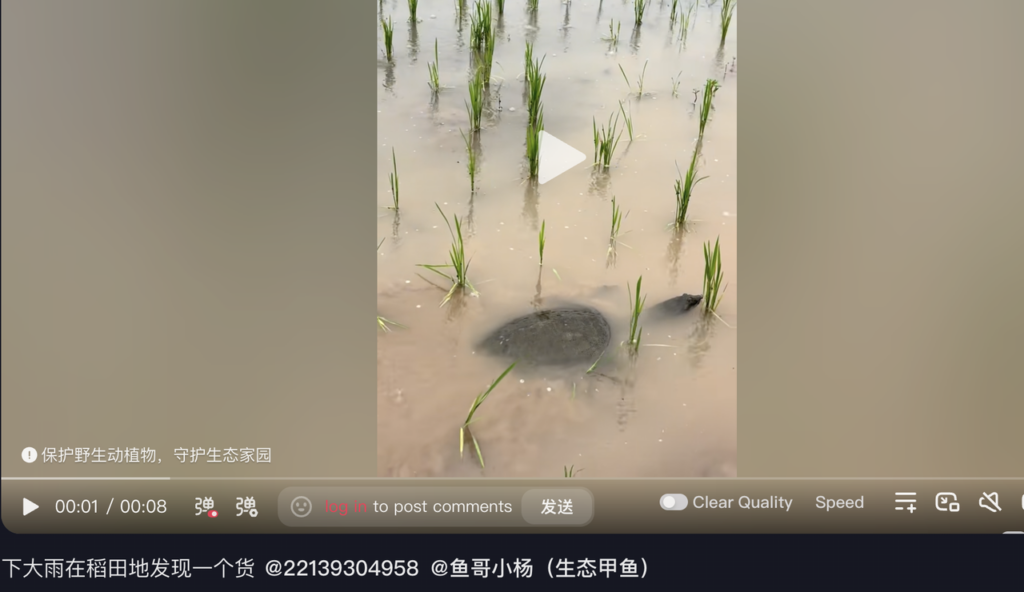
Comparison with other soft-shelled turtle footage shows that soft-shelled turtles typically expose only their heads and short necks above the water when surfacing to breathe, which is consistent with the small heads visible above the water in the viral clip. The footage does not show the long, winding bodies or continuous movement patterns of snakes. Therefore, it must be concluded the features are more consistent with soft-shelled turtles surfacing for air.
Figure 41-42: Images of Soft-Shelled Turtles Surfacing for Air
3.4 Mixing Real Flood Footage with Misleading Content (Clip 6, Clip 9)
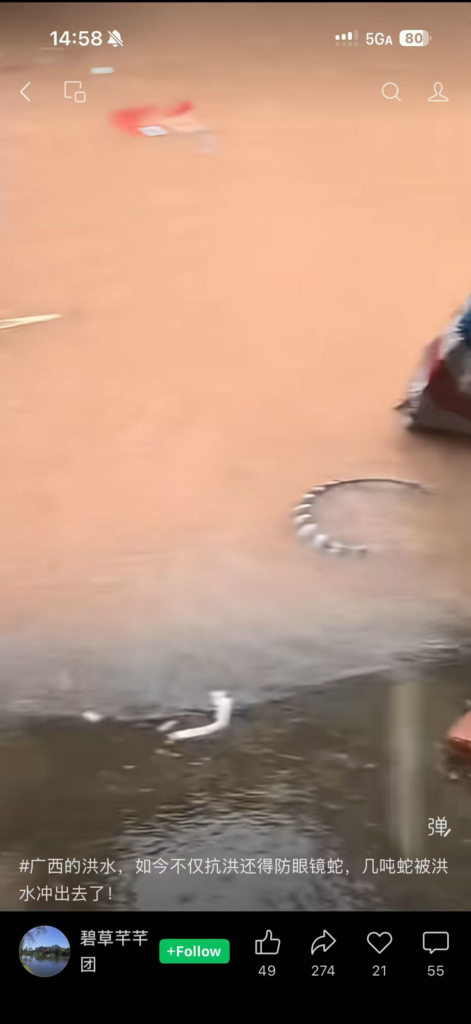
3.4.1 Video of a Chinese krait swimming
The earliest available version of this video can be traced to a full-length clip posted by WeChat Channels user @碧草芊芊团 on July 7. Verification found that the footage is consistent with the flood situation during that period, and no evidence indicates that it was fabricated or reused from unrelated sources.
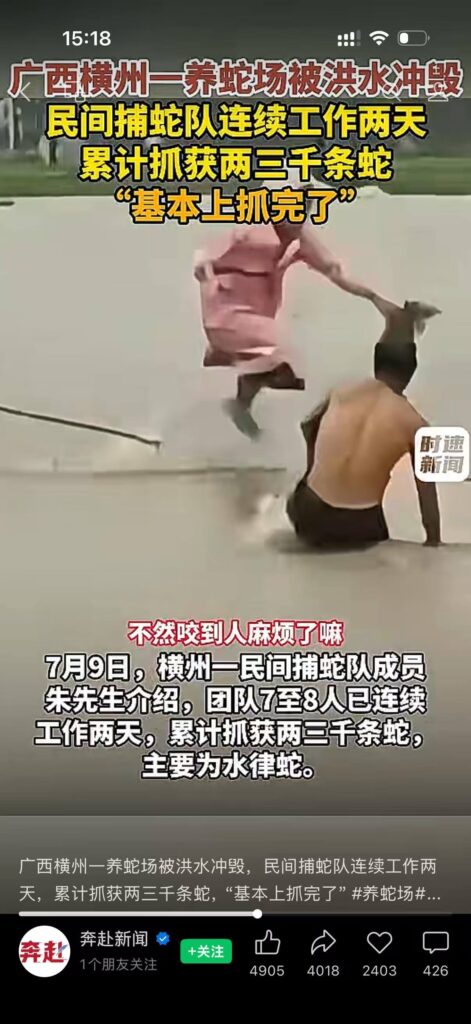
3.4.2 Snake-catching team video
The video shows residents searching for and capturing escaped snakes during the floods, consistent with reports from multiple Chinese media outlets. Although the original uploader has not been identified, several media reports used the footage as a record of local snake-catching efforts during the Guangxi floods. No evidence indicates that the video contains false information.
Figure 45-46: Screenshots of the Post(Instagram: @techvincible)
4. Dissemination Analysis
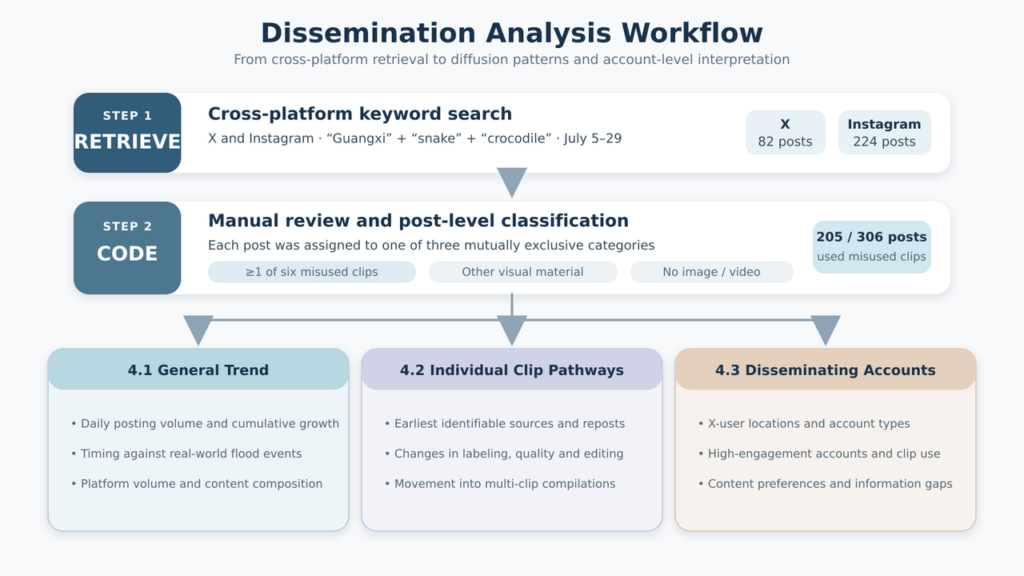
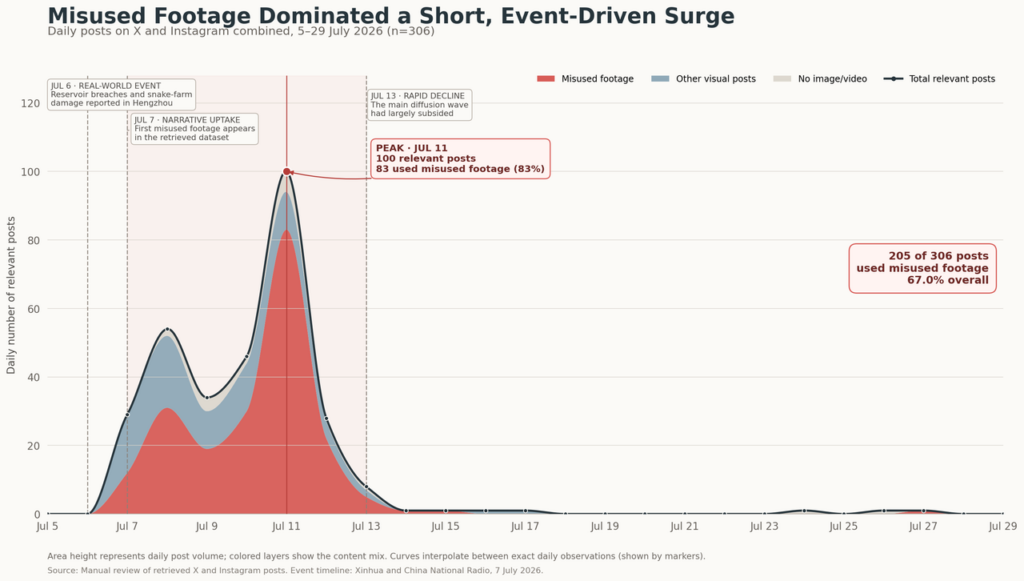
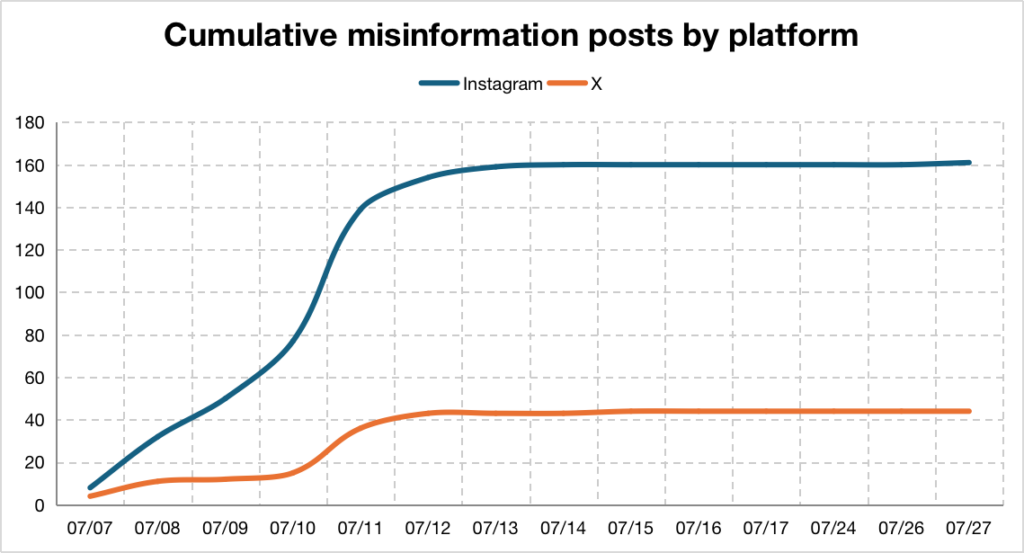
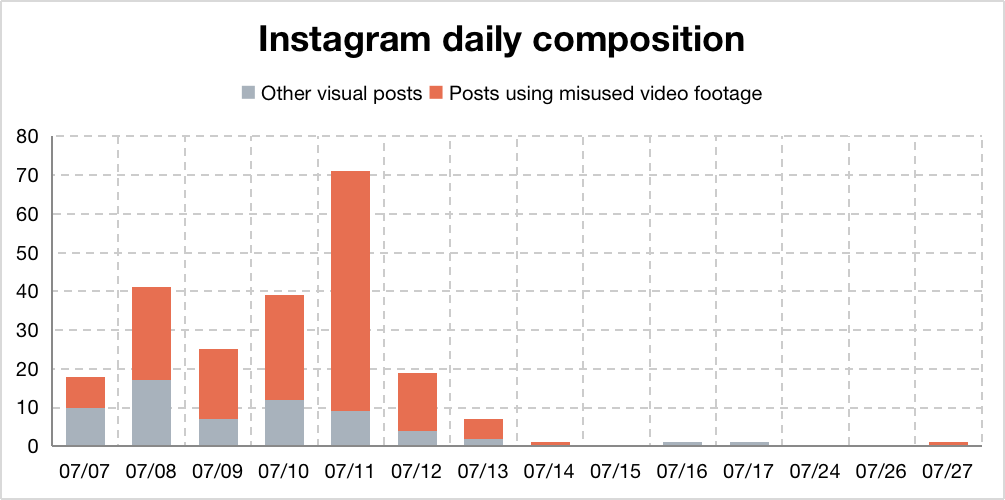
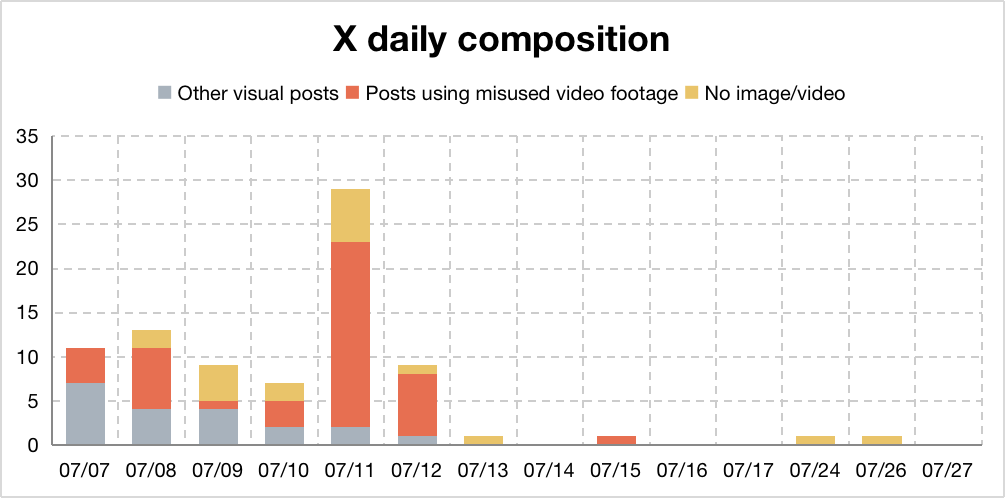
To examine the spread of the footage across social media, we searched X and Instagram for posts combining the keywords “Guangxi,” “snake,” and “crocodile” from July 5 to 29. We found 82 posts on X and 224 on Instagram. Each post was manually reviewed and sorted into three groups: those using at least one misused clip, those with other visuals, and those with no images or videos. Overall, 205 of the 306 posts (161 on Instagram, 44 on X) contained at least one of the six misused clips.
4.1 General trend
4.1.1 Temporal Analysis
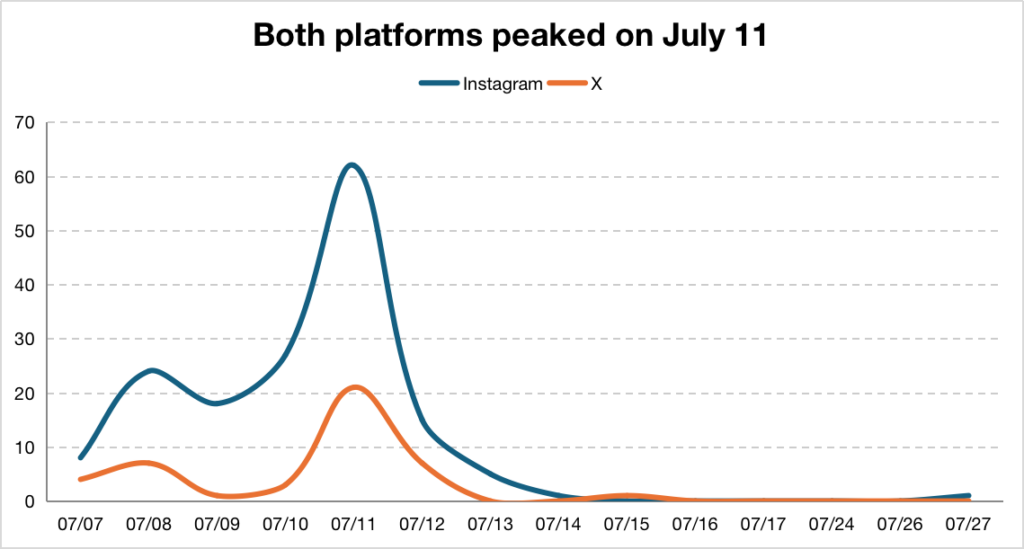
From July 4 to 6, Guangxi experienced a bout of severe flooding. On July 6, a snake farm in Hengzhou was flooded, causing hundreds of farmed snakes to escape. Local authorities confirmed the incident on July 7. On the same day, the first misused clip appeared in our dataset. Over the following three days, posting activity accumulated rapidly, peaking simultaneously on Instagram and X on July 11. On that day, problematic clips accounted for 87.3 percent of relevant Instagram posts and 72.4 percent of relevant X posts. The simultaneous peak on both platforms suggests the surge was driven by a shared news-attention cycle rather than cross-platform migration. Posting activity declined sharply after July 11, with the overall diffusion window lasting approximately one week — a typical pattern of brief, event-driven amplification.
4.1.2 Platform Analysis
In our sample, the misleading narrative appeared more often on Instagram, both visually and in repetition. Of 224 Instagram posts, 161 (71.9%) contained misused clips, versus 44 of 82 X posts (53.7%).
Despite these differences, both platforms showed nearly identical timing: activity rose together, peaked on July 11, and dropped sharply after July 12.
4.2 Dissemination Patterns of Individual Clips
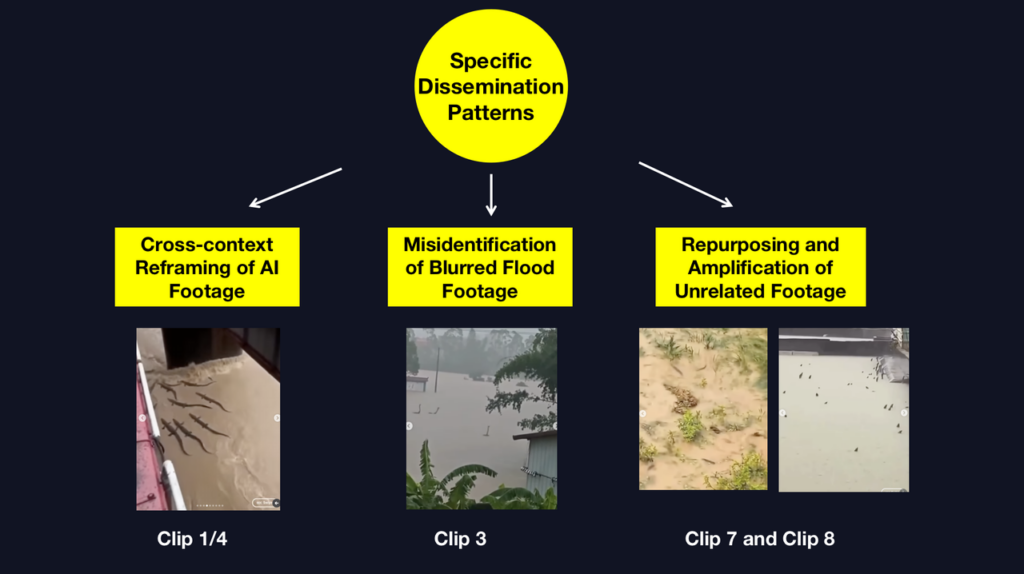
This section zooms in on how individual videos are shared and reframed. Three patterns emerged: (1) AI footage from abroad was given a new event context; (2) real flood clips were mislabeled after blurry circulation; and (3) unrelated old clips were repurposed and spread further. We illustrate these using the cases of the AI crocodile videos, the ostrich video, and the fish and softshell turtle videos.
4.2.1 Cross-context Reframing of AI Footage (The Case of the AI-Generated Crocodile Clips)
This pattern involves reusing clips outside their original context. Some AI-generated clips lack any location or event details from the start; others lose such cues—captions, locations, watermarks—during reposting. Once stripped of context, they can be reassigned to new events or places. Clips 1 and 4 in this report follow this pattern.
During our investigation, we identified another AI-generated crocodile video that was highly similar to Videos 1 and 4. It had also been falsely presented as showing animals escaping during the Guangxi floods and was later addressed by a Guangxi fact-checking platform. Despite their visual similarity and eventual association with the same event, the two videos entered circulation through.
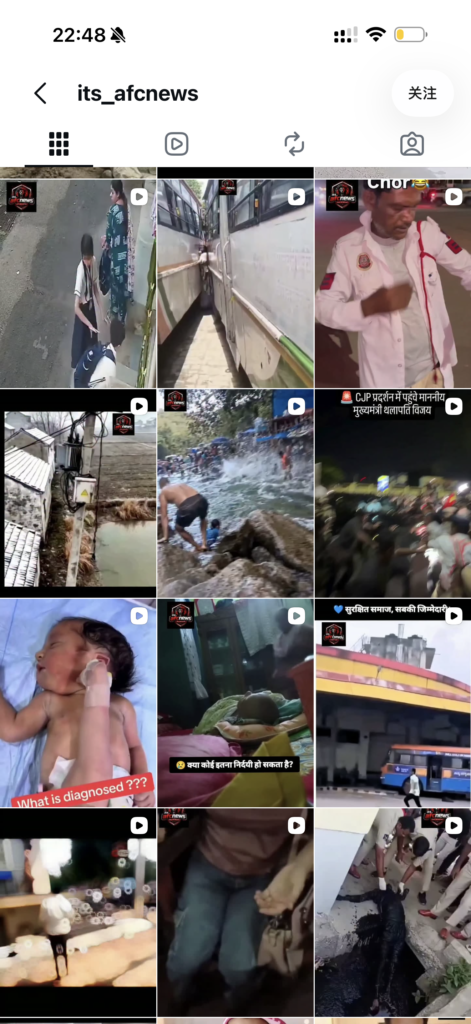
The clips in our sample followed a direct pathway. The earliest identified upload appeared on July 5 from Indian Instagram account @subhuvlog1, with an Indian-language caption but no location or event context. Two days later, overseas account @its_afcnews reframed it as footage from Guangxi, claiming that floods had released hundreds of farm animals. The clip was then reused in multi-video compilations alongside unrelated animal footage as evidence of the same narrative.
The other similar crocodile video followed a longer path. It was first posted by @fake_fact_f2 on Instagram back in March as showing crocodiles in India’s Brahmaputra River. By late March, it surfaced on a Chinese platform without the India reference. In early July, it was relabeled as evidence of crocodiles escaping during Guangxi floods, and was debunked on July 7.
Together, the two cases show that the same type of reframing can happen through different routes. In one, context-poor AI footage was directly given a false location and quickly integrated into a broader narrative. In the other, footage initially tied to India circulated across platforms, lost its original context, and was later reassigned to Guangxi. In both instances, the lack of verifiable context made visually similar AI clips become interchangeable in practice, and different videos were used to support the same misleading story.
4.2.2 Misidentification of Blurred Flood Footage (The Case of the Ostrich Clip)
This pattern starts with real footage, but early posts often fail to clearly identify what each clip shows. As image quality drops, distinguishing features become harder to see, and the subjects may be misidentified. This initial misunderstanding is then repeated and reinforced through further reposting and editing. Clip 3 in this report—the ostrich video—illustrates this pattern.
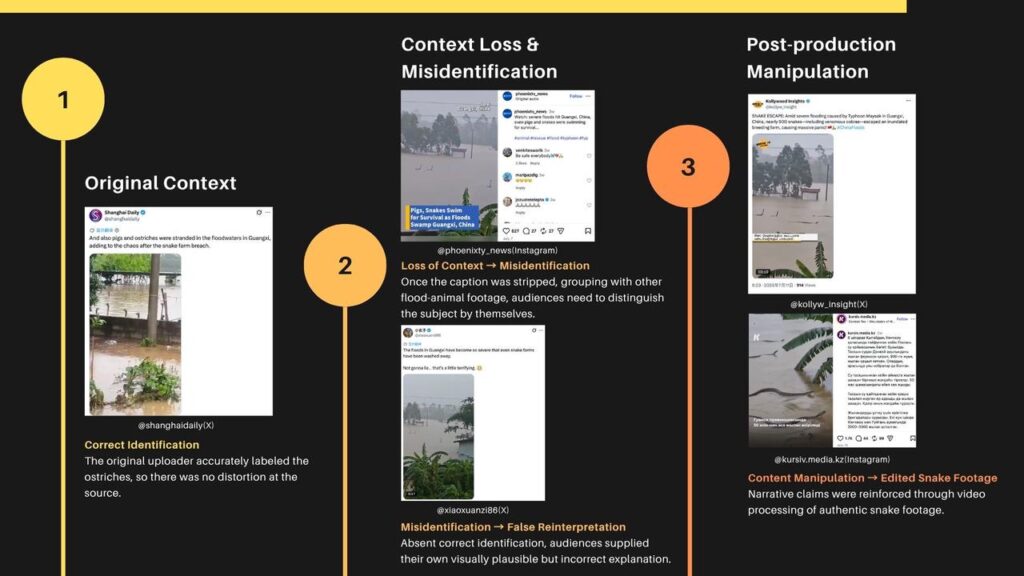
Clip 3 was authentic Guangxi flood footage, though its original source is unknown. Some posts correctly identified it as ostriches escaping a flooded farm, such as this Shanghai Daily post on X.
However, the clip also appeared in compilations with other animal scenes without clear labeling. For example, Instagram account @phoenixtv_news combined it with other footage but did not specify what each clip showed. This could mislead viewers into believing the scenes showed the same animal. Low image quality further blurred the ostriches’ bodies, making their necks easy to mistake for snakes. The clip was later reframed as snake footage and used in compilations claiming snakes and other animals escaped during the Guangxi floods. This appeared in posts by X users including @xiaoxuanzi86 and @Godsbaby2025.
The misidentification was later reinforced through visual alteration. On July 11, a modified version posted by @kollyw_insight included additional swimming snake-like figures that were absent from earlier versions. This altered version continued to circulate on Instagram, including in a July 13 post by @kursiv.media.kz.
4.2.3 Repurposing of Unrelated Footage (The Cases of the Fish and Softshell Turtle Clips)
This pattern uses footage unrelated to the actual event. Clips are sourced elsewhere, given a new context, and presented as breaking-news evidence. They are often grouped with other repurposed clips in compilations. Though the scenes are originally unconnected, presenting them together under the same claim cerates the impression of multiple pieces of evidence of a single event. The fish and softshell turtle videos (Clips 7 and 8) show this pattern.
The fish and turtle videos were not verified flood footage, and their original captions identified the animals as fish and turtles—not snakes. The turtle video was posted July 3 by a Douyin aquaculture account, and the fish video on July 5 showing fish in a flooded field.
The two clips were later posted on X by users like @thuylinh989 and @KangYu8964, falsely claiming they showed snakes during the Guangxi floods. The turtle video was repurposed this way on July 10, and the fish video on July 11. The reduced quality made the animals harder to distinguish, allowing the new false descriptions to override the original captions.
On July 13, both clips were posted by users @kursiv.media.kz and @diamond.viral.feed in Instagram compilations alongside other alleged snake footage. Once grouped together, the unrelated clips were presented as multiple pieces of evidence for the same story, rather than as isolated claims.
4.3 Characteristics of Accounts Disseminating Misused Clips
4.3.1 General Characteristics of Accounts Disseminating Misused Clips
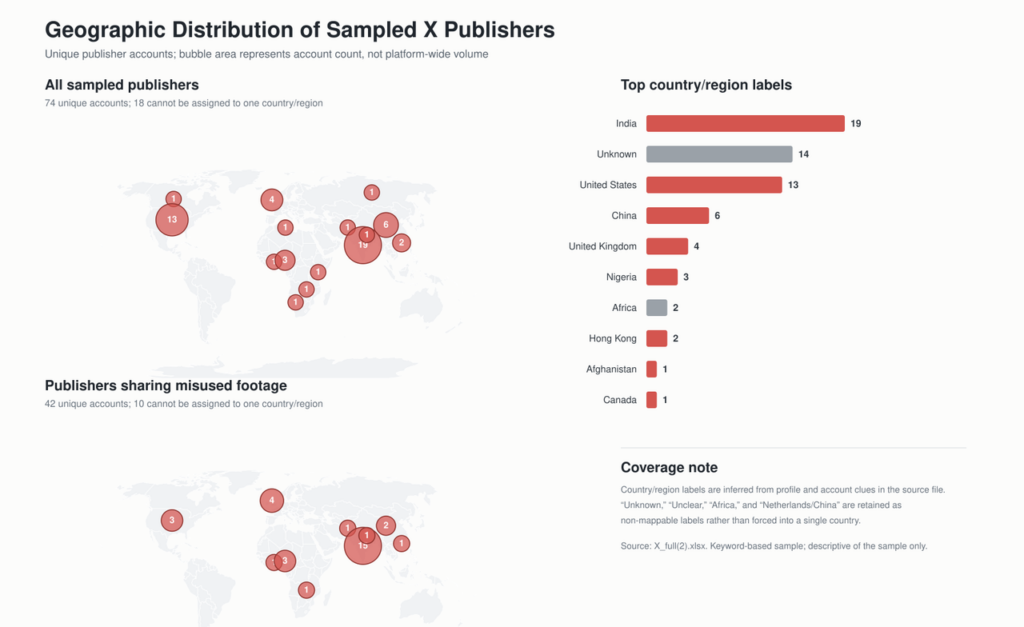
Based on retrievable location information from X profiles, the geographic distribution of relevant users was analyzed through two maps: one covering all identified publishers and the other focusing on users who shared misused footage.
The full sample consisted of 82 posts published by 74 unique X users. India was the most frequently identified location, accounting for 19 users (25.7 percent), followed by 14 users with unclear location information (18.9 percent), 13 from the United States (17.6 percent) and six from China (8.1 percent).
Among the 42 unique X users who shared misused footage, the proportion of India-based users increased to 35.7 percent (15 users). They were followed by four users from the United Kingdom, three each from the United States and Nigeria, and two from China. Although users sharing the misleading footage were associated with multiple countries and regions, India-based accounts represented the largest identified group within this sample.
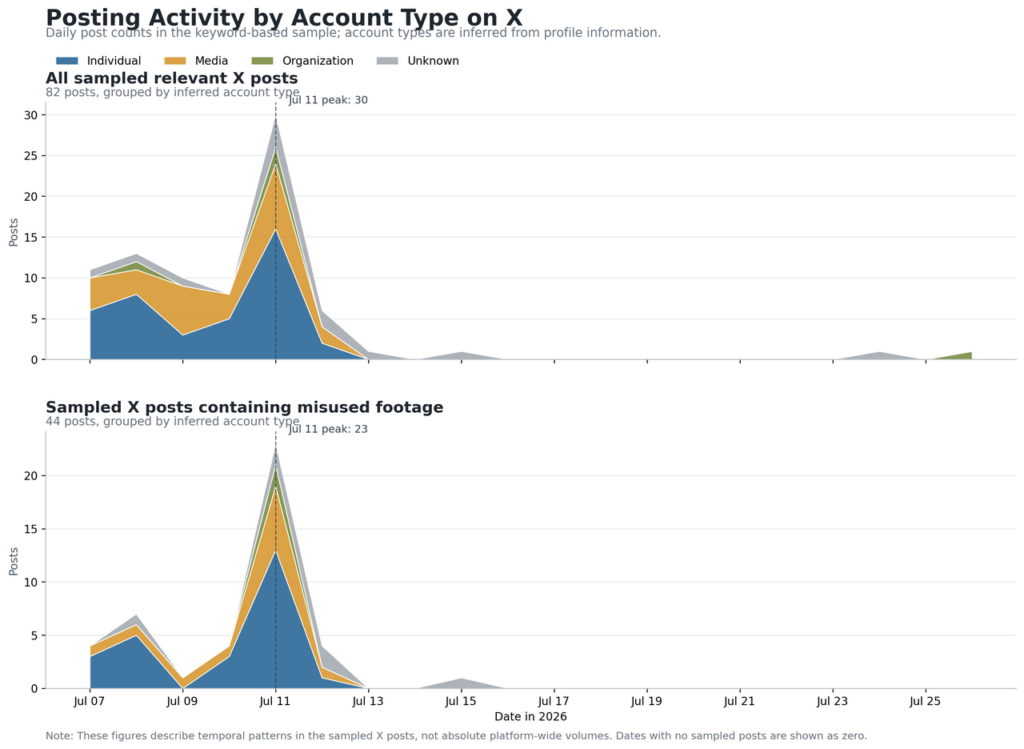
The account types of relevant users were analyzed through two figures: one covering all sampled X posts related to the flood narrative, and the other focusing specifically on posts containing misleading footage.
Posting activity among relevant X users was concentrated between July 7 and 12. Among the 82 relevant posts, individual accounts represented the largest share of activity, accounting for 40 posts (nearly 49 percent), followed by media accounts with 26 posts (31.7%), accounts with undetermined types with 12 posts (14.6%), and institutional accounts with four posts (nearly 5 percent).
Across the full observation period, individual accounts also showed a higher proportion of posts containing misused clips. Among posts published by individual accounts, 25 out of 40 (62.5 percent) involved misused footage, compared with 11 out of 26 (around 42 percent) among media accounts.
Both overall posting and misused-clip circulation peaked on July 11. Individual accounts posted 16 of that day’s 30 relevant posts, 13 containing misused footage (56.5 percent of the day’s total). Media accounts peaked separately on July 9 with six posts, but only one had misused footage. After July 12, activity dropped sharply. The sample shows a short, concentrated cycle, with individual X accounts driving most of the peak.
4.3.2 Characteristics of Major Accounts Disseminating Misused Clips
Selection and Profile of Major Accounts
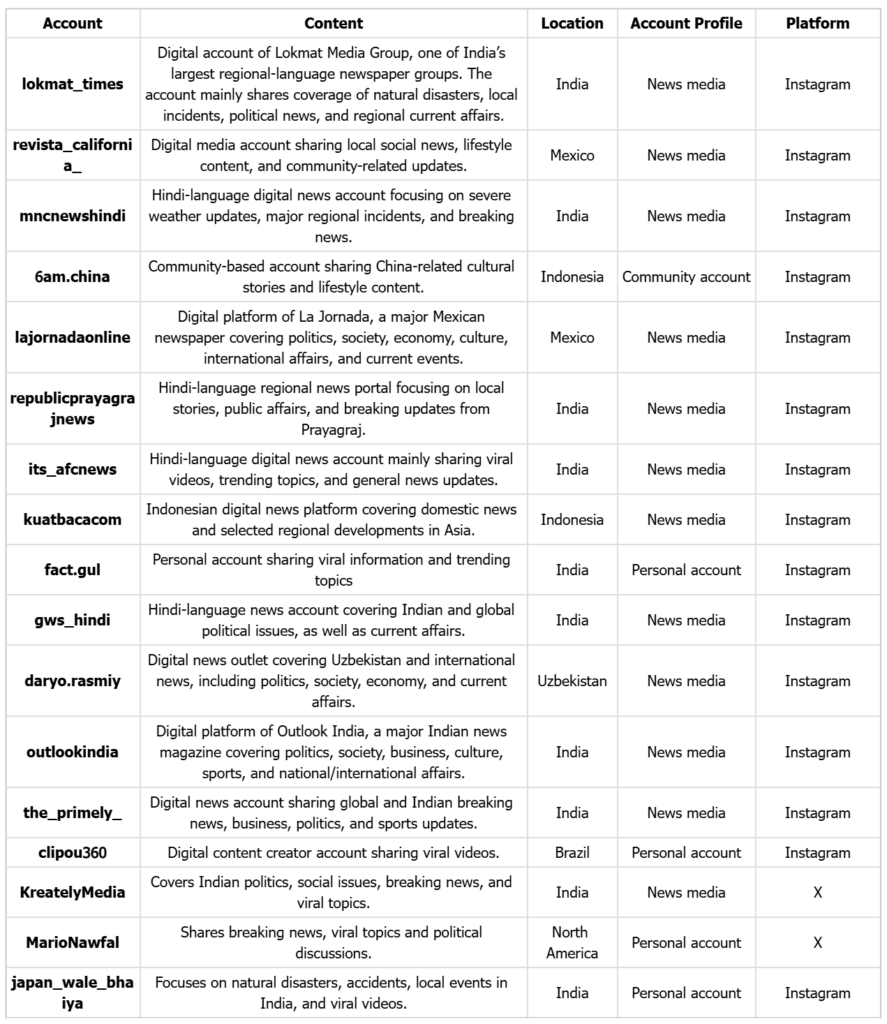
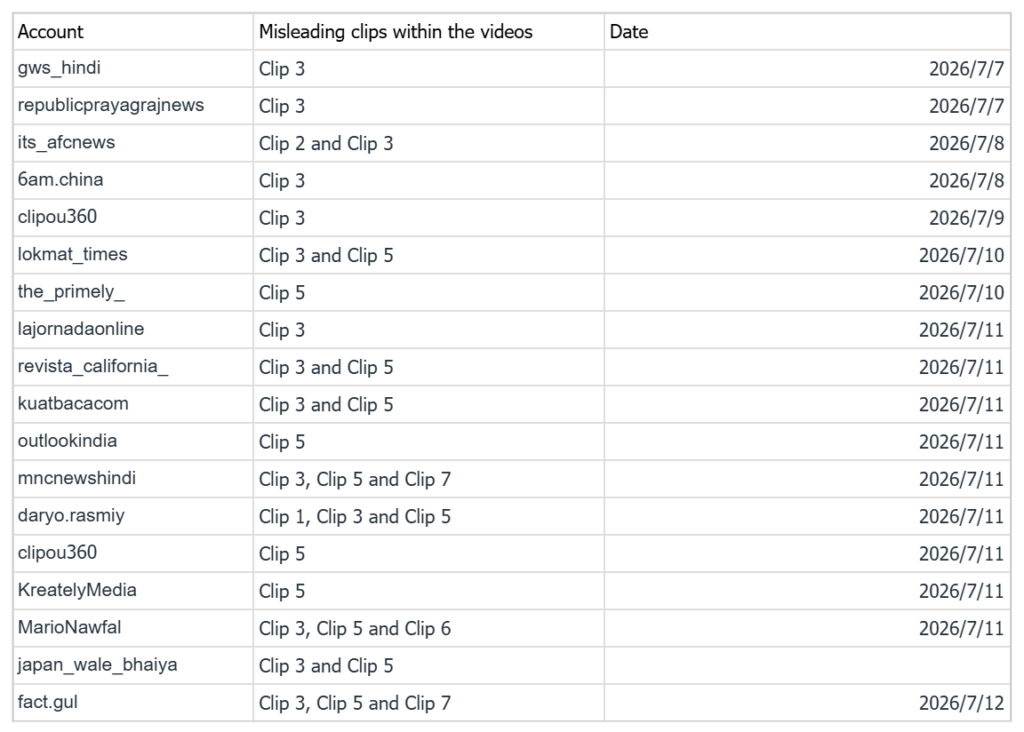
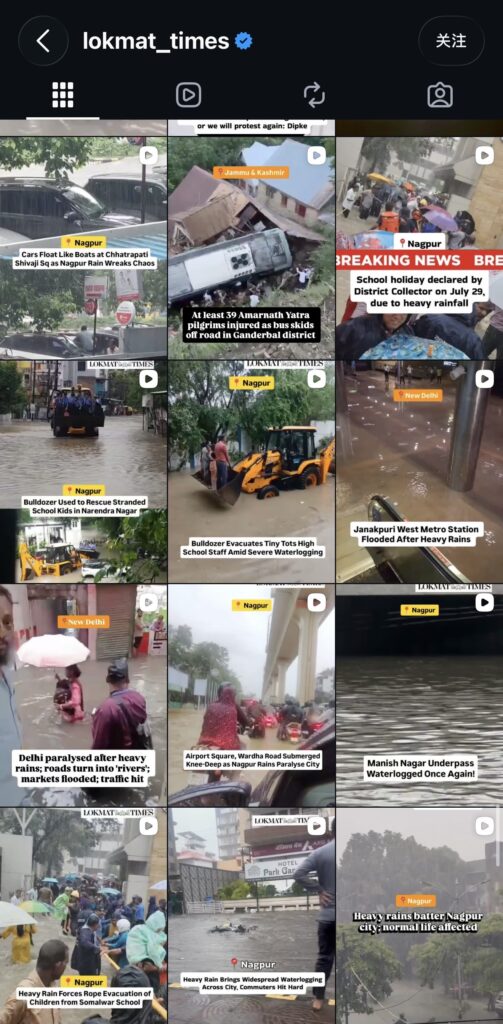
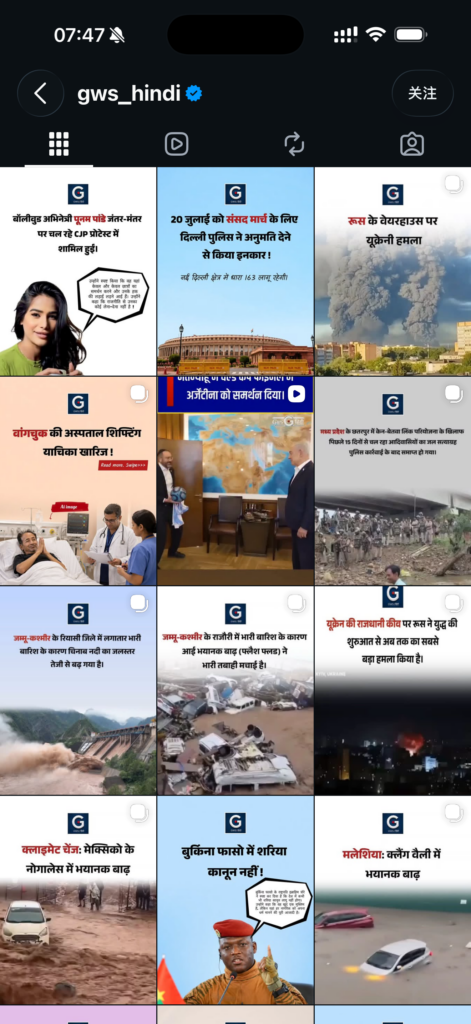
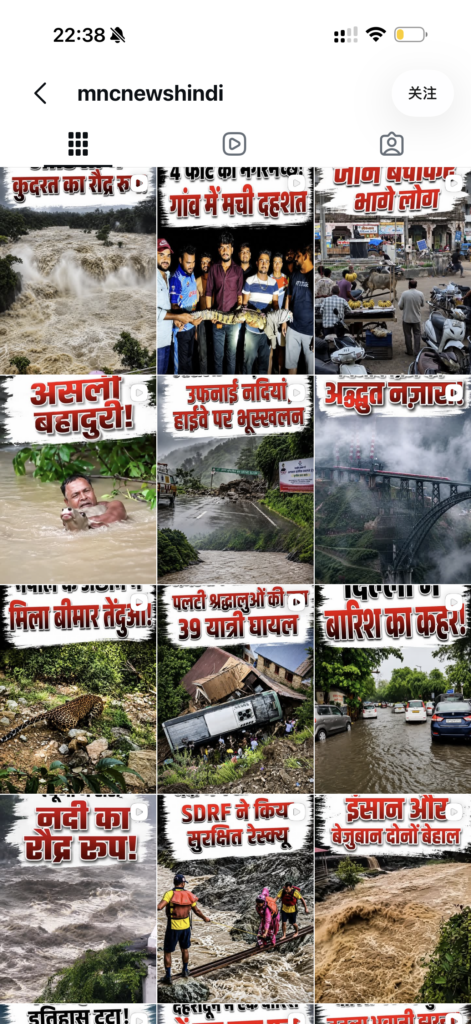
For this analysis, we selected accounts with relatively high engagement. On Instagram, criteria included individual posts with over 100,000 interactions, or accounts that repeatedly posted related content with more than 50,000 interactions. On X, we selected accounts that received over 5,000 interactions and had published such content multiple times. The analysis found that most high-engagement disseminating accounts were based in India and were mostly news media accounts.
The following table presents the account names, content focus, locations, and account positions.
Characteristics of Misleading Flood-Related Content Disseminated by Major Accounts
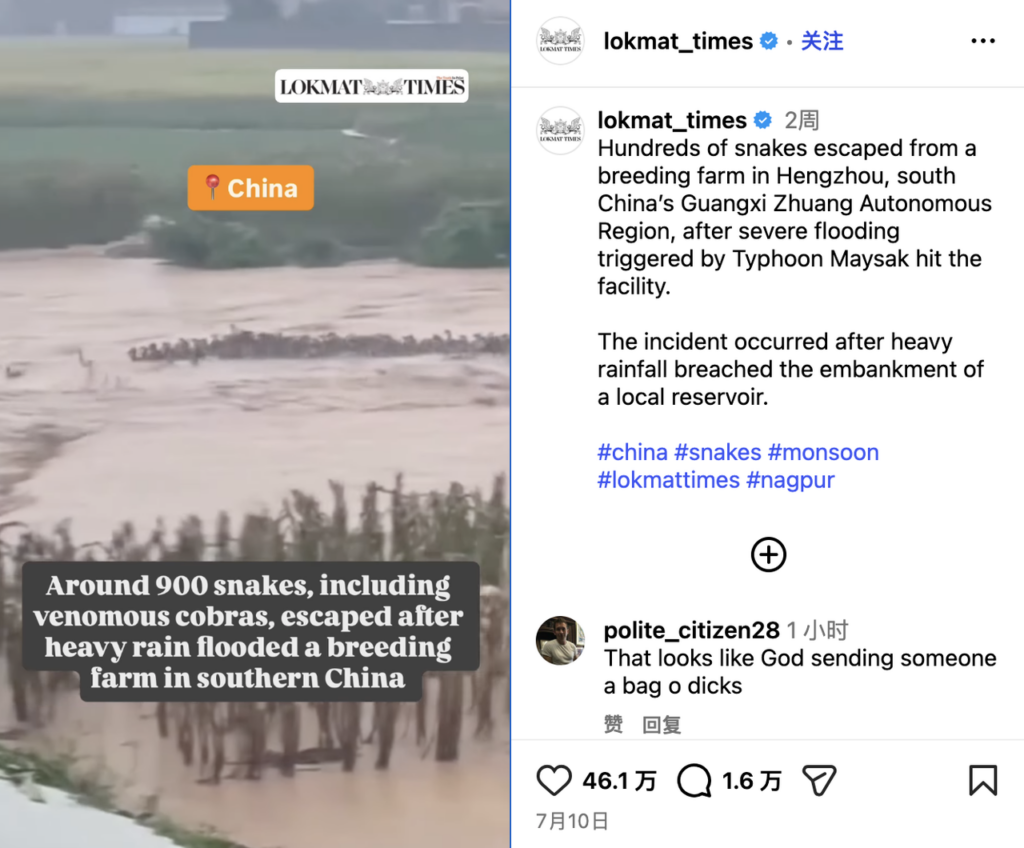
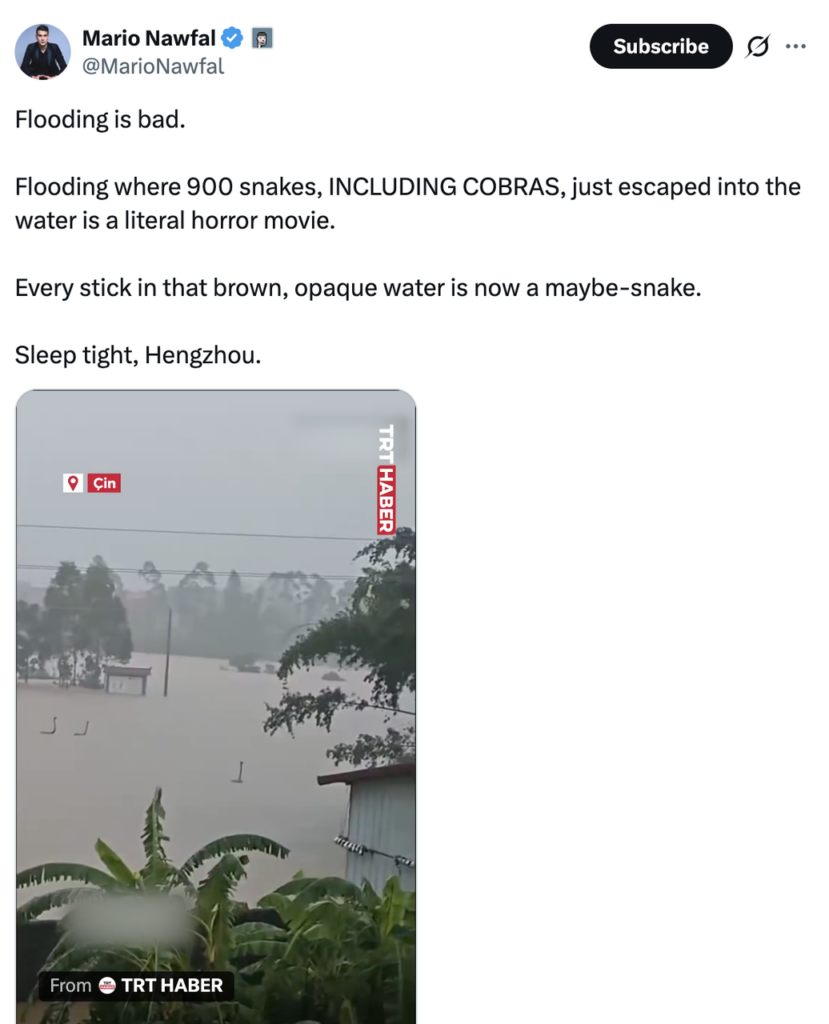
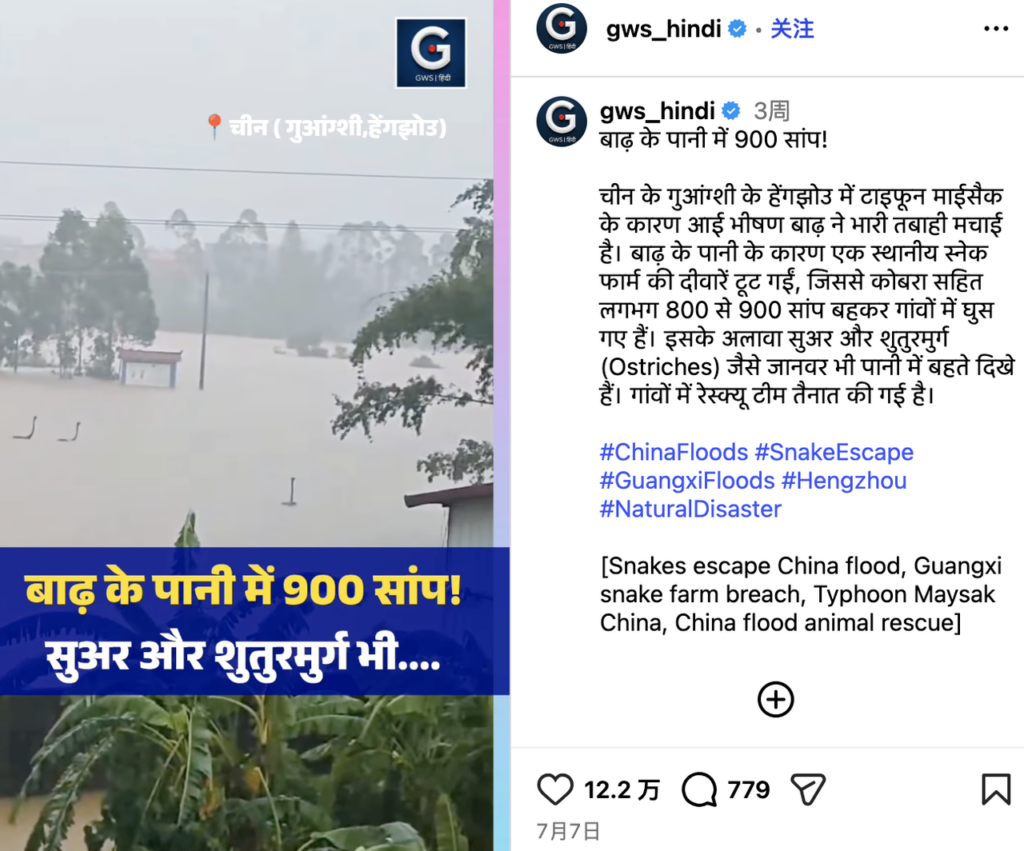
The identified posts consistently focused on the snake escape narrative, mainly emphasizing the claim that “floods caused 900 snakes, including cobras, to escape.”
These posts were secondary reposts that appeared after the relevant clips were first circulated on Instagram or X. For example, ostrich footage (Clip 3) began to appear in misleading posts after the clip was initially circulated on July 7, while duck footage (Clip 5) was incorporated into the narrative after the relevant clip appeared on July 10.
Over time, the misleading narrative expanded through the gradual accumulation and combination of different visual materials. Newly circulated clips were incorporated into the existing claim of “flood-related snake escapes.” The dissemination reached its peak around July 11, when multiple accounts published several related posts within a short period. Meanwhile, dissemination declined after July 12 as fewer new materials emerged.
4.3.3 Possible Factors Contributing to the Dissemination of Misused Clips
The following analysis examines possible factors behind the spread of these misleading videos, based on accounts’ content patterns, locations, and public information.
1)Disaster-related and wildlife content receives attention from some Indian accounts.
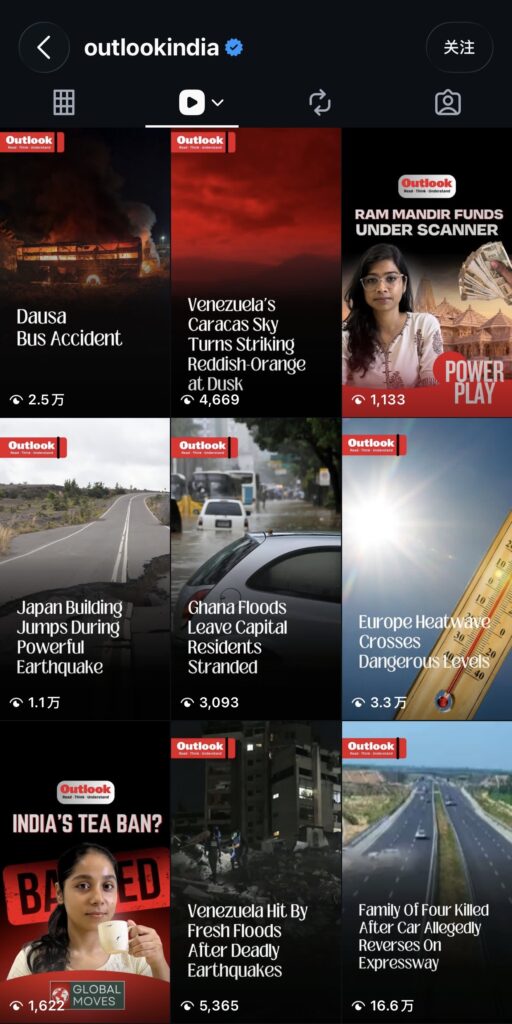
Many of the identified accounts regularly publish content related to natural disasters, floods, wildlife incidents, and emergency events. For example, Indian accounts such as @lokmat_times and @gws_hindi frequently cover domestic floods, extreme weather events, and local emergencies, while @outlookindia also reports disaster-related events from other countries.
2)Disaster context during the dissemination period
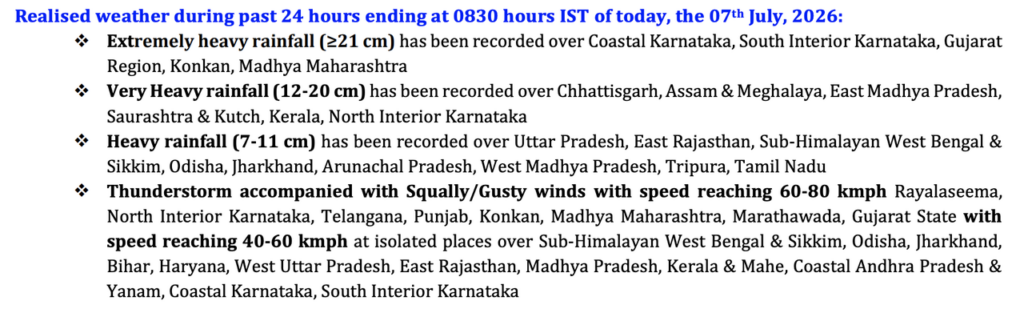
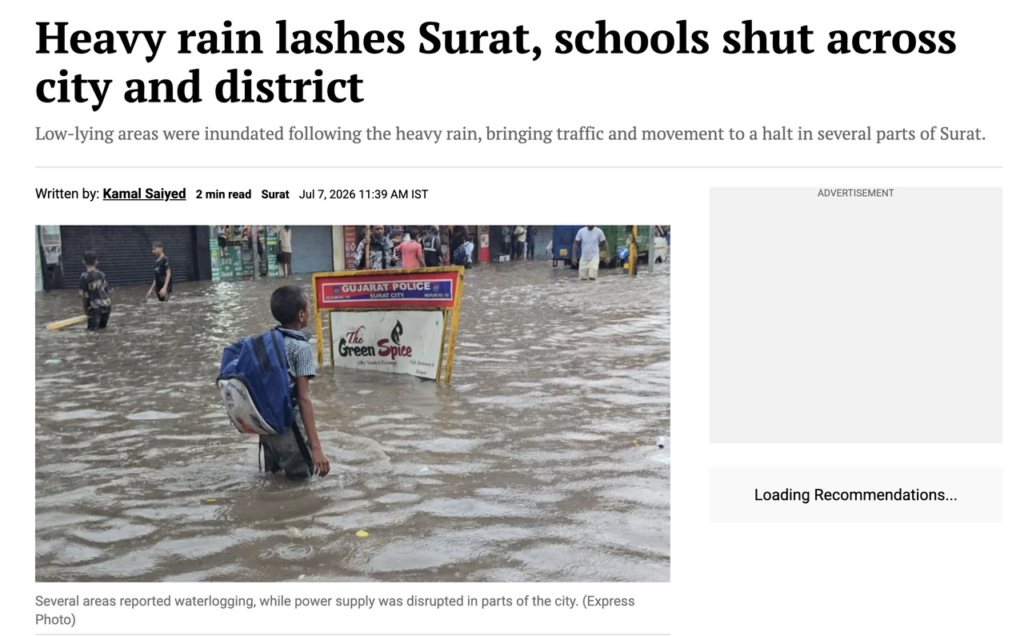
The dissemination period coincided with an active monsoon season in India. According to the India Meteorological Department (IMD) and The Indian Express, extremely heavy rainfall was recorded in several parts of India around July 7, with some areas experiencing flood-related disruptions. This broader disaster-related information environment may have increased the relevance of flood-related content for Indian audiences and media accounts.
3)The content aligned with the accounts’ preference for visually engaging materials.
A review found these accounts frequently share visually striking events, unusual incidents, and topics that have received wide attention. The misused clips align with these content patterns, as they feature disaster scenes, dangerous animals, and strong visual narratives. For example, ostrich footage labeled as snakes, ducks interpreted as snakes swept away by floods, and claims of ‘900 escaped snakes’ all present vivid visuals and dramatic storylines. Once such content gained initial visibility, other accounts reproduced the posts, resulting in increased engagement and further redistribution, which in turn contributed to broader circulation.
Verdict
Misleading
Conclusion
Verification found that some snake farms in Guangxi were damaged by flooding, resulting in the escape of approximately 800 to 900 farmed snakes. However, no evidence was found that crocodile farms were damaged during the floods or that crocodiles escaped from farms into affected areas.
The post combined a real snake escape incident with AI-generated footage, recycled footage from other locations or past events, misidentified animal species, and authentic videos, creating a mixed narrative that combined authentic and misleading content. Footage of crocodiles, ostriches, ducks, fish, and soft-shelled turtles was circulated as evidence of “escaped snakes or crocodiles.” Through dissemination across multiple platforms, these materials contributed to a narrative that the Guangxi floods had caused large-scale escapes of dangerous reptiles.
This post is an example of misleading information that combines footage from different sources with both factual and unrelated content and illustrates the dangers of how a real incident can be combined with unrelated footage to create a narrative that extends beyond what the available evidence supports.
Readers are advised to trace the original sources when assessing such information and to interpret visual materials assembled from multiple sources with the appropriate caution.
Have a questionable video or claim? Submit it to Fact Hunter’s investigation team at [therealfacthunter@outlook.com].
Primary Fact Checkers: Huang Yiting, Xu Xinying, Lin Jun
Secondary Fact Checker: Chen Hiotong
- https://www.news.cn/local/20260707/ba2ba289e86b443695c2b0e06f3bb79a/c.html
- https://www.news.cn/20260708/552764f57f25477587272b820d9724e3/c.htm
- https://www.news.cn/politics/20260708/1db47f4e0ff14918b7aaf6e00c589ca1/c.html
- https://mausam.imd.gov.in/Forecast/marquee_data/Press%20Release%2007-07-2026.pdf