Last updated on June 8th, 2026
Editor's Note
In early 2026, tensions among the United States, Israel, and Iran escalated into a conflict with significant regional and international implications. From late February to early May, a series of related military and diplomatic developments coincided with the circulation of misleading and contested information across online platforms. Within this information environment, AI-generated misinformation became a recurring category within the broader information environment, characterized by realistic presentation, rapid dissemination, and the use of emotionally salient themes.
This report examines AI-generated misinformation related to the 2026 U.S.–Israel–Iran conflict. Fact Hunter compiled a cross-lingual corpus of 135 fact-checking samples published by 11 fact-checking organizations in 10 languages. Covering the period from February 28 to May 5, 2026, the analysis focuses on the forms, themes, emotional framing, source attribution, and verification methods associated with synthetic misinformation during the conflict.
By documenting the misinformation patterns and fact-checking practices observed in this case, the report aims to provide empirical insight into the role of AI-generated content in conflict-related information environments. It also identifies practical considerations for fact-checking organizations, platform governance, and broader efforts to strengthen information resilience during crises.
Part Ⅰ: How We Built the Analysis
1.1 Data Collection
We constructed the corpus through a two-track strategy. The primary track queried the Google Fact Check Tools API across 17 keyword combinations spanning conflict terms (Iran, Iran Israel, Iranian missile, Khamenei, etc.) and AI-disinformation terms (AI Iran, deepfake Iran, synthetic media Iran, etc.).
These records then passed through a three-stage filter chain:
(1)Regex screening
A regex screen based on 70 multilingual keyword patterns was used to identify AI-relevant fact-checking reports.
(2)Temporal filtering
Reports were retained only if their publication dates fell within the study window: 2026-02-28 to 2026-05-01.
(3)Publisher filtering
The dataset was further limited to reports published by internationally recognized fact-checking organizations, identified through domain-matching and name-alias rules.
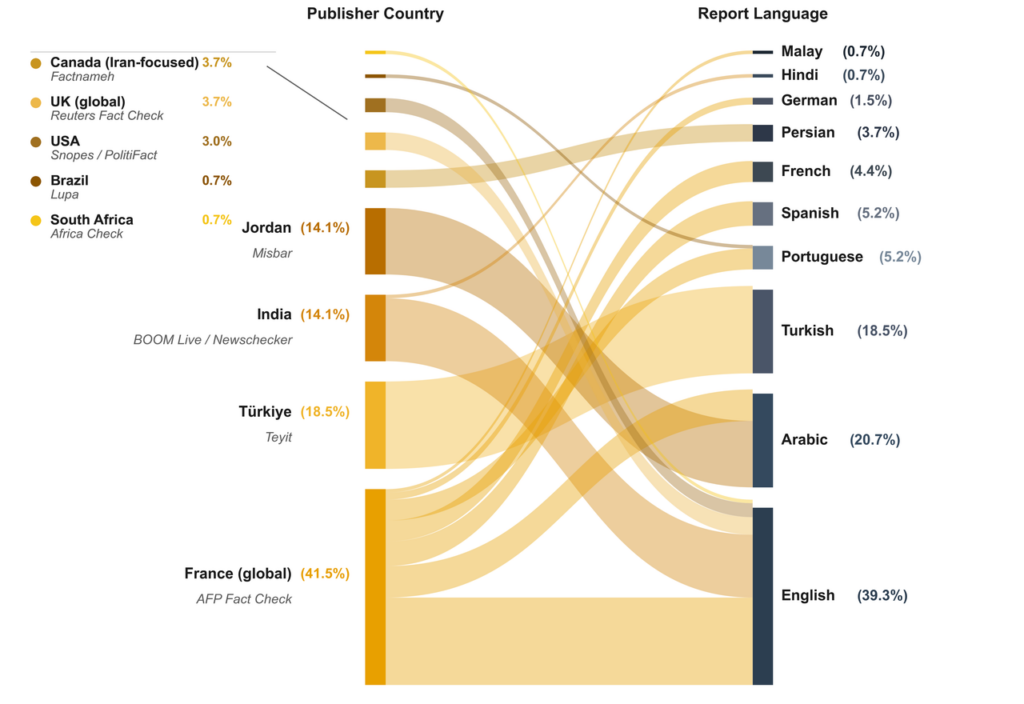
A second track manually collected reports from organizations that fell outside Google’s indexing or actively blocked scraping, following the same data schema as the API track. All non-English report title, claim text, and report body fields were machine-translated into English in place, while the original language code was preserved as a separate field. The final analytical corpus comprises 135 samples, drawn from 11 fact-checking organizations based in countries across Europe, North America , South Asia, Mena, Africa, Latam, originally published in 10 languages, including English, Arabic, Persian, Turkish, Spanish, Portuguese, French, German, Hindi, Malay.
1.2 Data Analysis
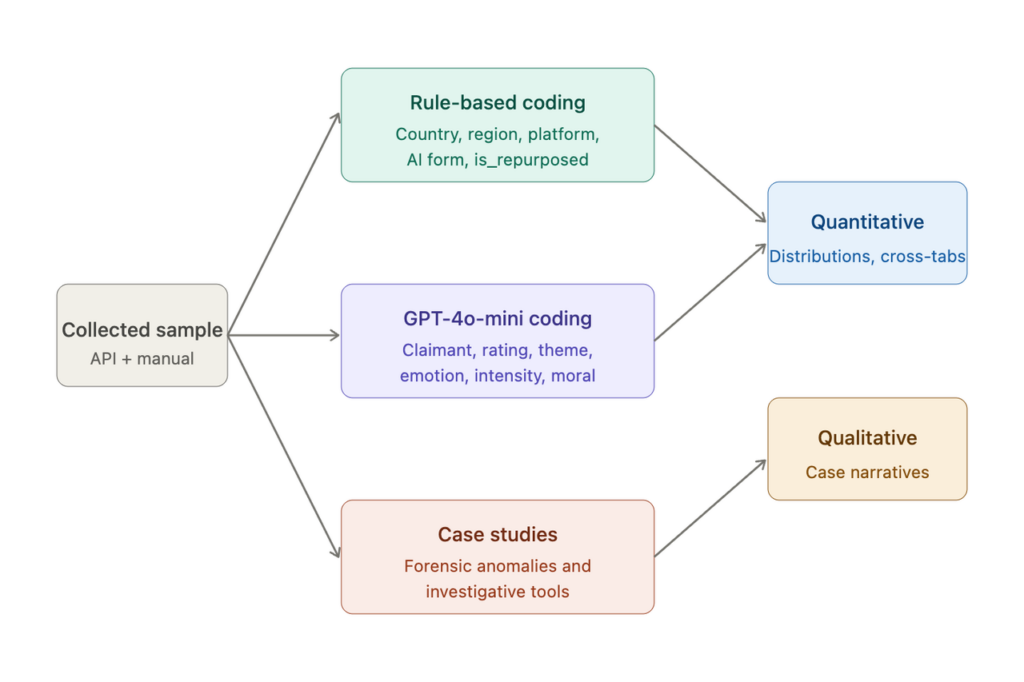
The analysis proceeded in three steps, described in turn below: rule-based coding of deterministic fields, GPT-4o-mini labeling of interpretive fields, and qualitative case studies of representative incidents.
(1)First Step: Rule-based Coding
Each sample was coded along five analytical dimensions(publisher metadata, claim attribution, formal characteristics of the AI fabrication, thematic content, and emotional-moral framing)using two complementary methods. Fields derivable through deterministic lookup or pattern matching (publisher country/region, originating platform, AI form, repurposing) were assigned through curated mapping tables and regex rule sets.
(2)Second Step: API Labeling
Fields requiring contextual interpretation (claimant, claimant type, rating standardization, theme, dominant emotion, polarity intensity, and moral appeal) were labeled by the GPT-4o-mini API with engineered system prompts containing anchored definitions, closed value sets, and 5–8 few-shot examples; all calls used temperature=0 and outputs were strictly validated against allowed values.
(3)Third Step:Case Studies
Beyond aggregate statistics, we conducted in-depth case studies of representative samples spanning the major AI fabrication forms and dominant thematic clusters, tracing for each case the original claim, the forensic anomalies that triggered suspicion , and the investigative tools fact-checkers deployed— complementing the quantitative findings with granular insight into how AI-fabricated conflict content is actually refuted.
Part II: Analysis of AI-Generated Misinformation
2.1 Format and Theme: What Was Fabricated
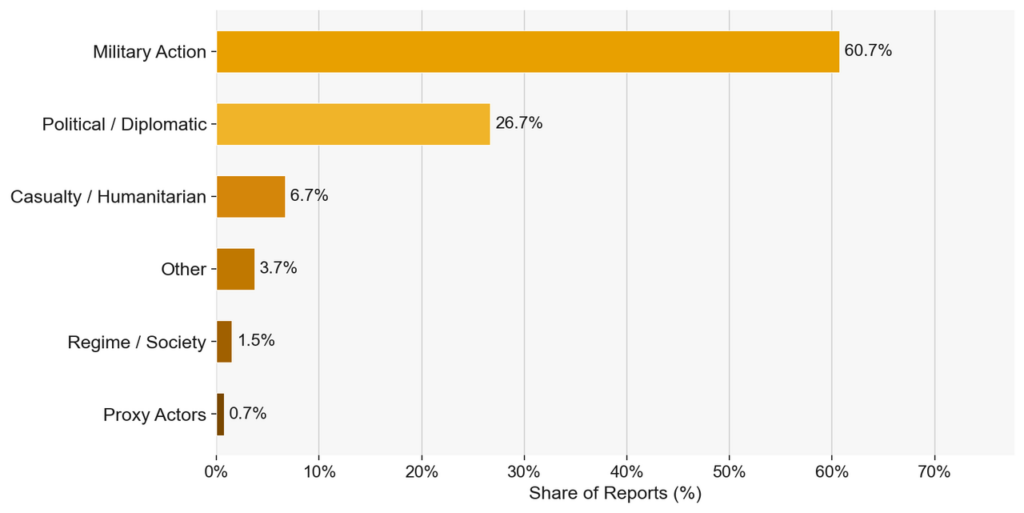
During the February–May 2026 conflict, Fact Hunter collected hundreds of AI-generated media items circulating across social platforms and messaging apps. The dataset shows a clear shift in format: short video(39.3%) had become the dominant carrier of synthetic misinformation. Across different subject matters, a clear hierarchy emerged. Military action was the dominant theme, far outpacing political or humanitarian content.
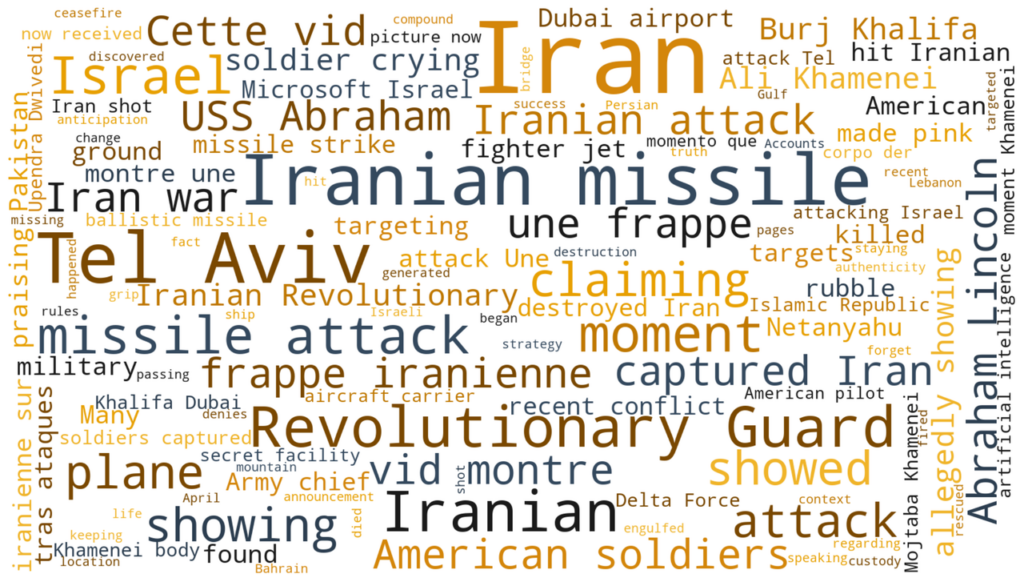
The language of the false claims relied heavily on recognizable place names, iconic landmarks, and military symbols. These references gave fabricated content an immediate sense of location, scale, and geopolitical significance.
Across the corpus, the most frequent terms included Tel Aviv, Tehran, the Burj Khalifa, Dubai Airport, the Abraham Lincoln, the Revolutionary Guard, ballistic missiles, and named senior figures from both sides.
2.2 Polarity and the Theme-Emotion Coupling
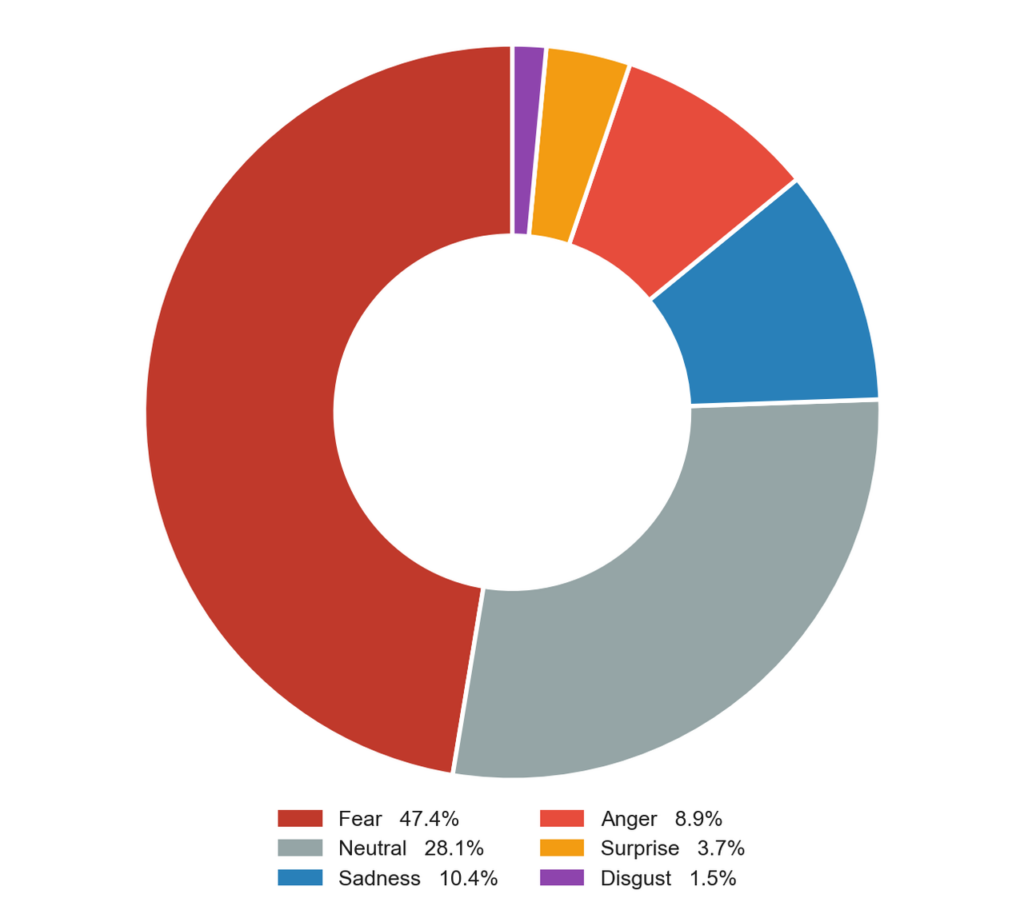
When it comes to emotional appeal, fear was by a wide margin the dominant emotional register, followed by a strategically crafted “neutral” tone. Nearly half of all fabrications were designed to provoke dread, depicting incoming missiles, mushroom clouds over residential cities, or naval vessels on fire. Fear is especially effective in conflict-related misinformation because it compresses attention and decision-making: audiences are more likely to share alarming content quickly when they perceive an immediate threat to civilian life, national security, or regional stability. In this sense, fear-based fabrications exploit the crisis environment itself, turning uncertainty into a trigger for rapid circulation.
The misinformation ecosystem was shaped less by emotion itself than by emotional intensity. Strongly and extremely charged items dominated the sample, while mild or moderate fabrications appeared far less frequently. These high-intensity fakes used heightened language, dramatic visuals, and catastrophic scenarios to maximize attention and encourage rapid sharing.
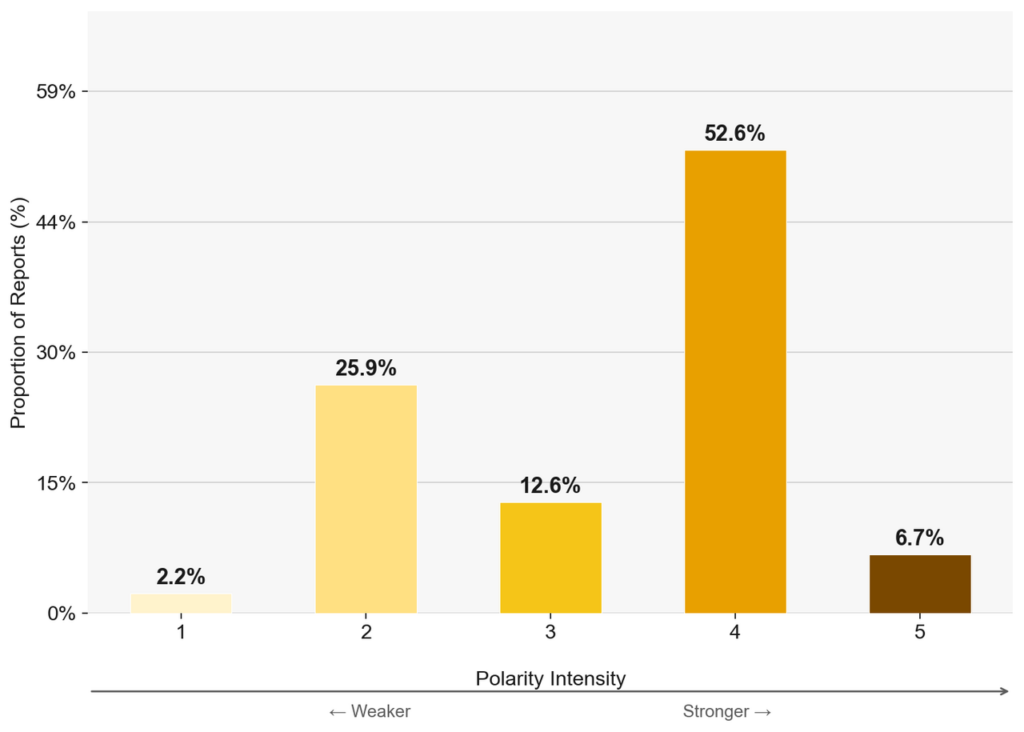
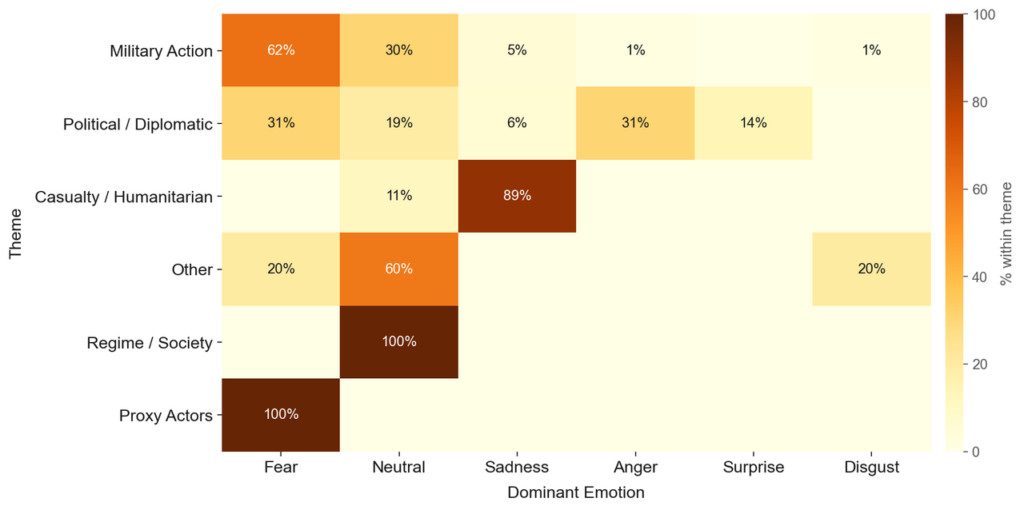
Figure 7 shows how dominant emotions varied across different misinformation themes. Rather than being evenly distributed, emotions were closely tied to the subject matter of the fabricated content. Several patterns stand out:
- Military Action was strongly associated with fear. This suggests that military misinformation mainly relied on threat perception to capture attention and encourage rapid sharing.
- Political / Diplomatic content showed a more mixed emotional profile. Such diversity suggests that political fabrications used multiple emotional routes: fear to create insecurity, anger to intensify blame, and neutral language to appear credible.
- Casualty / Humanitarian fabrications were overwhelmingly linked to sadness.
The goal was less to create immediate panic than to generate sympathy, grief, or moral outrage.
2.3 The Moral Architecture and Thematic Targeting
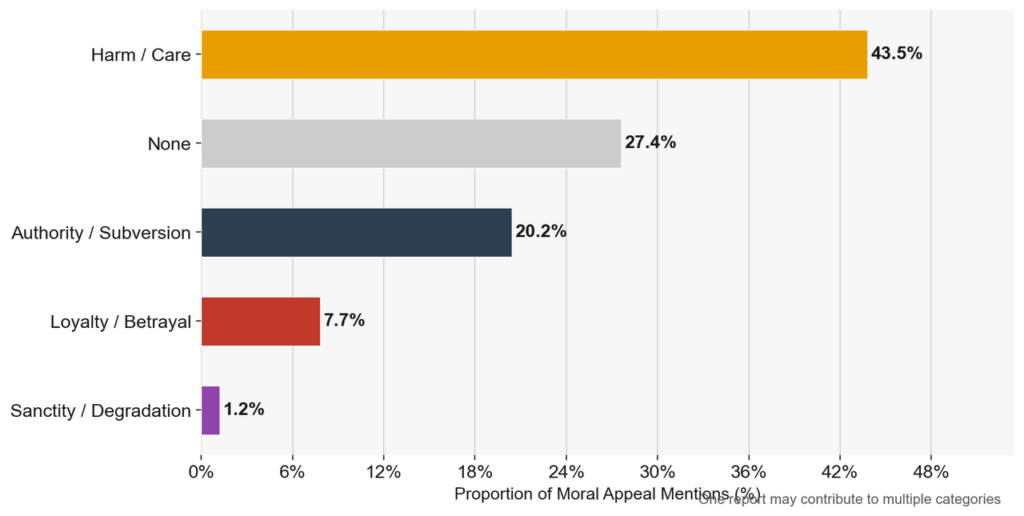
To understand the persuasive structure of these fakes, an analysis of moral appeals was conducted using Moral Foundations Theory. The Harm/Care foundation was the most frequently invoked moral appeal, reflecting the war-related nature of most content.
As expected, most fakes raised the threat of harm to civilians, soldiers, or sovereign territory. Authority/Subversion ranked second. Loyalty/Betrayal formed a smaller but still significant cluster. Sanctity/Degradation was rarely present. A meaningful number of cases carried no clear moral appeal at all, relying purely on shock value.
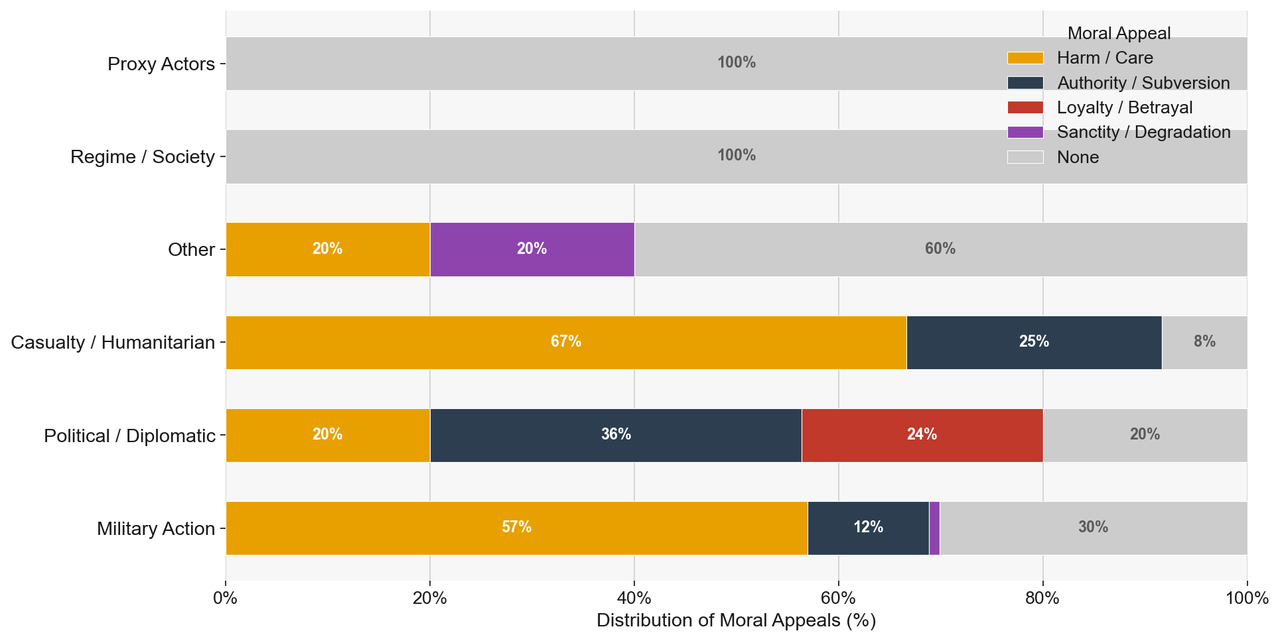
Different thematic categories drew on different moral foundations. Military action fakes leaned almost exclusively on Harm/Care, while political and diplomatic fakes mobilized a broader moral palette.
2.4 Claimant Identity: Sources of Fabricated Content
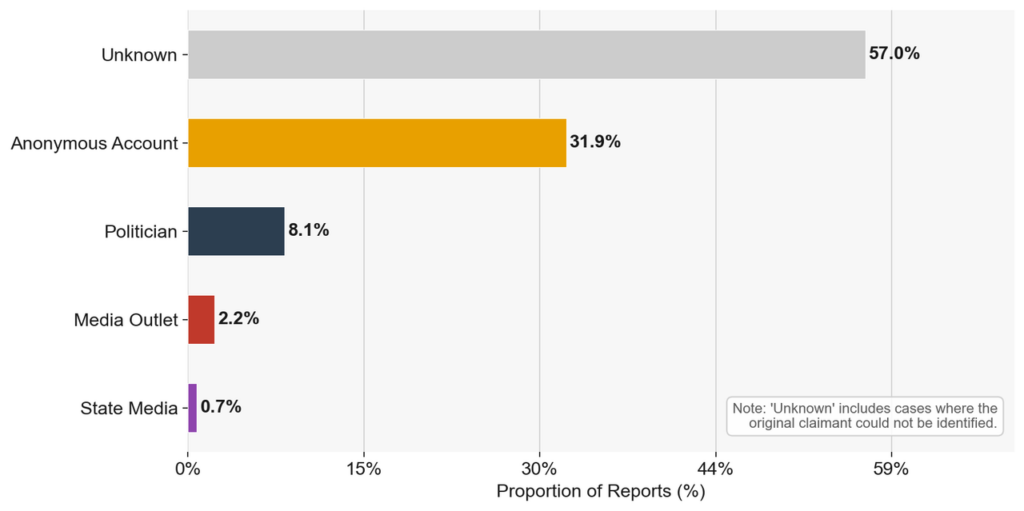
The most fundamental question in misinformation research is who created the false content. The original sources of the majority of fabrications could not be identified at all. In most cases, even after professional fact-checking, the original creator of the false content could not be traced. These cases were coded as Unknown in the dataset. Anonymous accounts on social platforms accounted for the next largest share. This means that the overwhelming bulk of AI misinformation in this confrontation came from sources without verifiable identity.
Part Ⅲ: The Fact-Check Counter-Offensive
3.1 Response Speed: How Long Does Truth Take
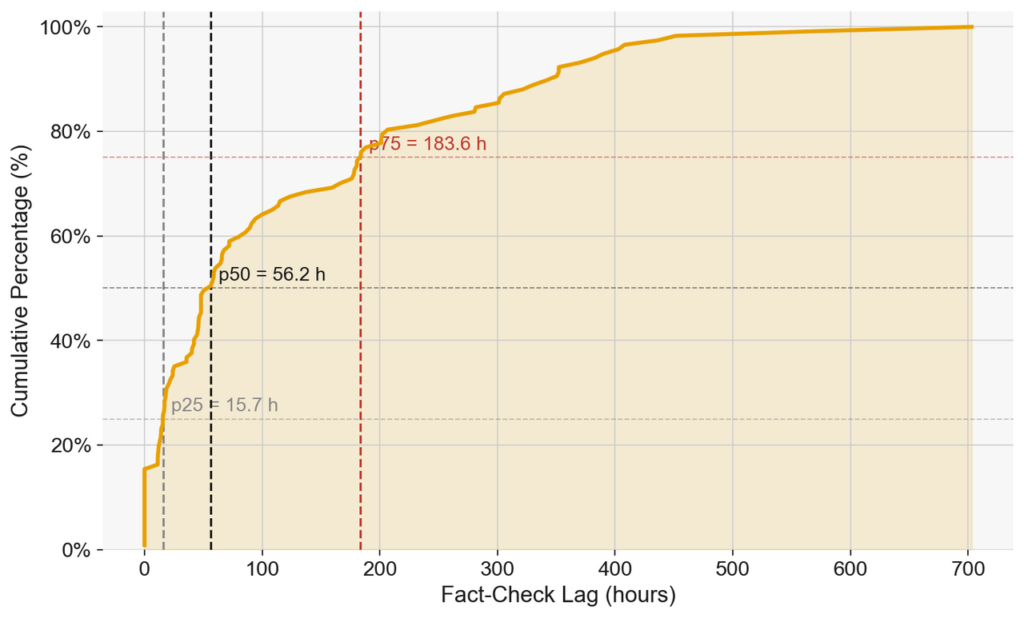
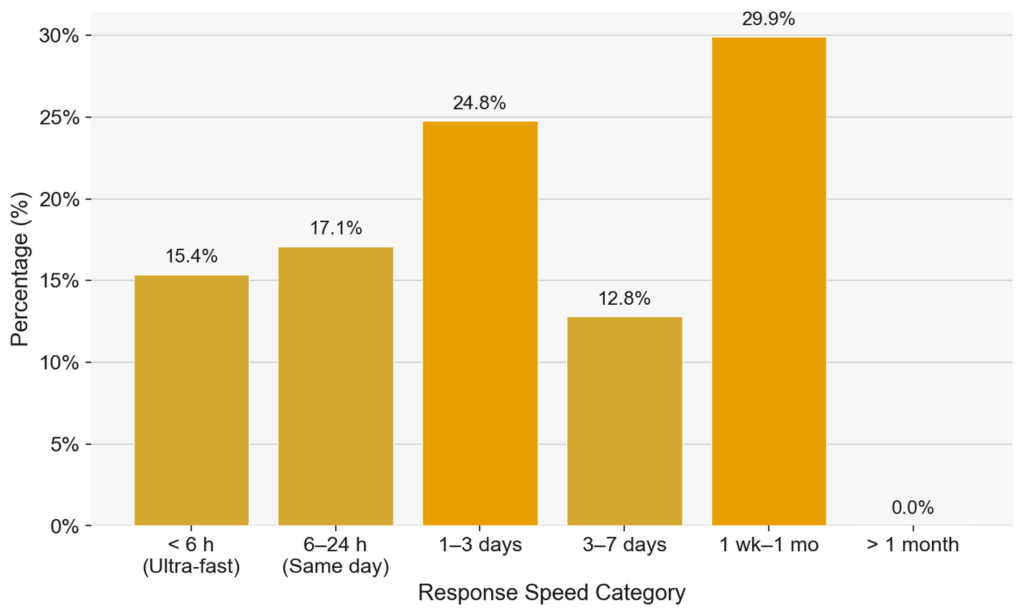
Based on an analysis of response speed, we found that 25% of misinformation cases were debunked within 15.7 hours, corresponding to the 25th percentile, while 50% were debunked within 56.2 hours, corresponding to the median. After 100 hours, the cumulative distribution curve flattens markedly, indicating that a substantial share of misinformation continued to circulate for days or even weeks before being fact-checked.
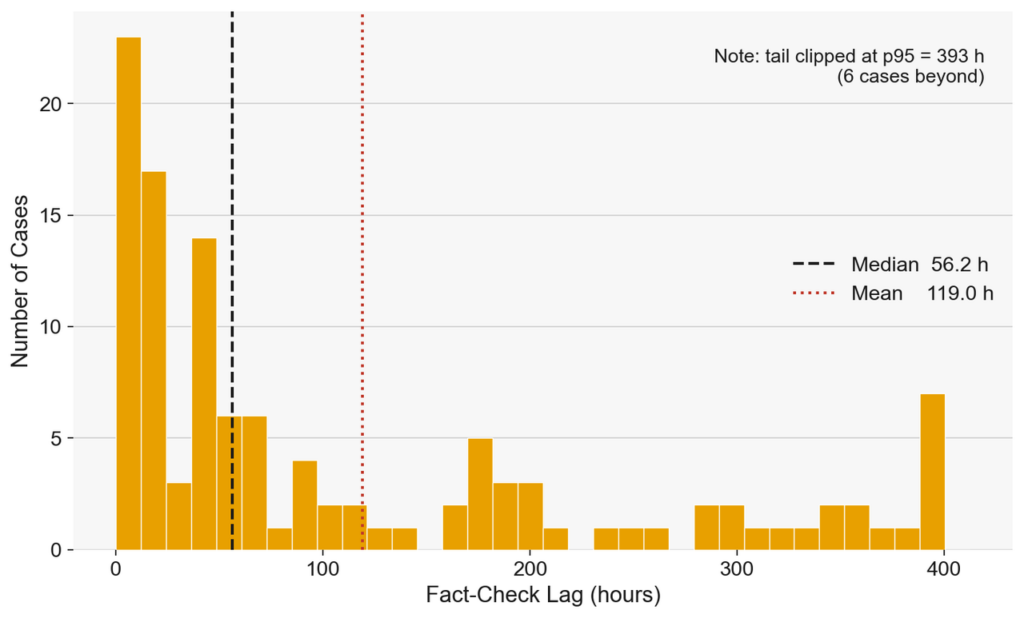
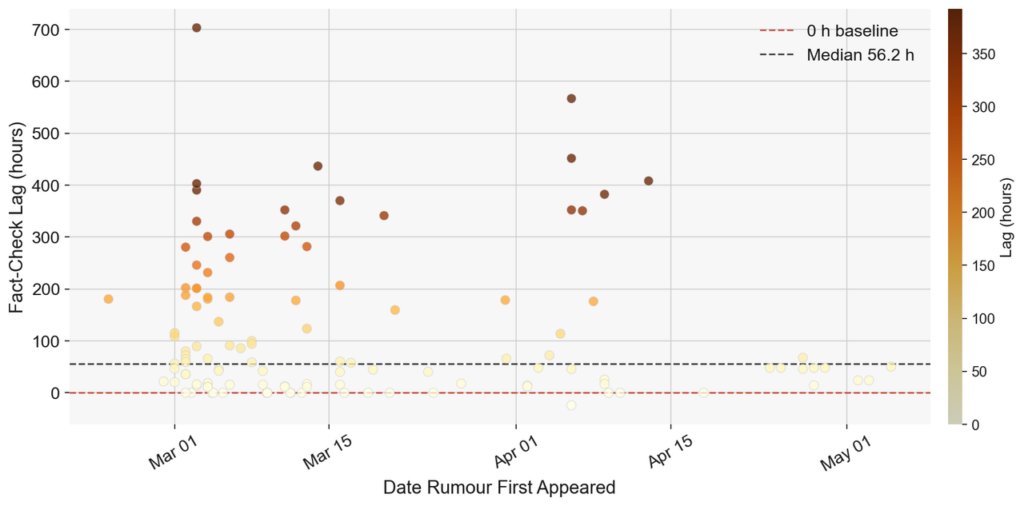
The scatter plot shows a relatively clear improvement over time. High-lag cases were concentrated mainly in late February and early March, while misinformation cases identified in April and May were mostly clustered below the median line. This suggests that, as the conflict progressed, fact-checking organizations gradually adapted to recurring fabrication patterns, developed reusable verification templates, and coordinated the use of relevant tools across networks.
3.2 Case Studies in Fact-Check Strategy
Beyond raw speed, the more practically useful question is how fact-checkers debunked AI fabrications during this confrontation. Drawing on the most-cited cases in our dataset, we identify five recurring methodologies, each of which deserves a name and an illustrative case.
3.2.1 AI Detection Tools in Synthetic Media Verification
As AI-generated content grows increasingly sophisticated, fact-checkers have turned to automated detection platforms as a frontline verification tool. These tools, including Google’s SynthID Detector, Hive Moderation, AI or Not, Deepfake-o-Meter, and Hiya Deepfake Voice Detector, analyze visual, structural, and acoustic signals to assign a probability score indicating whether media is synthetically generated. Within the U.S.–Israel–Iran conflict, this approach has been applied across two primary media types: visual content and audio.
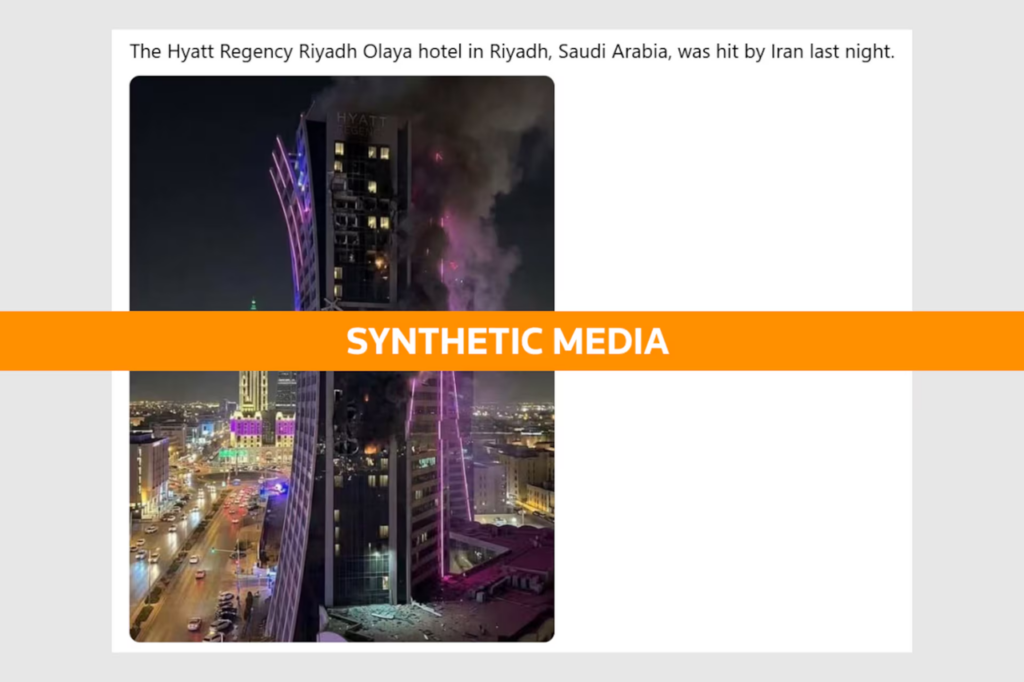
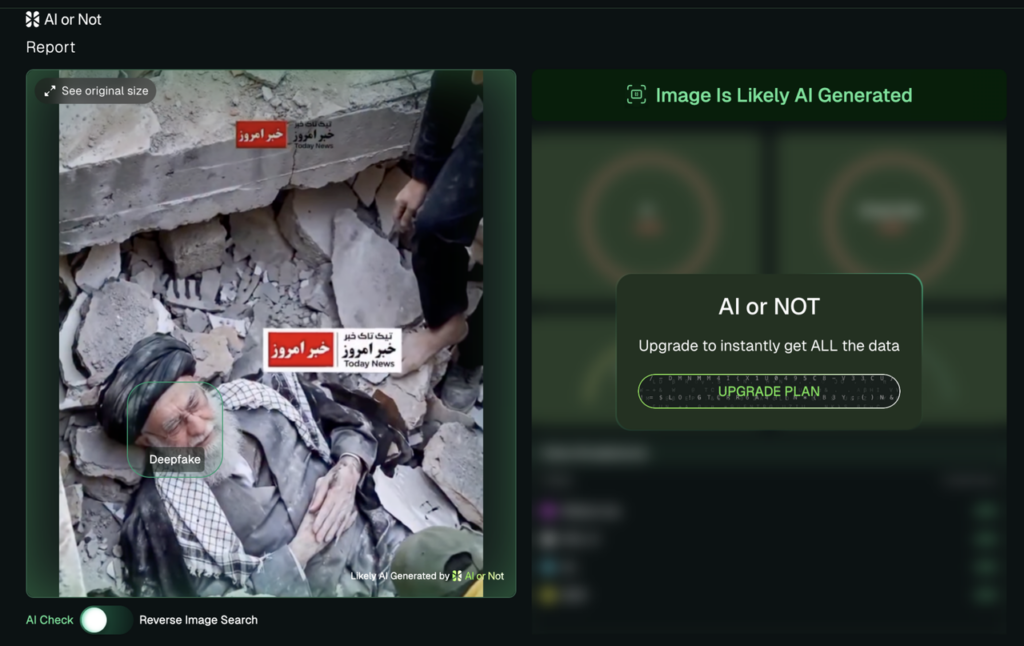
Visual detection consistently produced high-confidence findings when multiple tools were applied in combination. When an image circulated purportedly showing the Hyatt Regency hotel in Riyadh engulfed in smoke following an Iranian missile strike, Reuters submitted it to Google’s SynthID tool, which returned a “very high” confidence finding of AI generation. Similarly, when a video claimed to show rescue teams recovering Khamenei’s body from rubble, Agência Lupa’s analysis using SynthID Detector indicated AI generation, corroborated by AI or Not, with additional contextual support from the absence of any officially released imagery.
Audio detection applied the same multi-tool logic, yielding equally definitive results. When a video purportedly showed Indian MP Shashi Tharoor criticizing his government’s handling of the conflict, BOOM submitted a voice sample to Hiya Deepfake Voice Detector, which returned a low authenticity score. Cross-checking by other outlets using Hive Moderation reported the audio as 98.3% likely AI-generated.
Despite its utility, AIGC detection remains largely reactive: tools can flag content with high confidence, but typically only after it has already accumulated millions of views. Accuracy also varies across media types and compression levels, and no single tool offers a definitive universal verdict.
3.2.2 Human Perceptual Inspection:Visual and Auditory Analysis
Human perceptual inspection involves the direct perceptual scrutiny of media content to identify signs of synthetic generation without relying on automated tools. The method draws on trained attention to physical and logical inconsistencies — in anatomy, lighting, physics, and sound — that AI systems frequently produce, offering qualitative judgment that contextualizes signals automated tools may miss.
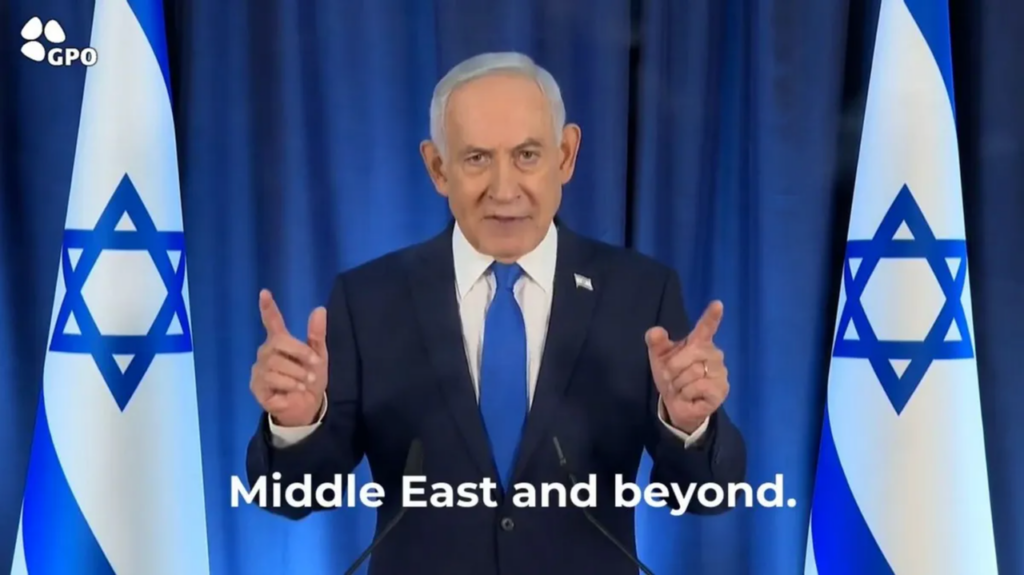
Visual inspection serves a dual function: detecting genuine AI artifacts while guarding against false positives. When a Netanyahu speech video circulated with claims of a six-fingered hand and fabricated footage, Snopes’ review of the original Government Press Office broadcast found five fingers on each hand, with the apparent anomaly identified as the hypothenar eminence. Factnameh debunked a purported Iranian strike on Tel Aviv through frame-by-frame analysis, flagging cars freezing mid-scene and a physically unattached floating flag. Misbar identified an image of an alleged Houthi missile city as AI-generated through illogical lighting, exaggerated structural repetition, and unrealistic object-background blending.
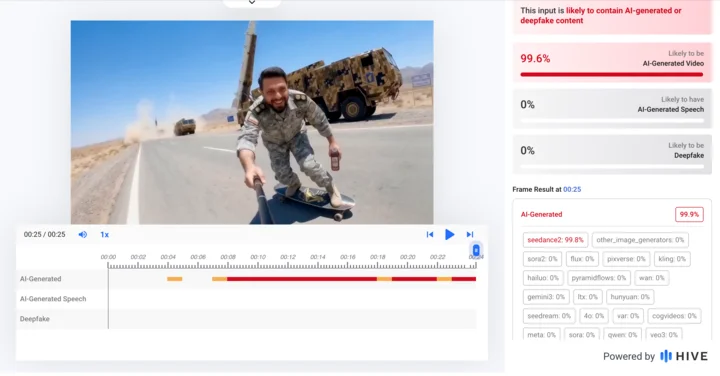
Auditory inspection applies the same reasoning to acoustic evidence. Teyit’s analysis of a video purportedly showing IRGC-linked soldiers launching missiles noted that figures remained completely still despite the vibration, noise, and shockwave a real launch would produce. Sound and image were mismatched, and the launch appeared implausibly symmetrical — observations corroborated by an AI detection tool returning a 99.6% synthetic probability.
Human perceptual inspection, while essential, is inherently limited by observer experience and subjectivity. As generative models improve, artifacts become subtler and less reliably detectable by the unaided eye or ear, underscoring the need for complementary verification methods.
3.2.3 Reverse Image Search as a Provenance Tracing Method
Reverse image search enables fact-checkers to trace the origin and circulation history of a visual by querying it against indexed image databases, thereby revealing recycled footage, misattributed imagery, or AI-generated visuals with no traceable real-world source.
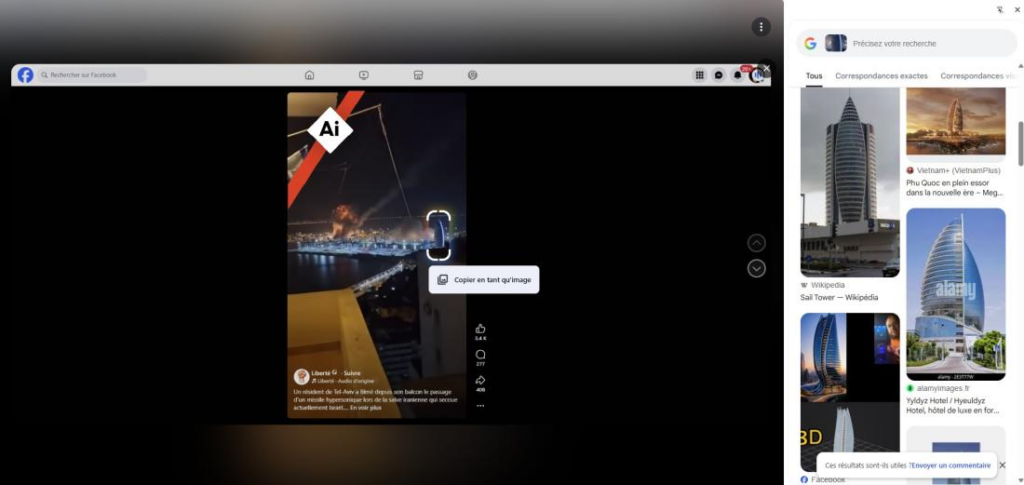
For example, when a video circulated claiming to show Iranian fighter jets bombing areas near Dubai’s Burj Khalifa, Newschecker’s reverse image search of key frames returned no credible matching reports. Cross-referencing the depicted environment against Google Street View from all four directions further revealed that the tower appeared in near-isolation, contradicting the densely built real-world surroundings — confirming the footage as AI-generated. In a separate case, AFP searched a distinctive shell-shaped skyscraper visible in a video purportedly showing Iranian missiles striking Tel Aviv. Results pointed to structures in Dubai and Ashgabat rather than Tel Aviv, with the closest match identified as the Sail Tower in Haifa — consistent with Hebrew-language audio in the video referencing Haifa, not Tel Aviv. DeepFake-O-Meter further returned a 100% synthetic audio probability.
3.2.4 Expert Forensic Analysis and Cross-Domain Consultation
Expert forensic analysis engages specialists, including digital forensics academics, weapons analysts, and domain-specific subject-matter experts, to assess media authenticity beyond what automated tools can conclusively determine, serving as a qualitative verification layer alongside tool-based detection.
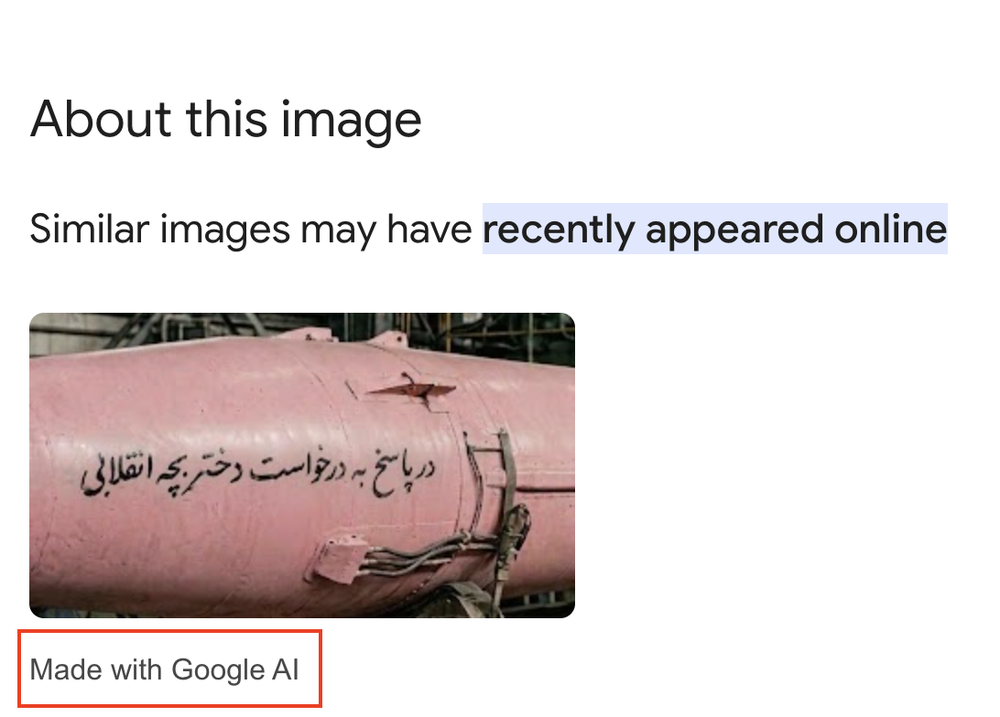
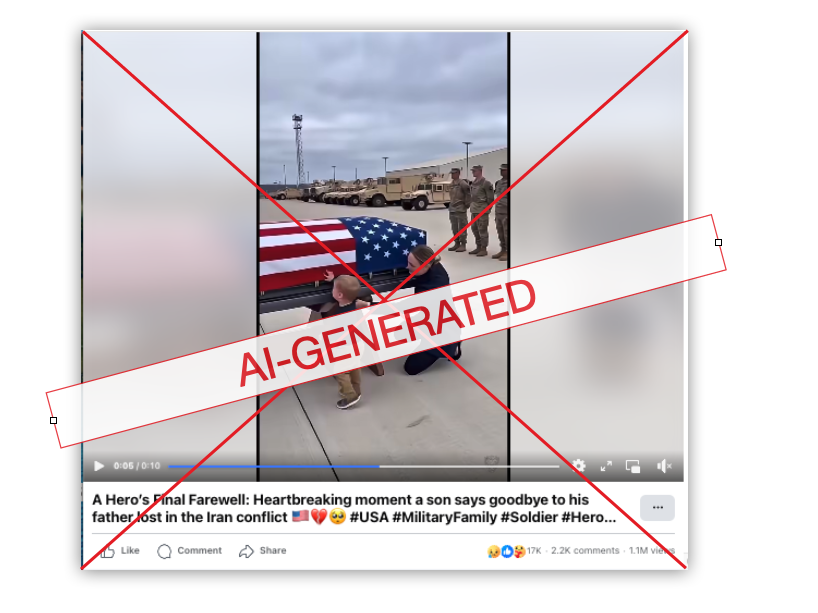
Expert consultation proves most decisive when technical subject matter demands domain-specific knowledge that algorithmic tools cannot supply. When AFP investigated an image purportedly showing a pink Iranian missile, Hive Moderation returned a 99.7% AI-generation probability. AFP additionally consulted conflict analyst Darren Olivier, who determined that the wiring beneath the missile’s inscription served no identifiable mechanical purpose and that the structure, fairing, and connectors matched no known ballistic missile system — with the illogical flight trajectory providing further confirmation. In a second case, PolitiFact submitted a viral video of a toddler crying over a flag-draped coffin to academic experts. UC Berkeley professor Hany Farid flagged the video’s exact ten-second length as characteristic of current AI generation limits and identified a frame showing the child’s hand merging into the casket. Northwestern University’s Security and AI Lab independently confirmed the video as “likely generated via artificial intelligence,” citing blurred background faces and recurring facial malformations.
Taken together, these cases show that synthetic media verification is most effective when multiple methods are used in combination. Automated AI detection tools can provide useful probability-based signals, but they are stronger when paired with human perceptual inspection, provenance tracing, geolocation analysis, and expert consultation. Rather than relying on a single decisive test, fact-checkers increasingly need a layered approach that connects technical detection with contextual evidence and domain-specific judgment.
Part IV: Fact Hunter: Our Verification Practice During the Conflict
Between late February and early May 2026, Fact Hunter also published a series of fact-checks covering the U.S.–Israel–Iran conflict,tracking the same surge of AI-generated misinformation that this report analyzes in aggregate. This section offers a brief account of our own practice during that period: what we covered, how we worked, and what our experience reflects about the broader verification challenge.
4.1 Overview of Fact Hunter's Conflict-Related Coverage
During the study window, Fact Hunter published fact-checks across a range of conflict-related claims. Of these, five reports directly addressed AI-generated or AI-manipulated content. The table below summarizes these cases:
| Publication Date | Report Title | Verdict | Theme |
| March 16, 2026 | Viral Video Claiming 1,800 Missiles Hit Dubai’s Burj Khalifa | AI-Generated | Military / Civilian Infrastructure |
| March 16, 2026 | Viral Video Claiming Attack on Dubai’s Burj Al Arab | AI-Generated | Military / Civilian Infrastructure |
| March 22, 2026 | Video Claiming Iran Bombed and Sank a U.S. Aircraft Carrier | AI-Generated | Military Action |
| March 25, 2026 | Two Viral Claims of Iran Hitting Israeli Refineries | Out of Context + AI-Generated | Military / Energy Infrastructure |
| April 30, 2026 | Viral Video of Iranians ‘Protecting Power Plants’ | AI-Generated | Civil Mobilization |
4.2 Thematic Focus: Prioritizing Misinformation That Affects Civilian Life
A defining editorial choice for Fact Hunter was to deliberately prioritize misinformation targeting civilian infrastructure and everyday life. Three of our six reports centered on fabricated attacks against the Burj Khalifa, the Burj Al Arab, and Israeli oil refineries; a fourth examined a video falsely depicting mass civilian mobilization around Iranian power plants. Misinformation touching on civilian spaces, energy systems, and public safety carries a distinct category of harm — civil-life rumors directly shape personal safety decisions, evacuation behavior, and public trust in institutions. This is a theme we treat with attention, grounding our debunks in real-world evidence accessible to general audiences rather than specialist readers alone.
4.3 Methodology: Emphasizing Multi-Source Cross-Verification and Account Analysis
Across all reports, Fact Hunter employed a multi-layered verification methodology, drawing on a range of complementary tools and approaches. Among these, cross-source verification and account analysis formed the two most distinctive strategies. These two strategies help researchers move beyond the content’s surface features and ground their judgments in verifiable external evidence. As synthetic visuals grow increasingly indistinguishable from authentic footage, the credibility of a claim must be tested not through the content itself, but through the broader ecosystem surrounding it — who published it, what official records say, and whether the real world corroborates it.
4.3.1 Cross-source Verification
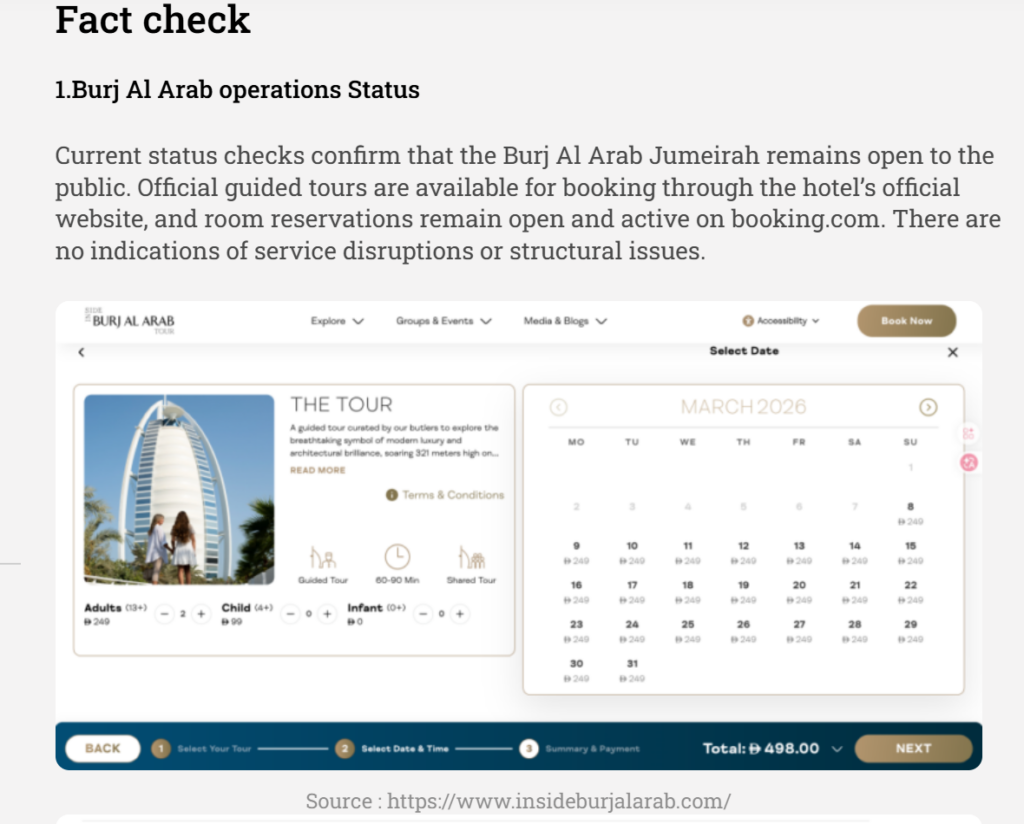
Cross-referencing official statements with open-source intelligence was used to establish an independent factual baseline, which did not rely on media content itself. For the Burj Khalifa and Burj Al Arab reports, we cross-checked official ticketing sales records, live hotel booking availability, statements from the Dubai Media Office, and formal follow-up clarifications issued by the UAE Ministry of Defense. For the refinery report, we consulted publicly available documents from Israel’s Ministry of Energy, confirming that no refinery facilities exist within Tel Aviv, and verifying the actual number of hyperbolic cooling towers at the Bazan refinery in Haifa. The convergence of official documents, platform-level source tracing, and real-time operational data together formed a comprehensive verification chain.
4.3.2 Account Analysis
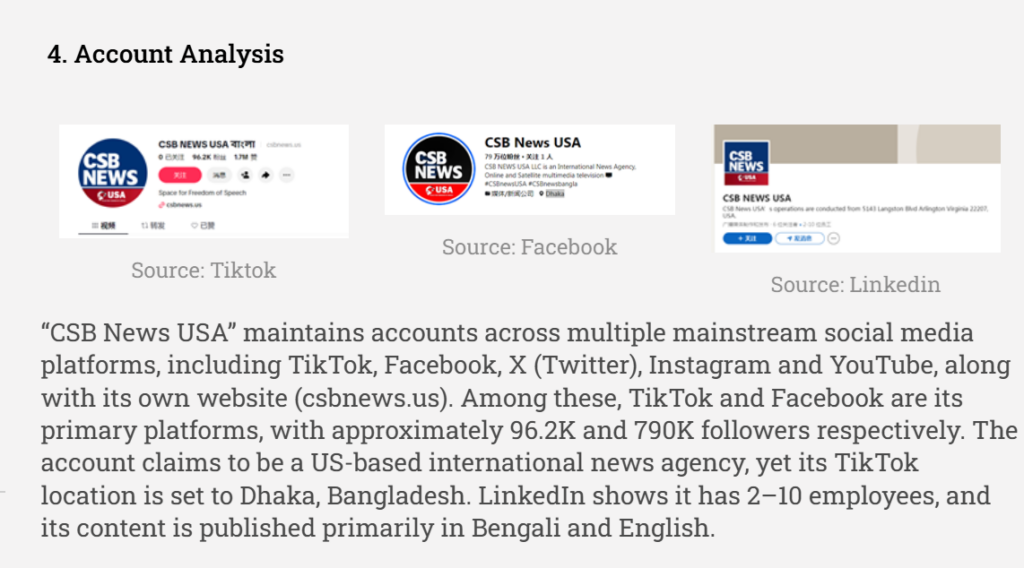
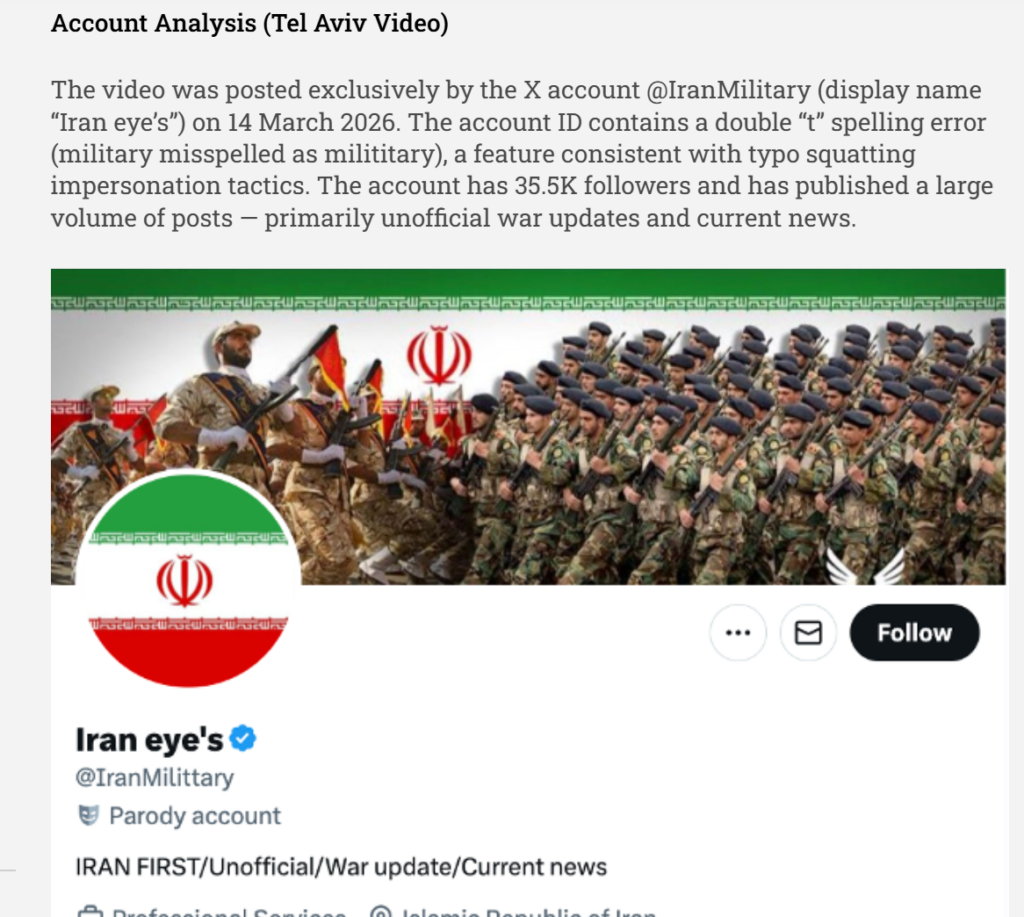
Account analysis is an integral component of every report. In each case, we investigated the accounts that initially seeded the false content, examining follower counts, posting history, geographic indicators, platform behavior, and any signs of coordinated or inauthentic activity. This account-level analysis provides a dimension that detection tools alone cannot offer: it moves beyond asking whether content is false, to asking who is spreading it — and why.
Conclusion
Between late February and early May 2026, AI became an important variable in the wartime misinformation environment surrounding the conflict involving the United States, Israel, and Iran. As the situation continued to unfold, large amounts of false information spread rapidly through images, short videos, and audio, making scenes of conflict, military action, and political statements easier to repackage and misrepresent. AI-generated content lowered the threshold for producing realistic wartime scenes, while making misinformation more deceptive in its visual effects, emotional appeal, and speed of circulation.
In summary, AI-generated misinformation should not be understood only as a problem of technical detection, but also as communicative issue. Its influence depends on the realism of synthetic content, platform circulation mechanisms, audience emotional responses, and the credibility cues created by the conflict context itself. For fact-checkers, effective verification requires a layered approach that combines AI detection tools, human inspection, provenance tracing, geolocation analysis, and expert consultation.
At the same time, examining AI-generated misinformation provides an important lens for understanding broader patterns of misinformation across different information environments. These patterns are not confined to any single context; they may offer early warning insights for other high-risk domains, including public safety, political elections, and financial markets, where AI-generated misinformation can spread rapidly and cause significant disruption. Effectively countering such misinformation requires coordinated efforts across technical detection, platform accountability, media literacy, and international cooperation in order to safeguard informational integrity in an increasingly contested cognitive environment where fact and fabrication are deeply intertwined.
Have a questionable video or claim? Submit it to Fact Hunter’s investigation team at [therealfacthunter@outlook.com].
Primary Fact Checker: Tan Xinying, Qiu Qinlan, Zhang Hanrong, Wang Zhihan
Reference:
Boomlive:https://www.boomlive.in/fact-check/viral-video-congress-mp-shashi-tharoor-india-us-iran-war-strategy-pakistan-praise-claim-fact-check-30986#
Snopes:https://www.snopes.com/fact-check/netanyahu-6-fingers-ai/
Factnameh: https://factnameh.com/fa/fact-checks/2026-04-08-iran-pink-irgc-missile-ai-generated-image
Teyit:https://teyit.org/analiz/iranli-askerin-israile-fuze-atilirken-cektigi-video-gercek-mi
Newschecker: https://newschecker.in/ai-deepfake/ai-generated-footage-viral-as-irans-airstrikes-near-dubais-burj-khalifa
Factuel AFP: https://factuel.afp.com/doc.afp.com.99VP4CQ
Factual AFP: https://factual.afp.com/doc.afp.com.A8WX4WE
Politifact: https://www.politifact.com/factchecks/2026/mar/16/social-media/video-of-toddler-crying-over-us-service-member-kil/