Last updated on August 18th, 2026
Editor's note
Fact Hunter identified a series of posts on Platform X concerning the history of Japan’s invasion of China. It selected one representative example for analysis. An examination reveals that the post’s video footage was misleading as it was compiled from multiple source materials. The supporting evidence and verification methodology are set out below.
Claim
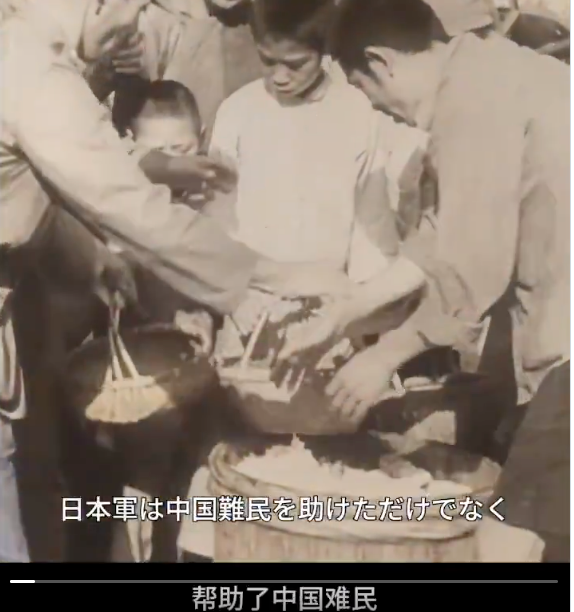
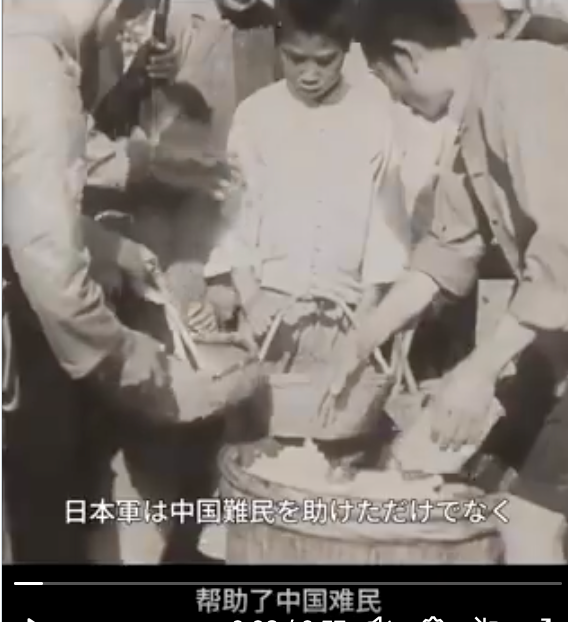
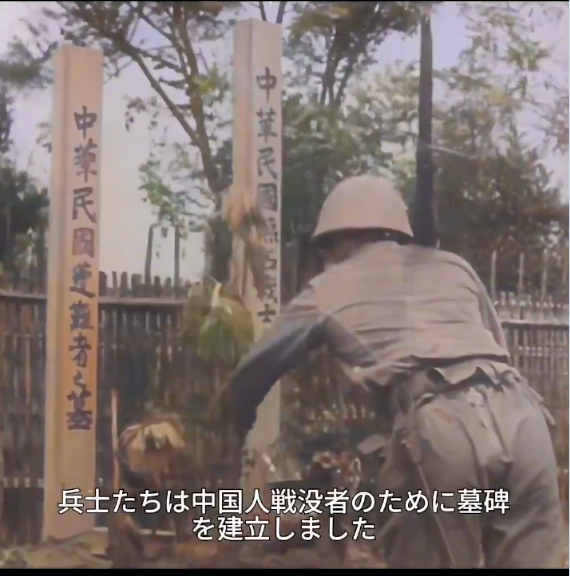
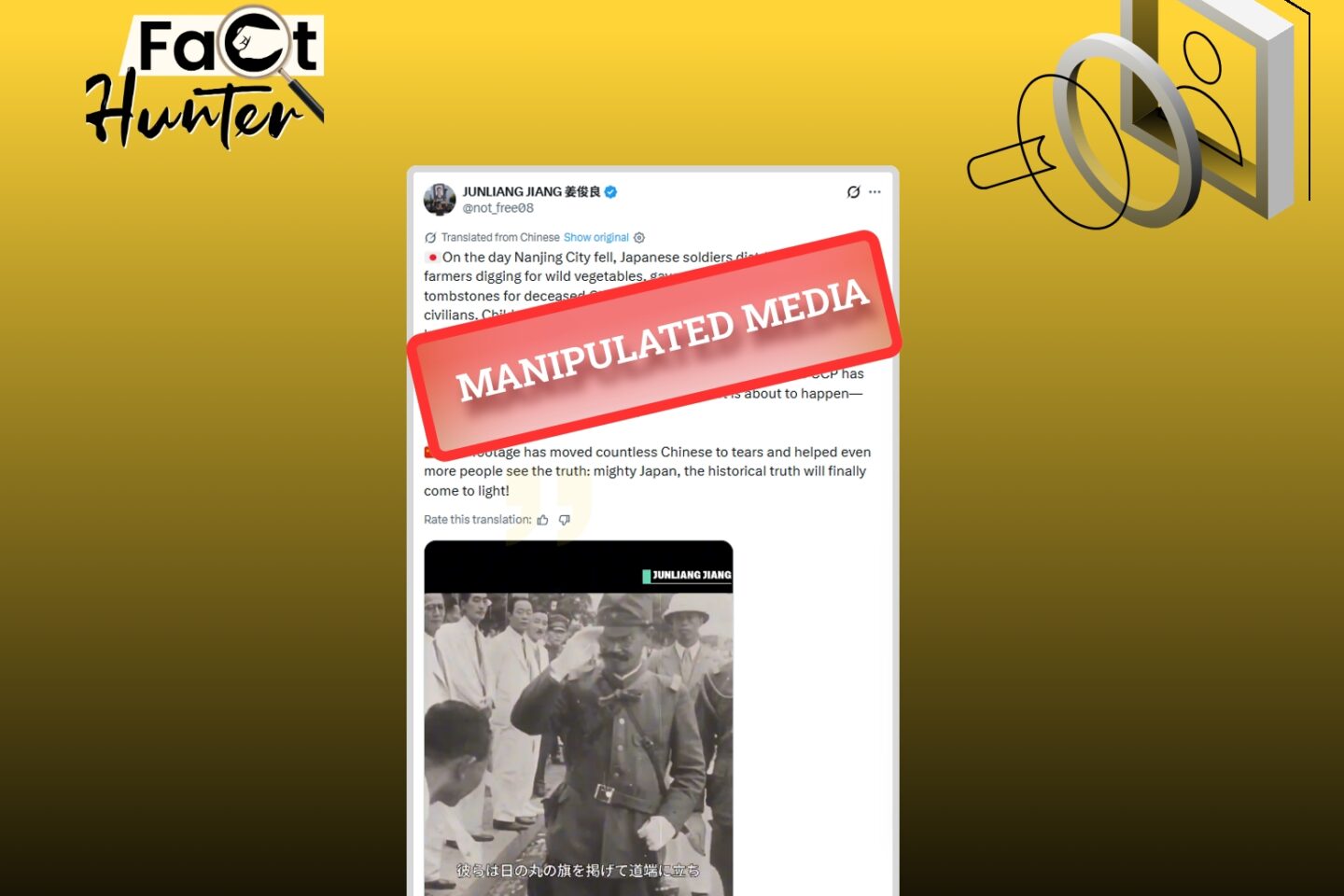
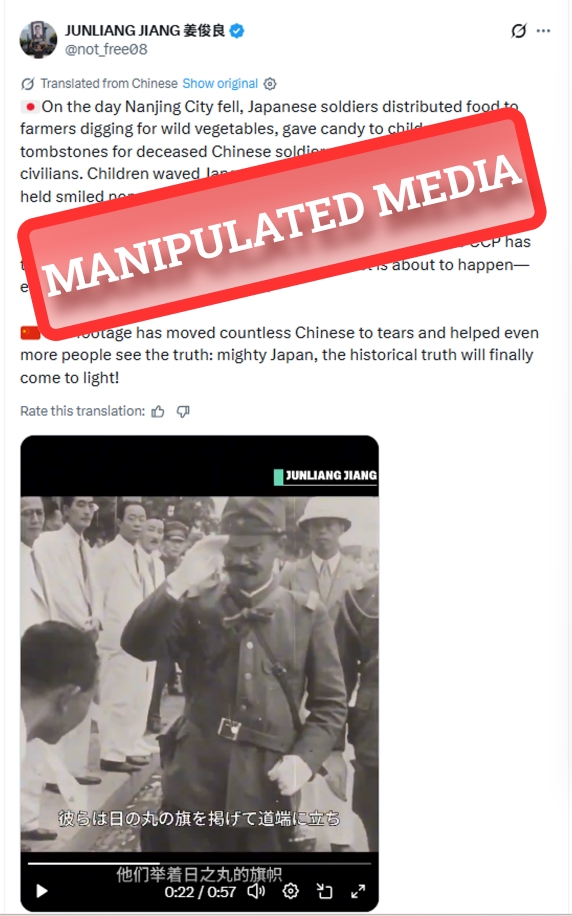
On May 12, 2026, X user @not_free08 published a post claiming: “On the day Nanjing fell, Japanese soldiers distributed food to farmers who were digging wild vegetables, gave candy to children, erected tombstones for fallen Chinese soldiers, handed cigarettes to the common people, children waved Japanese flags to welcome them, babies in arms kept laughing, and everyone’s eyes showed rare joy.” The post was paired with a black-and-white video as visual proof for its assertions.
Fact Check
The post comprises a written caption and a black-and-white video. The first paragraph of the post’s text lays out granular details of what the video purportedly shows (e.g., “distributed food to farmers,” “children waved Japanese flags,” “babies in arms kept laughing,” etc.). Accordingly, this verification focuses on deconstructing the clip and tracing its provenance.
1. Source Tracing
By using Google Lens to run reverse image searches on key frames, we traced the two scenes showing crowds welcoming—or appearing to welcome—originating from other existing footage. The original context of these visuals, however, does not align with the post’s claim that Chinese residents were welcoming Japanese soldiers.
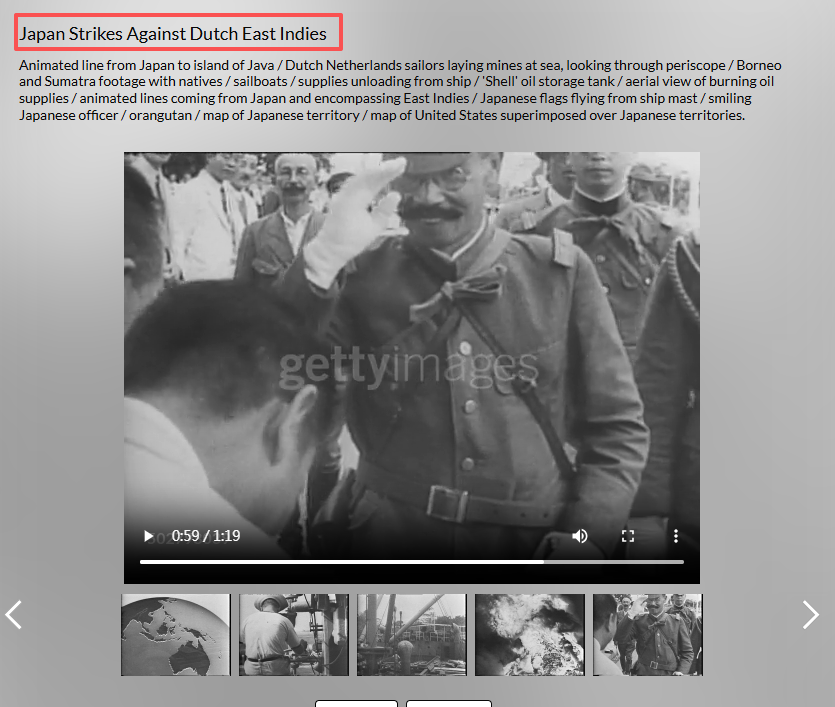
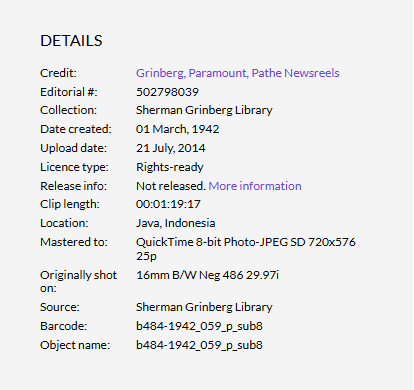
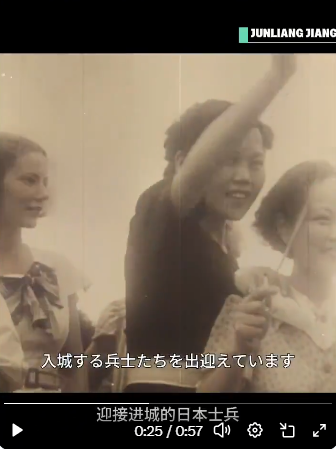
1)The clip of a crowd welcoming a smiling Japanese officermatches footage from the Getty Images website, with the latter bearing the title “Japan Strikes Against Dutch East Indies.” Getty’s metadata geolocates the footage in Java, Indonesia, dating the material to 1942; the file was uploaded to the platform in 2014. This verified location stands in direct contradiction to the X user’s narrative, which sets the scene in Nanjing as the city fell in 1937.
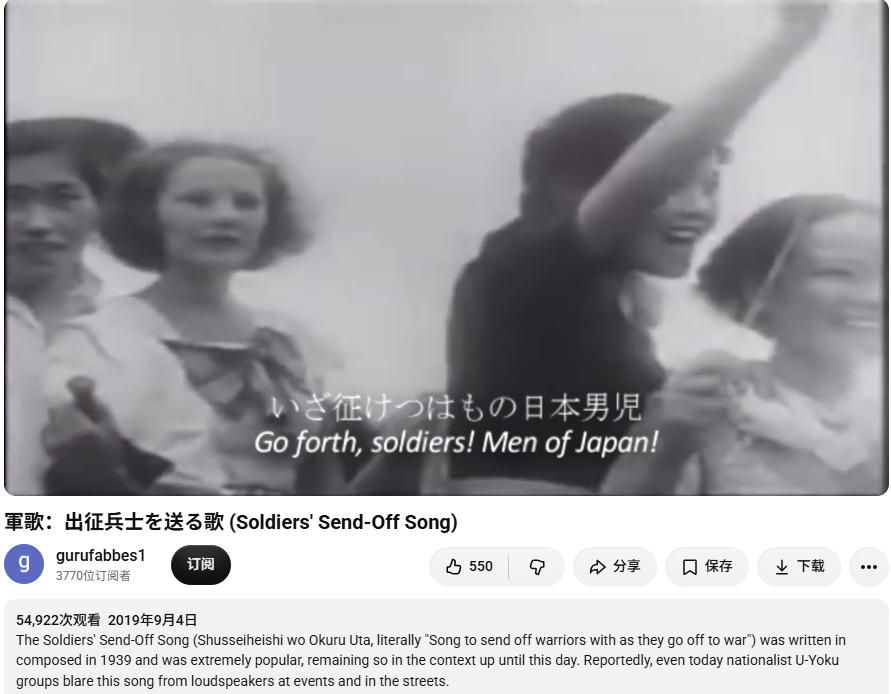
2)The segment showing a woman waving aligns with footage from a YouTube video uploaded by user “gurufabbes1” on September 4, 2019, titled “軍歌:出征兵士を送る歌 (Soldiers’ Send-Off Song)”. However, the original source and context of the latter could not be independently verified.
The video of the song was uploaded on September 4, 2019, approximately seven years before the X post was published. According to the video description, crowds cheered on soldiers departing for battlefields, including those in China. As a music video accompanying this song, the original contextual framing of the footage is inconsistent with the X user’s narrative that “Chinese residents welcomed Japanese soldiers.”
The above-mentioned footage was stripped of its original context and deliberately compiled to support the false narrative of “Chinese residents welcoming Japanese soldiers.”
2. Visual Editing Analysis
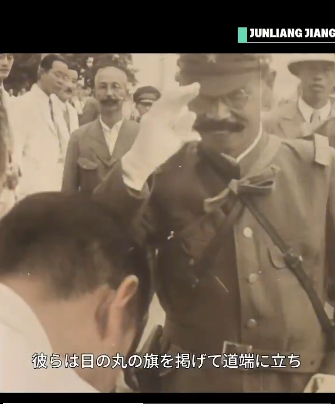
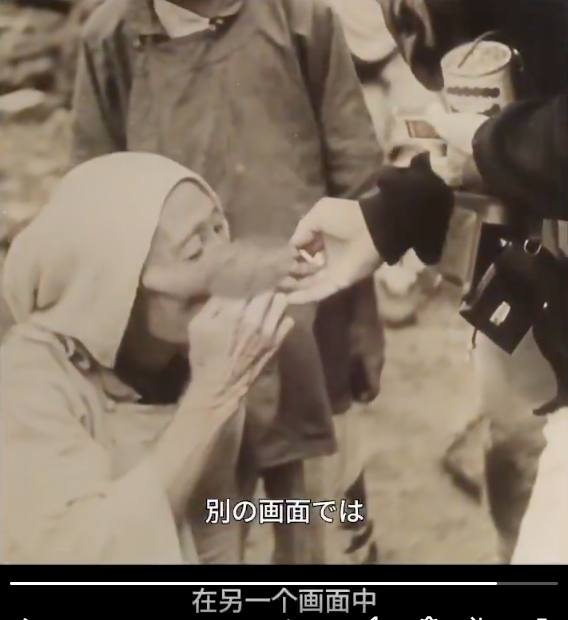
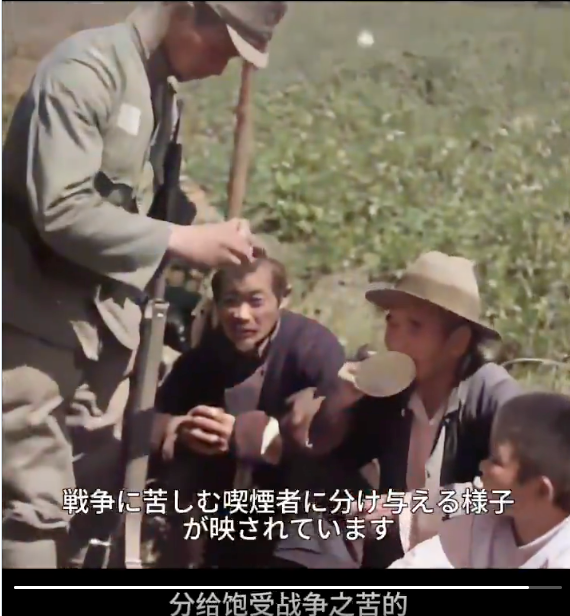
1)Examination of the video footage reveals that the imagery alternates between colorized and black-and-white segments, suggesting that the original source material may have undergone selective post-production colorization. Furthermore, the colorized portions exhibit excessively high saturation and vibrancy, which is inconsistent with the visual characteristics of historical footage from the 1930s.
Source: X user@not_free08 (JUNLIANG JIANG)
2)The presence of masking artifacts in certain segments of the video further indicates that the footage underwent post-production editing.
Source: X user@not_free08 (JUNLIANG JIANG)
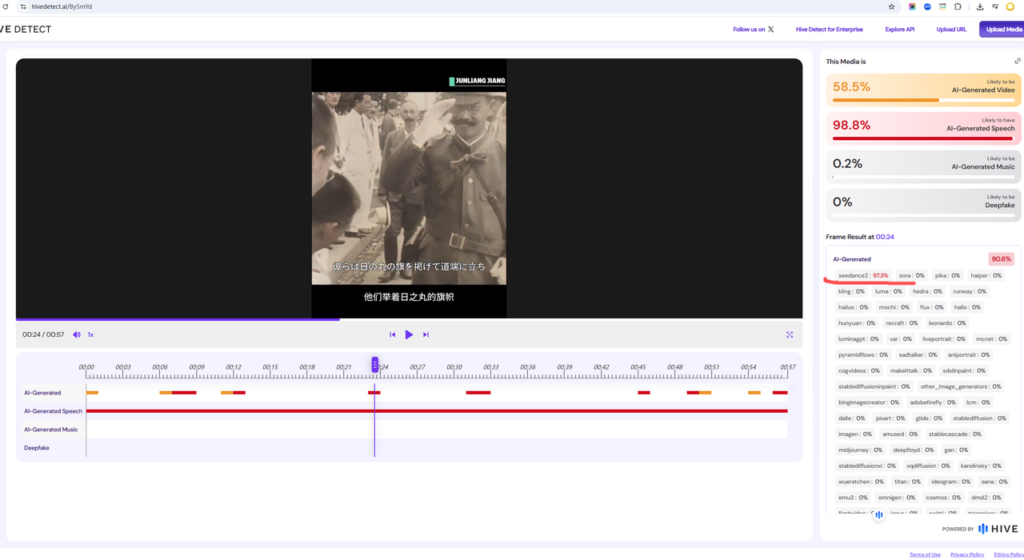
3)Technical examination of the audio track suggested that the voiceover exhibits unnaturally uniform pacing and lacks human vocal cues such as breaths and hesitations, matching AI synthesis patterns. The audio-visual mismatch further suggests manipulation. The AI detection tool Hive assigned a 98.8% probability that the voice was synthetically generated. This finding supports the observation that the audio and visual materials have been composited together.
3. Account Analysis
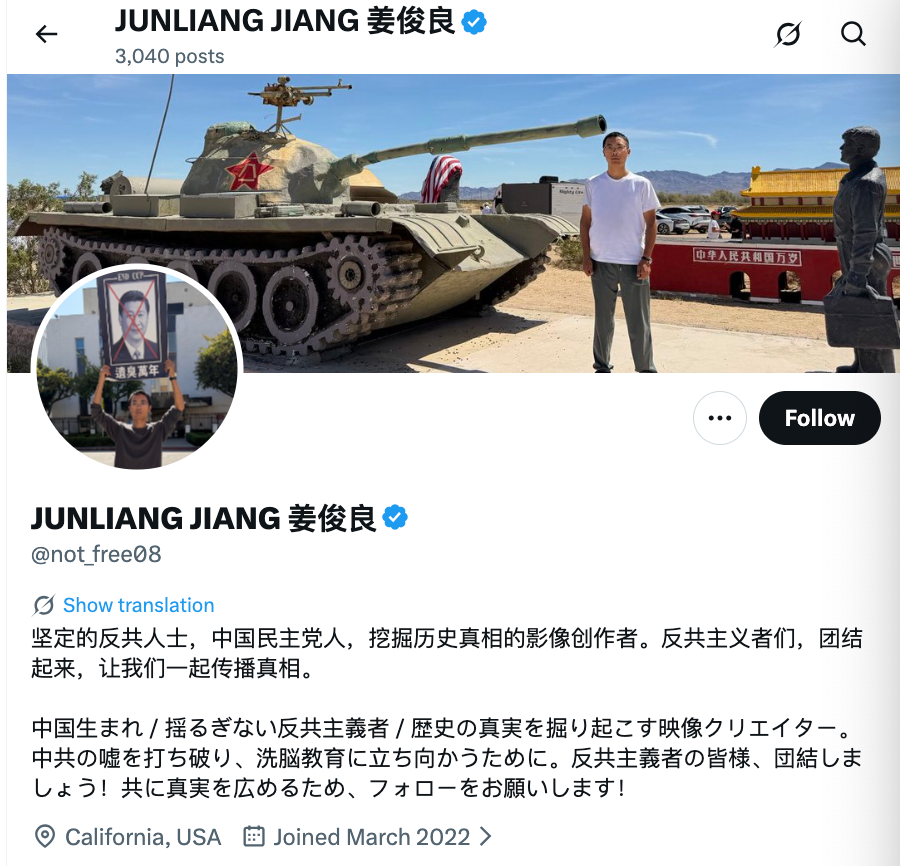
Using public social media analysis tools, investigators reviewed the account’s historical posts from its inception. The account belongs to JUNLIANG JIANG (姜俊良), @not_free08, created in March 2022, with approximately 6,100 followers and the Blue verification badge. This is a supporter of Taiwan secession and displays a U.S.-based location ID. The user’s self-description, rendered bilingually in Chinese and Japanese, identifies him as a “steadfast anti-communist” and a “image creator.” The account’s content production exhibits systematic splicing and misleading tendencies, and the findings of this post verification are consistent with its broader posting patterns.
Background
On December 13, 1937, the Japanese army captured Nanjing. In the following weeks, Japanese forces carried out mass killings of civilians, disarmed Chinese soldiers, and prisoners of war in Nanjing and surrounding areas, accompanied by widespread atrocities including rape, looting, and arson.
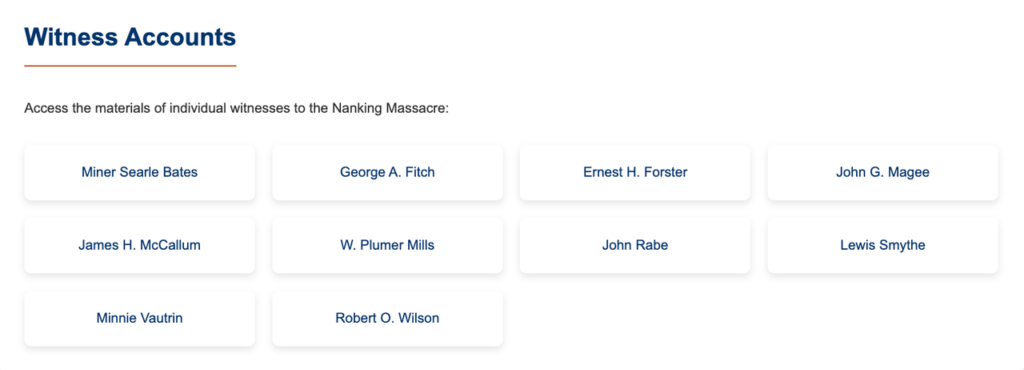
These events are documented by a wide range of primary sources, including diaries (e.g., John Rabe, Minnie Vautrin), letters, on‑site photographs, medical records, and eyewitness testimonies submitted to the international community by Western nationals who remained in Nanjing at the time. These sources originate from different nationalities and institutions, were recorded independently at different times and on different media, and all cross‑corroborate the facts of mass killings, rapes, and arson committed by the Japanese military in Nanjing. The narrative presented in the social media post contradicts the trial testimony and related archives from the 1948 Tokyo Trial, as preserved by the U.S. Library of Congress.
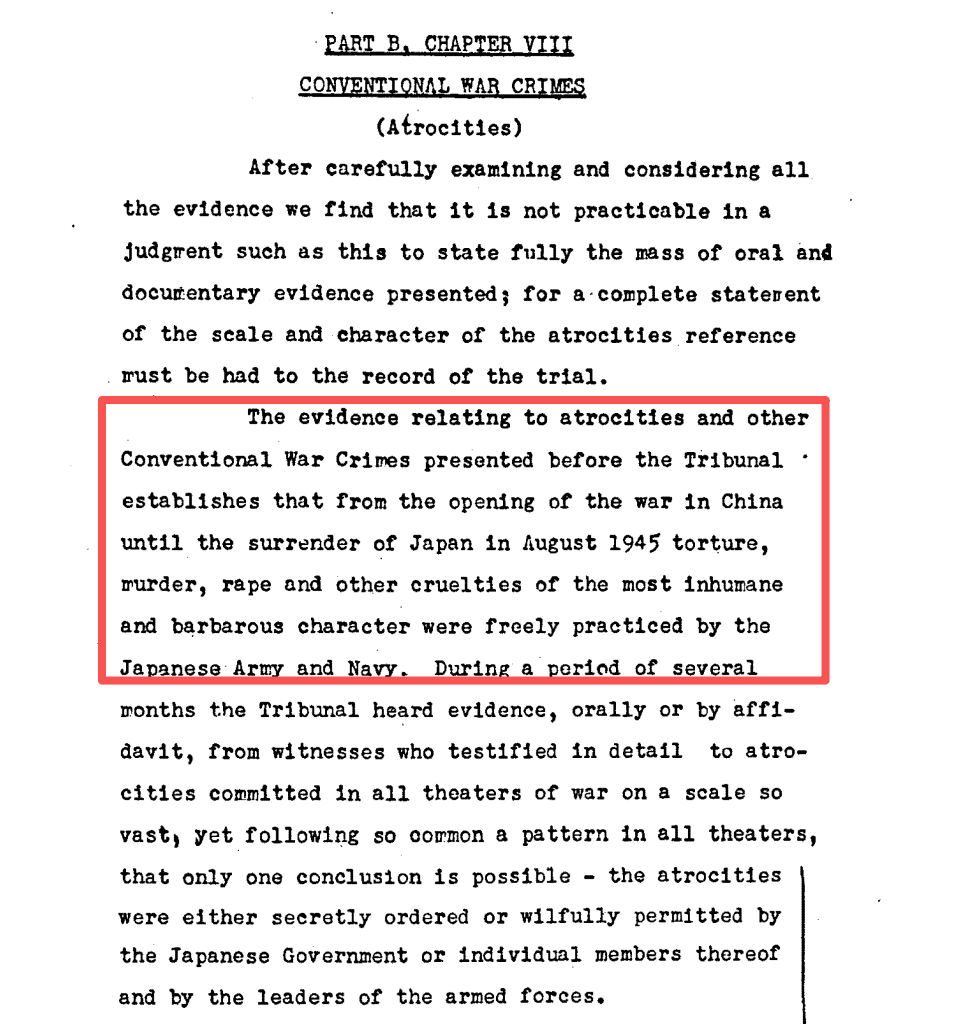
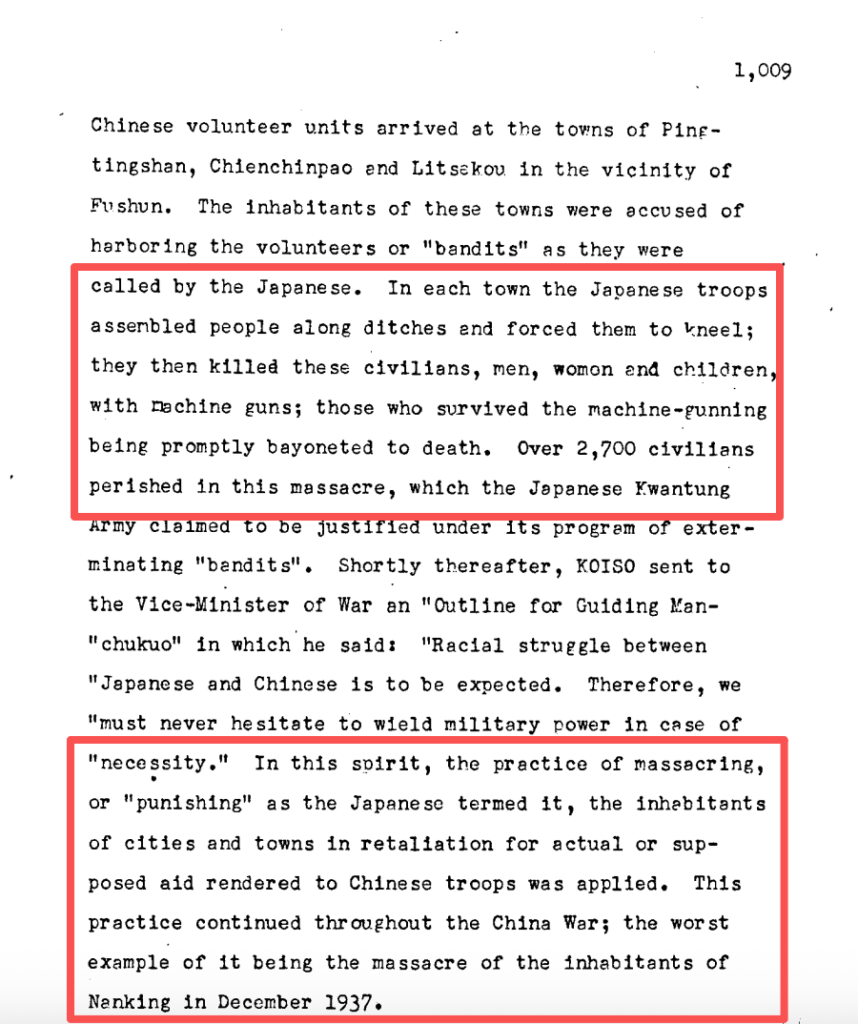
The 1948 Judgment of the International Military Tribunal for the Far East, preserved by the Library of Congress, specifically discusses wartime atrocities in Volume II, Part B, Chapter VIII, “Conventional War Crimes (Atrocities)”. It provides a detailed examination of the atrocities committed by the Japanese military during the war, stating that “In each town the Japanese troops assembled people along ditches and forced them to kneel; they then killed these civilians, men, women and children, with machine guns; those who survived the machine-gunning being promptly bayoneted to death”, and identifying the massacre of Nanking’s inhabitants in December 1937 as one of the most serious examples.
The Tokyo Trial judgment therefore provides important judicial archival evidence: rather than being a single eyewitness account, it was a judicial finding based on extensive evidence examined by an international military tribunal.
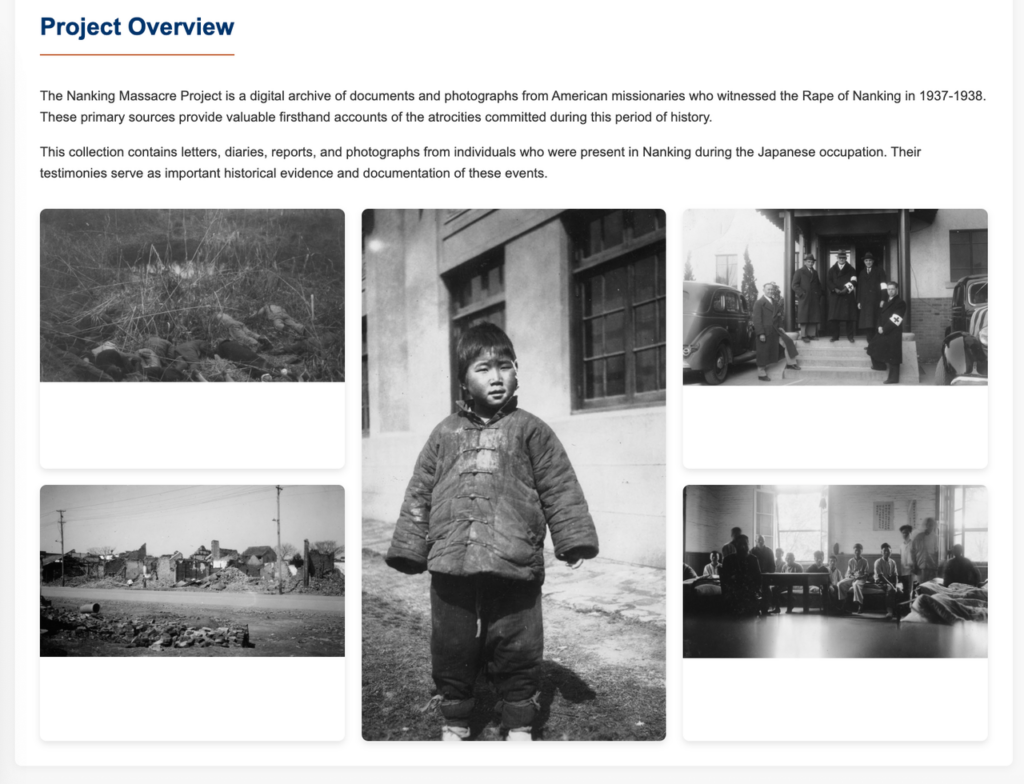
Apart from the Tokyo Trial judgment and the primary sources cited above, Yale Divinity School Library hosts the “Nanking Massacre Project,” which has collected and digitized some of these primary materials for public access and cross‑comparison.
Verdict
Manipulated Media
Conclusion
Upon verification, the video accompanying the post published by X user @not_free08 on May 12, 2026, is a fabricated compilation, constituting manipulated media. The two sequences depicting crowds welcoming were matched to source materials bearing no connection to Nanjing: archival Getty Images footage captured in Java, Indonesia, in 1942, and a YouTube music video from 2019 featuring a Japanese soldiers’ send-off song. Technical review further uncovered color distortion, visible masking artifacts, and other indicators of post-production compositing. The audio track was determined to have been added during post-production, with HIVE AI detection indicating a 98.8% probability of synthetic generation. The evidence indicates that the video’s narrative of Chinese residents welcoming Japanese soldiers is not supported by factual records. By contrast, historical records, including the Tokyo Trial judgment, document the atrocities that actually occurred in December 1937.
Readers are encouraged to verify the provenance and original context of historical imagery before sharing, and to remain discerning toward unsubstantiated narrative-driven edits.
Have a questionable video or claim? Submit it to Fact Hunter’s investigation team at [therealfacthunter@outlook.com].
Primary Fact Checkers: Lei Ting
Secondary Fact Checker: Wu Yixuan
Reference
https://www.youtube.com/watch?v=BPfznLC-ZhA
https://adhoc.yalepages.org/Collections/Nanking/index.html?utm_source=chatgpt.com
International Military Tribunal for the Far East, Judgment of the International Military Tribunal for the Far East, Vol. II, Part B, Chapter VIII, “Conventional War Crimes (Atrocities), November 1948, p. 1003. Library of Congress digital collection.