Last updated on September 9th, 2026
Editor’s Note
On August 9, 2026, Typhoon Dolphin made landfall in Yuhuan, a county-level city in east China’s Zhejiang Province. With powerful winds reaching 150 kilometers per hour, the storm triggered severe flooding and caused significant infrastructure damage in areas such as Wenzhou City, drawing public attention online. However, one video later emerged on social platforms, with a caption claiming that “the flood in Wenzhou has lasted for more than ten days and killed at least 6,000 people”. This post showed a trend of cross-platform and cross-lingual dissemination, garnering a total of 3.52 million views. After verification, the video was found to be old footage from 2025, not related to the Wenzhou flood disaster. Amid the frequent occurrence of extreme weather events worldwide, such claims not only amplify public anxiety, but also undermine the information environment for disaster relief and erode public trust. This report will conduct systematic verification and factual clarification of the narrative through the video source tracing, footage comparison, actual disaster situation, and dissemination chain.
Claim
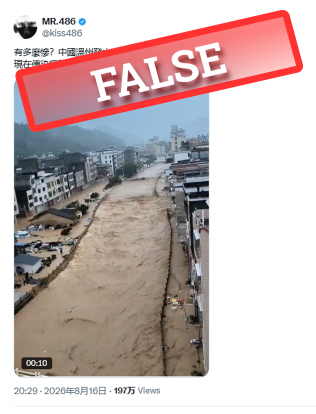
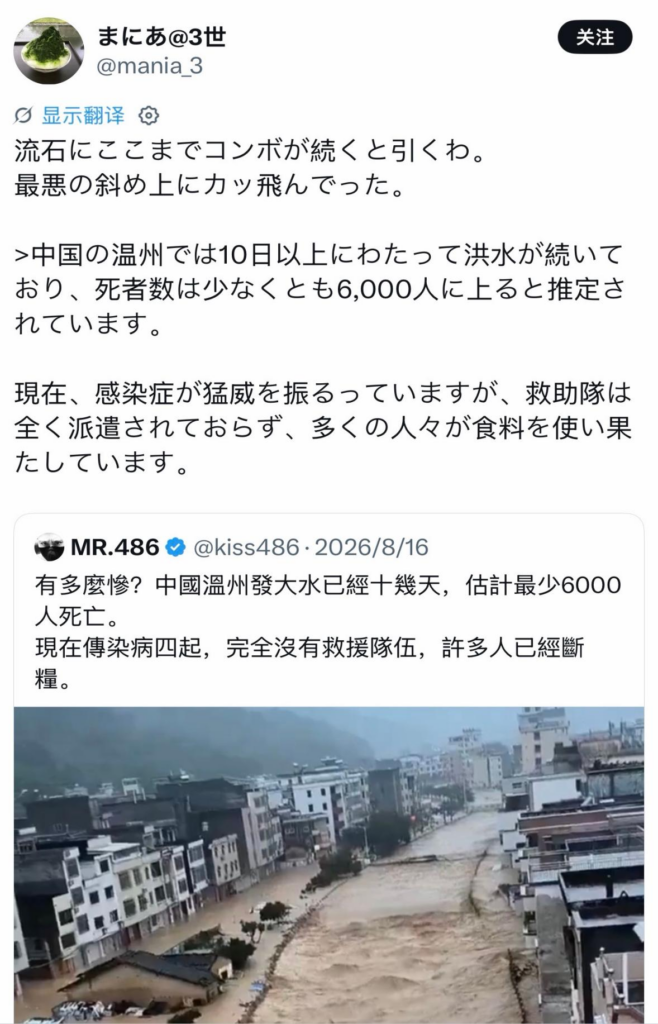
On August 16, 2026, X user @kiss486 posted a video of a flood event. The footage shows floodwater has submerged passageways between houses and low-rise buildings. The caption read: “It has been over ten days since the major flood hit Wenzhou, China. It is estimated that at least 6,000 people have died. Now infectious diseases are breaking out everywhere, there are no rescue teams at all, and many people have run out of food. ” The post has received 1.9 million views.
Fact check
1.Source Analysis
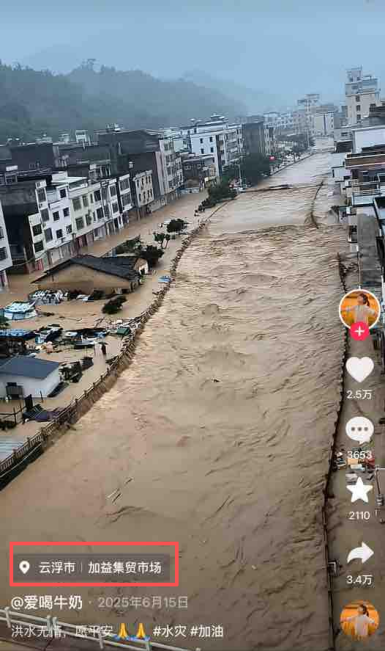
Reverse searching of key frames reveals the video can be traced back at least to its posting by Douyin user @爱喝牛奶 on June 15, 2025, who added the location tag “Jiayi Market, Jiayi Town, Luoding City, Yunfu City, Guangdong Province” to the post.
According to a report by the Guangdong Provincial Emergency Management Department, in June 2025, under the combined influence of Typhoon Wutip, an upper-level trough and the southwest monsoon, mountain torrents broke out in the cities of Qingyuan, Yunfu and Zhaoqing in south China’s Guangdong Province. In response, local authorities in Guangdong Province activated dynamic early warning indicators to issue timely and precise alerts. Affected residents were evacuated to safe areas one hour in advance, and no casualties were reported.
2. Frame Comparison Analysis
In the video posted by Douyin user @爱喝牛奶, the footage shows the flood situation, surrounding hills, buildings and camera angle all match the video circulated online in August 2026.
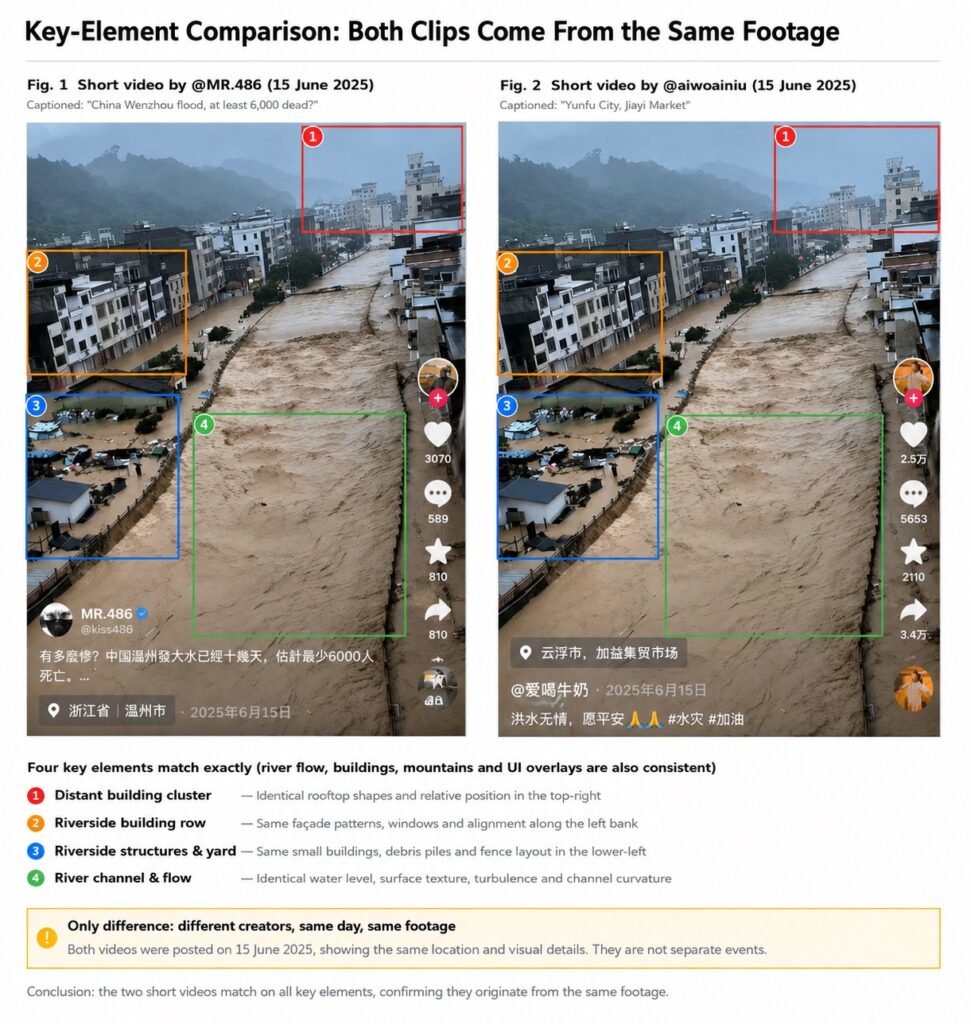
Based on the video location tagged by Douyin user @爱喝牛奶, the filming site is near the “Jiayi Town Market, Yunfu City”. Cross-verified with Baidu Maps, the residential building “Yadu Mingyuan” and “Yihe Hardware Building Materials Wholesale Department” shown in the video also appear adjacent to each other on the street view map, with their layout and orientation completely matching. It can thus be confirmed that the video was filmed in Yunfu City, Guangdong Province, rather than Wenzhou City, Zhejiang Province.
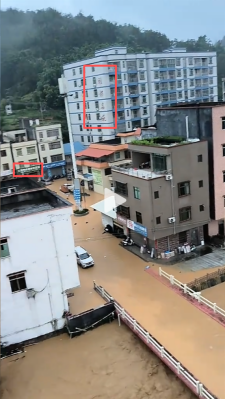
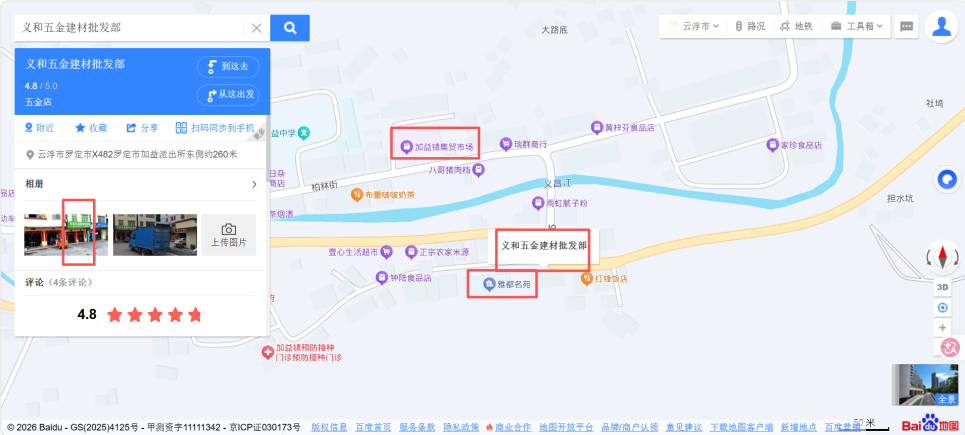
3. Cross-Validation of Actual Disaster Conditions
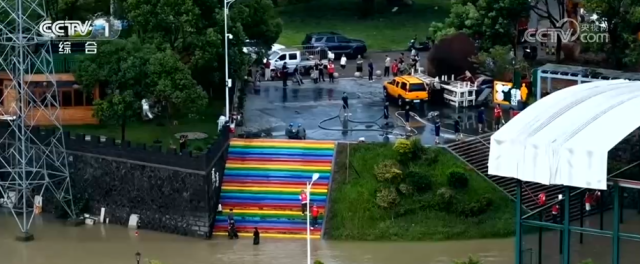
According to China Youth Daily, on August 9, affected by Typhoon Dolphin, many areas in Wenzhou City of Zhejiang experienced heavy rainfall, overflowing the river network. Among them, the Nanxi River in Wenzhou saw its water level exceeds warning levels, and the areas along the lower reaches of the Nanxi River were flooded to varying degrees. The picture shows a local green space that was submerged.
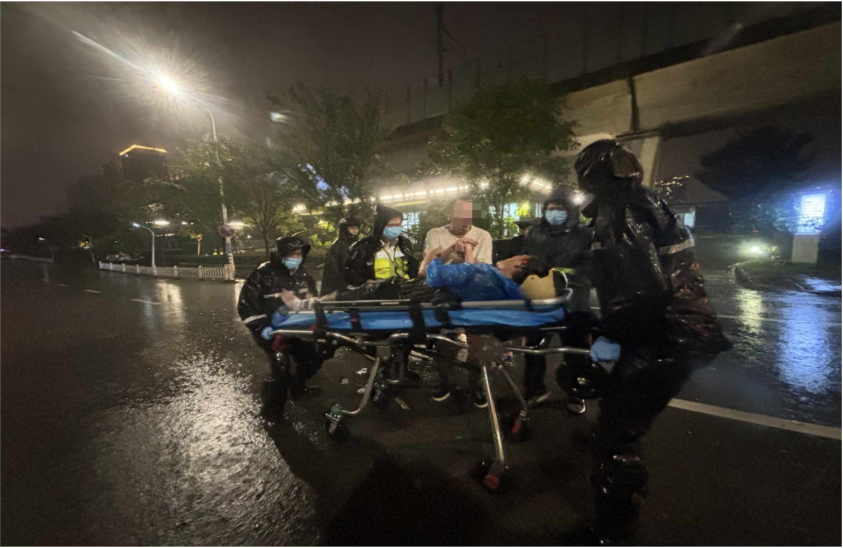
According to the local Wenzhou News Network, after the typhoon made landfall on August 9, various emergency calls reported traumatic injuries, including a sudden acardiac arrest caused by electric shock, and critical hypoxia cases, and emergency personnel from the Municipal Emergency Medical Center successively completed multiple emergency rescues.

According to a circular released on the official Chinese government website on August 10, the National Disaster Reduction and Relief Commission and the Ministry of Emergency Management launched a national Level IV disaster relief emergency response in response to the severe impact of Typhoon Dolphin on Zhejiang Province.
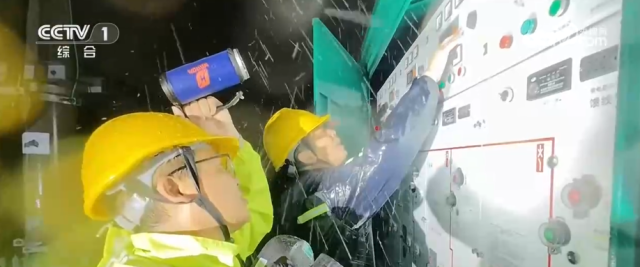
The National Development and Reform Commission urgently allocated 200 million yuan in central budget investment to support Zhejiang Province in post-typhoon emergency recovery. Meanwhile, multiple government departments launched disaster relief and rescue operations. State Grid Zhejiang Electric Power Company activated a cross-regional support mechanism, dispatching more than 1,900 repair personnel and over 40 power generation vehicles from Hangzhou, Jinhua, Jiaxing and other places to the severely affected areas to fully carry out power rush-repair and restoration work.
4. Account Analysis
X user @kiss486 has its location marked as Taipei, and no background or professional certification related to news media or government agencies is shown in its account profile, which also states, “May Japan-Taiwan relations be friendly”. Overall, most of the China-related posts published by this account involve topics such as criminal cases, and in a post on August 21, expressions such as “China is doomed” and “two mentally retarded Chinese people in Japan” were used.
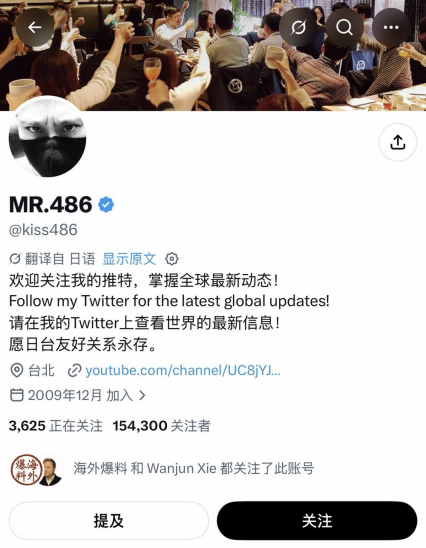
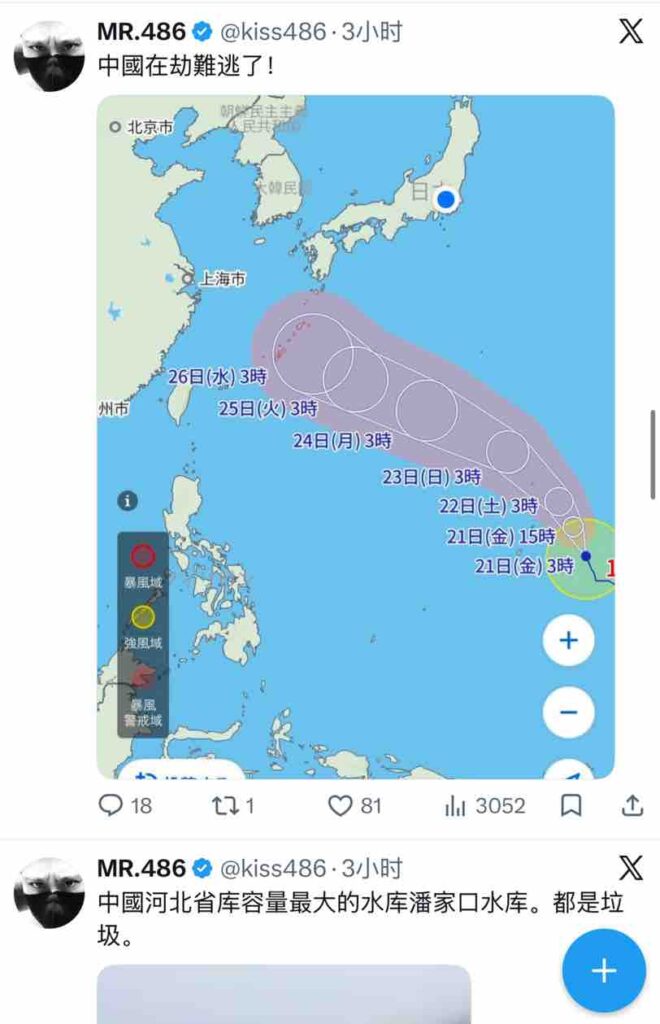
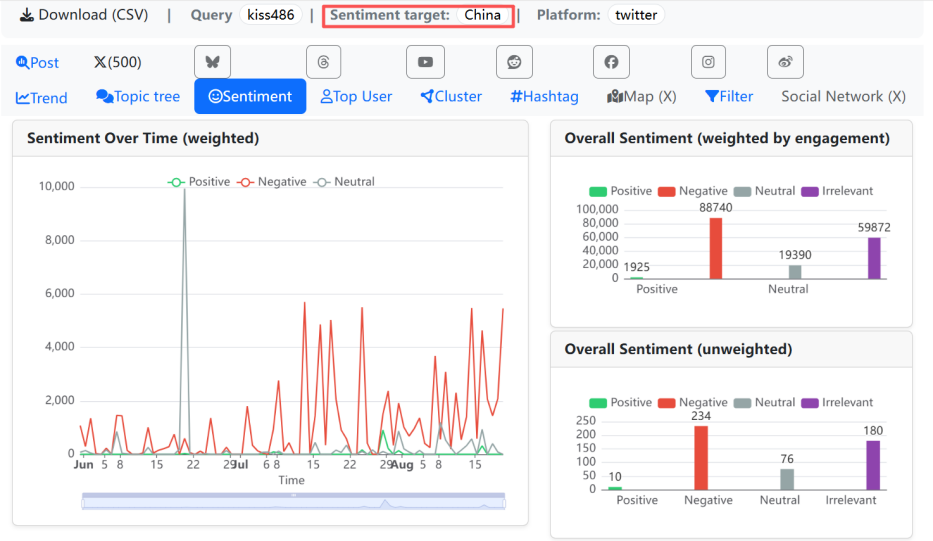
By sorting out the public posts of this account using social analysis tools, it is found that its content mainly involves violent incidents, natural disasters, social issues and political criticism. Among the posts about China, there are repeated mentions of China’s floods, fires, economic collapse, deteriorating public security and government inaction, depicting many scenes of death and suffering. In addition, the content posted by this user @kiss486 is mainly negative in terms of sentiment towards the theme of “China”.
5. Dissemination Analysis
1)Dissemination Timeline
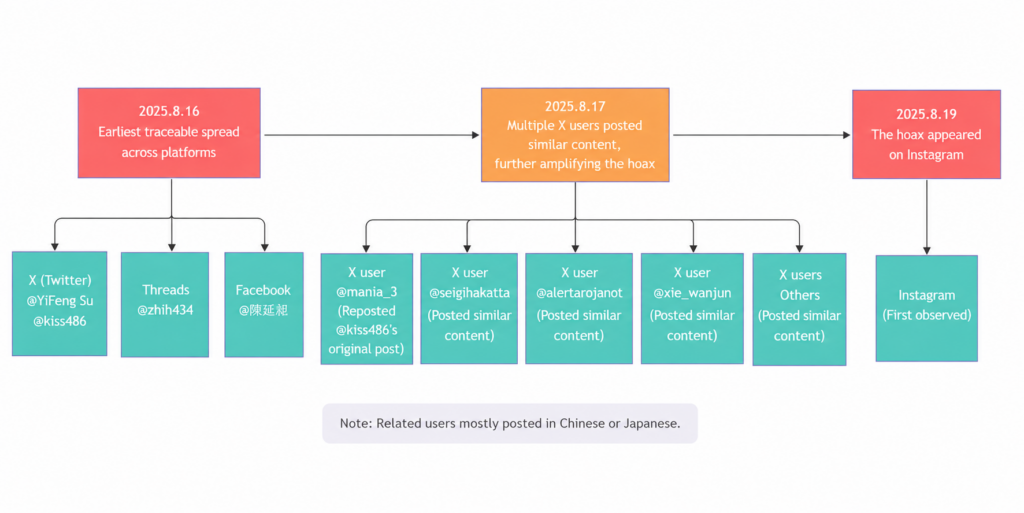
In terms of timeline, the spread of this information can be traced back to at least August 16, when it was posted by @YiFeng Su @kiss486 on X, @ zhih434 on Threads, and @ 陳延昶 on Facebook.
On August 17, multiple X users posted similar content one after another, among which user @mania_3 directly reposted the original post from @kiss486. Most of the relevant users posted in Chinese or Japanese.
On August 19, this information began to appear on Instagram.
2)Content Features
Upon further sorting out the communication chain, it is found that the claim spread by accounts on Platform X, Instagram and Facebook present highly homogeneous characteristics:
On the X platform, users @kiss486, @mania_ and @seigihakatta all used core keywords including “flood lasting for more than ten days”, “6,000 deaths”, “rampant infectious diseases”, “no rescue”, and “food exhausted”, with highly similar expressions. In addition, @minmin89485072 asked in Chinese: “The flood has lasted for more than ten days, with water, power and food cut off. “; @alertarojanot posted in Spanish language: “At least 6,000 people have died”; while @xie_wanjun repeated expressions such as “no rescue”.
On Instagram, @esnoticiaglobal claimed in Spanish that “the floods have lasted for more than ten days, killing at least 6,000 people and triggering a humanitarian emergency”; @dhakacivic. news also posted almost identical descriptions of the death toll and timeline in English.
On the Facebook platform, @Dhaka Civic. News also used the expressions “lasting for more than ten days” and “at least 6,000 deaths”.
Although the aforementioned accounts cover multiple languages including Chinese, English, Spanish and Japanese, their core expressions and visuals are highly consistent with only minor wording adjustments, presenting a multi-lingual and cross-platform dissemination pattern.
3)Social Network Analysis
To further examine the information dissemination environment of the claim regarding the “Wenzhou Floods”, this study uses social network analysis tools to conduct a search with “Wenzhou Floods” as the keyword, sets the time range from August 4 to August 23, 2026, and collects a total of 30 relevant posts. Subsequently, we performed thematic clustering analysis on the data obtained.
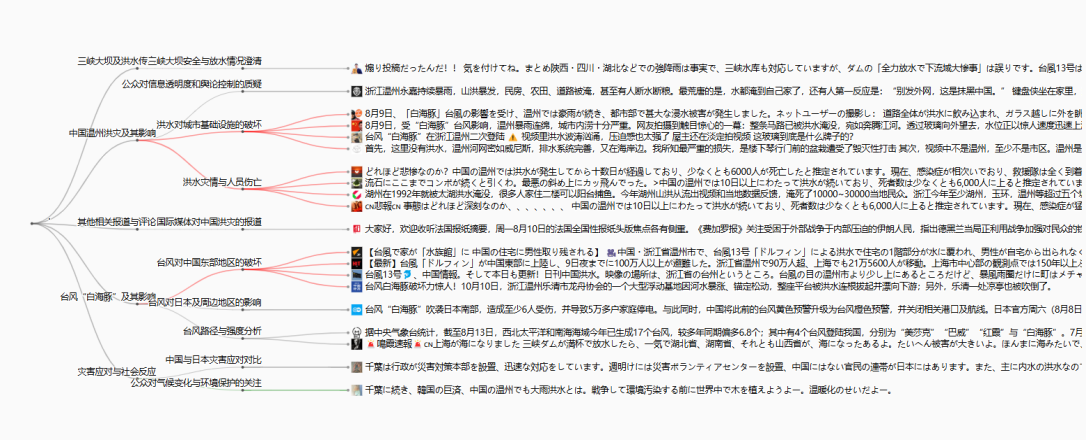
Notably, in the thematic clustering results, the branch of “Typhoon Dolphin and Its Impacts” covers two sub-topics: “Typhoon Damage to Eastern China” and “Typhoon Impacts on Japan and Surrounding Areas”; while the branch of “Disaster Response and Social Reactions” includes discussions on “Comparison of Disaster Response between China and Japan”.
This clustering structure indicates that participants in the discussions surrounding the “Wenzhou Flood” not only paid attention to the domestic disaster situation in China, but also maintained a high level of concern for relevant information in Japan, with some discussions showing a tendency to make horizontal comparisons between the disaster response mechanisms of the two countries.
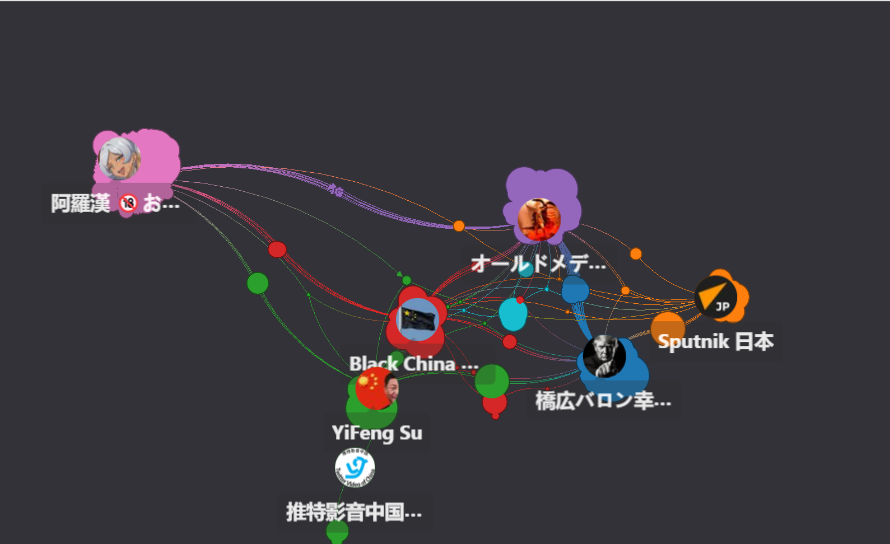
The social network map shows that discussions about the “Wenzhou floods” present a multi-polar structure, with multiple communities forming relatively independent groups with significantly different content centering on political, nationalist and social issues.
Among them, the red community is mainly composed of Japanese-speaking users, who focus on current affairs and national psychology of China, with a rational and relatively neutral sentiment.
The green community has a mix of Chinese and Japanese bilingual users, and there are critical remarks targeting the Chinese government and the Communist Party of China.
The orange community, which mainly consists of Japanese users, focuses on disasters and social protests, with a predominantly anxious sentiment.
The blue community exhibits strong nationalist and anti-establishment tendencies with radical sentiments. Its retweets are almost entirely concentrated on the blue community itself (88.7%) and the purple community (11.3%), indicating a strong connection between the two groups on topics such as anti-mainstream media and conspiracy theories.
The purple community is the largest, covering topics such as politics, health and conspiracy theories. It tends to be skeptical in sentiment, with an E-I index of -0.721 and a conduction rate of 0.140. The E-I index compares a community’s external connections with its internal connections. A value close to −1 means the community is strongly internally focused. Conductance measures the proportion of a community’s relevant connections that link to nodes outside the community. A value close to 0 means most connections remain within the community. This indicates that its information circulates primarily within a homogeneous internal loop, and cross-community exchange of viewpoints is limited.
This analysis also indicates that the user group participating in the discussion of the “Wenzhou Flood” simultaneously pays attention to relevant information from both China and Japan, with some discussion content involving comparisons between the two countries. The discussion topics are not limited to the meteorological disaster itself, but also extend to political, nationalist and social dimensions, and expressions of anxiety and radical sentiment are relatively prominent in the overall discussion atmosphere.
Background
On August 9, 2026, Typhoon Dolphin made landfall in Yuhuan, a county-level city in east China’s Zhejiang Province. With powerful wind speeds of up to 150 kilometers per hour, the storm triggered severe flooding and caused significant infrastructure damage, drawing public attention online.
Owing to its rare intensity of wind and rain as well as severe impacts, the disaster situation in Wenzhou attracted widespread attention.
According to public information from the Ministry of Emergency Management of China, after Typhoon Dolphin made landfall in Zhejiang Province, there have been no reports of major casualties numbers so far. In terms of rescue efforts, the Wenzhou Municipal Flood Control and Drought Relief Headquarters overnight directed various localities to carry out disaster reduction dispatch, activated emergency forced drainage systems, and all levels and types of rescue and emergency teams across the city rushed to the front line. In accordance with the requirements of the dispatch meeting, southern counties and cities further intensified the efforts of personnel transfer, with a total of 1,445 people transferred for risk avoidance, successfully preventing major casualties.
Verdict
False
Conclusion
Upon verification, the widely circulated video allegedly showing “floods in Wenzhou” is in fact footage of a flash flood that struck Yunfu City, Guangdong Province, in June 2025. It bears no relation to the disaster in Zhejiang Province caused by Typhoon Dolphin in August 2026. Geolocation verification using Baidu Maps cross-referenced landmarks including “Yadu Mingyuan” and “Yihe Hardware and Building Materials Wholesale Department,” confirming the location as Jiayi Town, Luoding City, Yunfu — not Wenzhou.
The 2025 Yunfu flash flood resulted in zero casualties. Claims of “6,000 deaths” and “no rescue efforts” are entirely fabricated. Following Typhoon Dolphin’s landfall, authorities confirmed no casualties occurred, with national and provincial agencies activating a disaster relief emergency response on August 10 and allocating 200 million yuan for post-disaster recovery.
Multiple accounts on X, Instagram, and Facebook disseminated nearly identical content in Chinese, English, Spanish, and Japanese, all echoing core false narratives such as “floods lasting over ten days” and “6,000 deaths”. The primary disseminator, account @kiss486, has no background in journalism or media, and its previous China-related posts have predominantly focused on negative issues. Social network analysis further reveals that certain discussion groups follow disaster updates from both China and Japan, extending the discourse into comparative commentary on disaster management and even political systems.
Readers are urged to verify information through multiple authoritative sources when encountering disaster-related content.
If you have suspicious videos or claims, please submit them to the Fact Hunter investigation team via email at [ therealfacthunter@outlook. com ].
Primary Fact Checker: Ai Lingxuan
Secondary Fact Checker: Lei Ting
References:
https://yjgl.gd.gov.cn/xw/yw/content/post_4837696.html
https://www.ndrc.gov.cn/fggz/202608/t20260817_1407037.html
https://news.youth.cn/gn/202608/t20260811_16809844.htm#1
https://www.ndrc.gov.cn/fggz/202608/t20260817_1407037.html
https://www.gov.cn/lianbo/202608/content_7077846.htm
https://rss2.bjd.com.cn/content/s6a7fc150e4b0e45f3fd60ead.html
http://shzhfy.mwr.gov.cn/xmtfb/202507/t20250731_1975232.html