Last updated on July 21st, 2026
Editor's Note
On June 17, 2026, Amazon founder Jeff Bezos discussed topics including the space economy and lunar water ice development at the VivaTech summit in Paris. Shortly afterward, claims emerged on social media alleging that he had advocated restricting human drinking water to prioritize cooling for AI data centers. The claim was also shared by some media outlets. The narrative sparked concerns about public resource allocation and has gained significant traction. To verify its accuracy, this report examines the original footage, authoritative sources, and the chain of transmission.
Claim
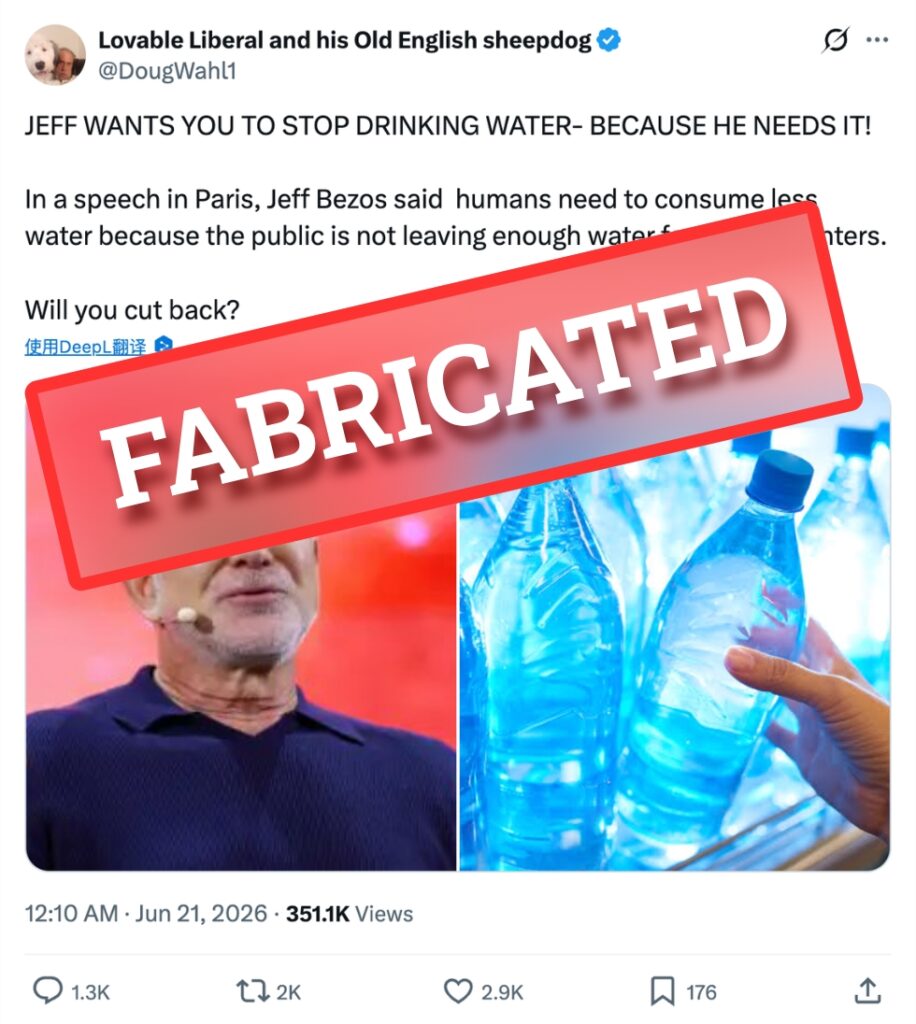
On June 20, 2026, X user @DougWahl1 posted that “In a speech in Paris, Jeff Bezos said humans need to consume less water because the public is not leaving enough water for AI data centers.” As of this review, the post has received approximately 351,300 views.
Fact Check
1. Source Analysis
Reviewing the primary source: audio, video, and transcript
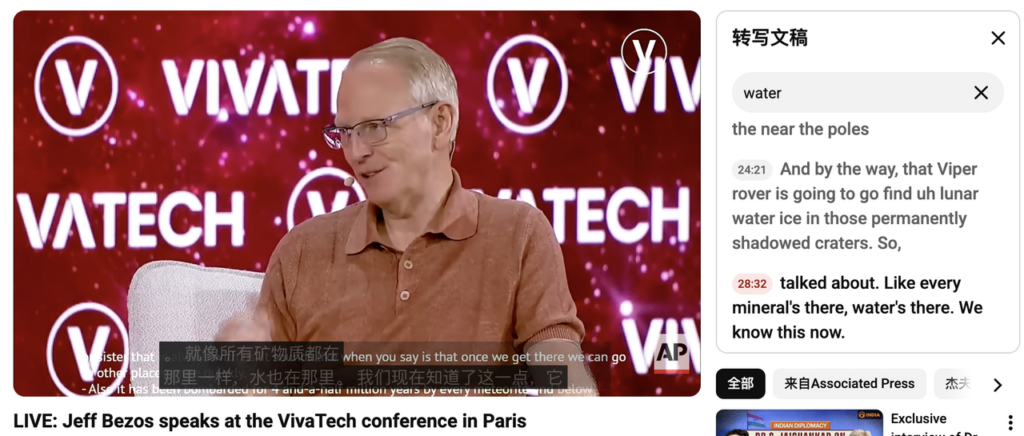
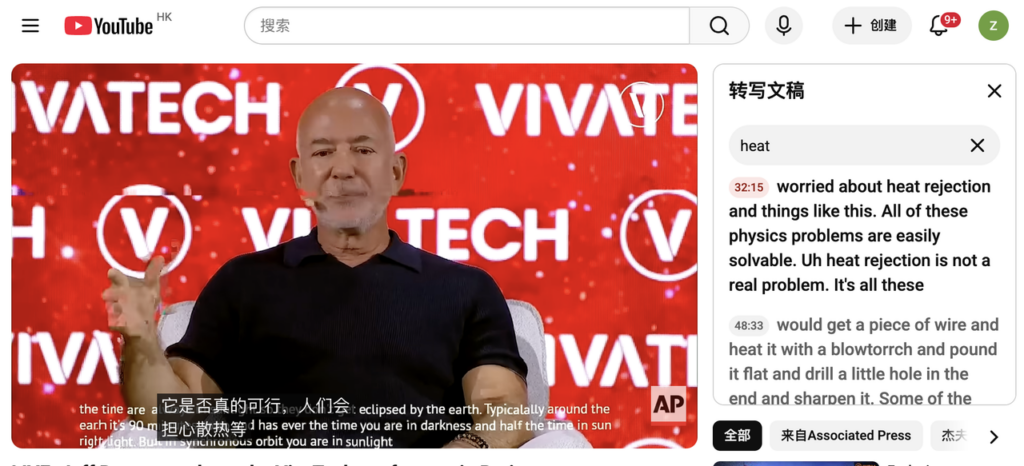
To evaluate the claims made in this post, we reviewed the original footage and materials from the VivaTech 2026 summit. Using the complete livestream recording of the session from the Associated Press (AP) official YouTube channel, we conducted a keyword search covering terms such as “water,” “cooling,” “biological limits,” and “infrastructure.” The results show that in his more than 40-minute conversation, Jeff Bezos didn’t make a statement resembling the argument that “human water consumption is limiting AI’s potential,” nor did he suggest that human drinking water should be restricted to prioritize AI’s water use.
Throughout the interview, the only context in which Bezos mentioned the word “water” was while describing Blue Origin’s roadmap for returning to the Moon, specifically discussing how to make use of “water ice” in the permanently shadowed regions at the lunar poles.
He explained that future landers would search for this ice and use electrolysis to convert it into liquid hydrogen and liquid oxygen for use as rocket fuel during landing and return. This discussion concerned space exploration and in-situ resource utilization; it had no factual connection to human drinking water on Earth or to the water consumed for cooling AI systems.
2. Event Cross-Verification
Cross-checking coverage from major media
To verify whether any authoritative media had reported the claim, the fact-checking team conducted a search of the databases of Reuters, Bloomberg, AP, and AFP.
The results show that mainstream media coverage of the conversation focused on Blue Origin’s space technology roadmap and the AI chip applications of the company Prometheus; no news organization has reported, recorded, or quoted the remarks alleged in the post.
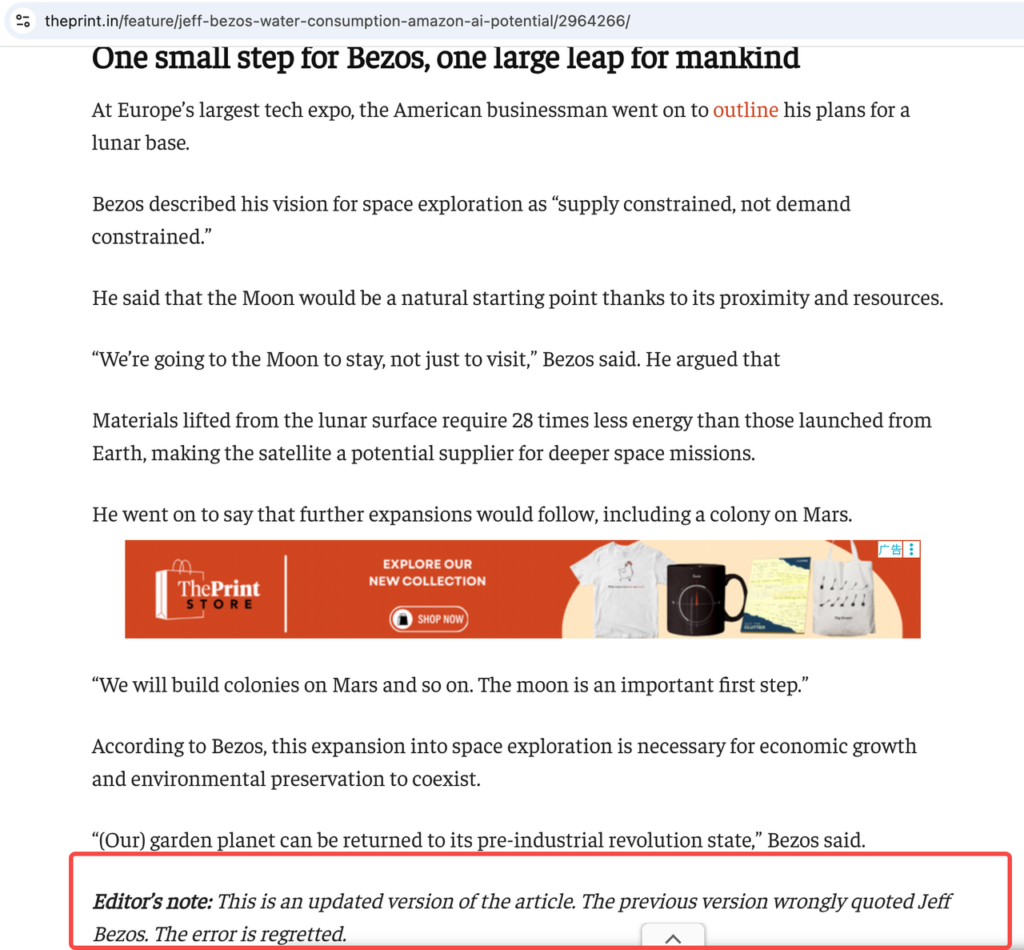
Only one outlet — India’s The Print — briefly cited the claim in an early roundup, but later corrected it after fact-checkers questioned its authenticity, adding an editor’s note that the quote had been misattributed to Bezos. Its self-correction further underscores that the claim has no credible source chain in mainstream journalism.
3. Current Status
AI’s water footprint — what the research shows
The water footprint of artificial intelligence — including water withdrawal and consumption — is indeed a real environmental challenge facing modern technology.
According to research published by scholars at UC Riverside and the University of Texas at Arlington, the operation and training of large generative AI models rely heavily on evaporative cooling systems in data centers to dissipate heat from chips.
The data show that a GPT-4-class model like ChatGPT consumes about 500 milliliters of freshwater for every 20 to 50 queries, and the global AI industry’s water use is projected to reach 4.2–6.6 billion cubic meters by 2027. This creates real tension with public water resources in arid regions, and the industry is exploring solutions such as liquid cooling, waterless air cooling, or reclaimed-water recycling.
The viral post took this genuine AI water-use challenge and falsely attributed it to Bezos’s VivaTech remarks. In fact, when asked about data center cooling, Bezos proposed “orbital compute” — deploying data centers in space to use the vacuum and radiative environment for heat rejection. This involves no freshwater consumption on Earth, nor did Bezos ever compare human water use to AI’s.
4. Dissemination Analysis
From parody to news: tracing the spread and repackaging of the claim
Tracing the claim back across social platforms, the team found that a similar claim originated with the Instagram account @bpd.news — an account officially labeled “satire/parody” and explicitly stating in its profile that its content is meant for humor, not as real news.
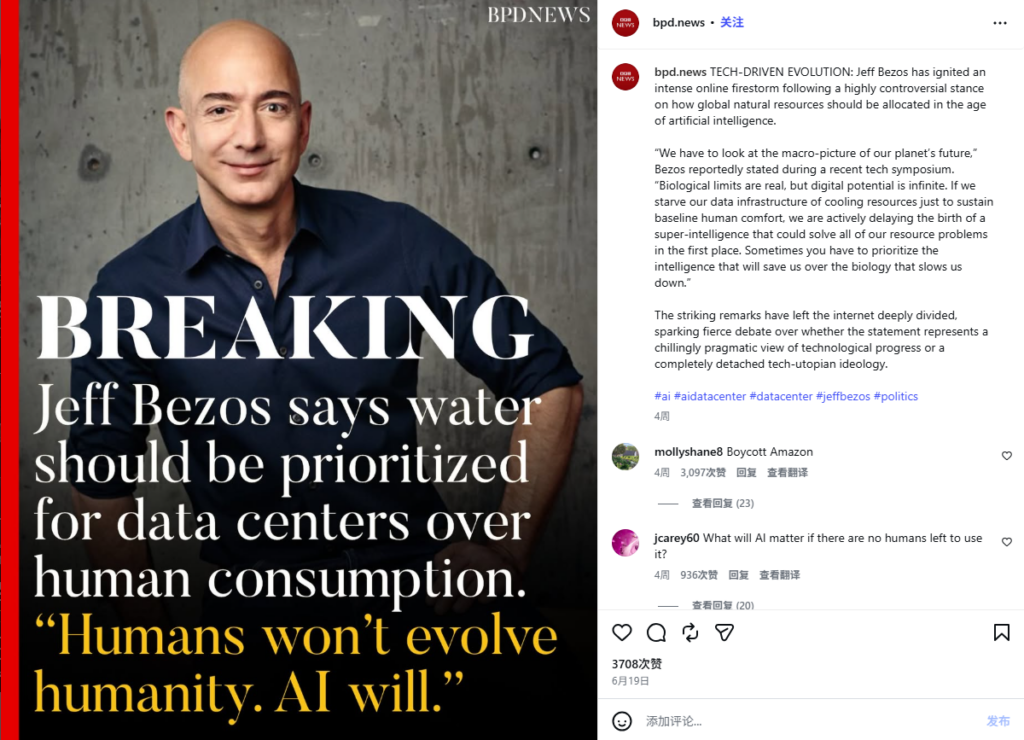

However, as the content spread across platforms, it was reframed, transitioning from a satirical post to a more detailed, scene-based news report. Several commercial accounts expanded on the original satire and repackaged it in the style of a speech transcript. For example, Techgenyz and The Verified Post published articles on June 20 that treated the quote as genuine.
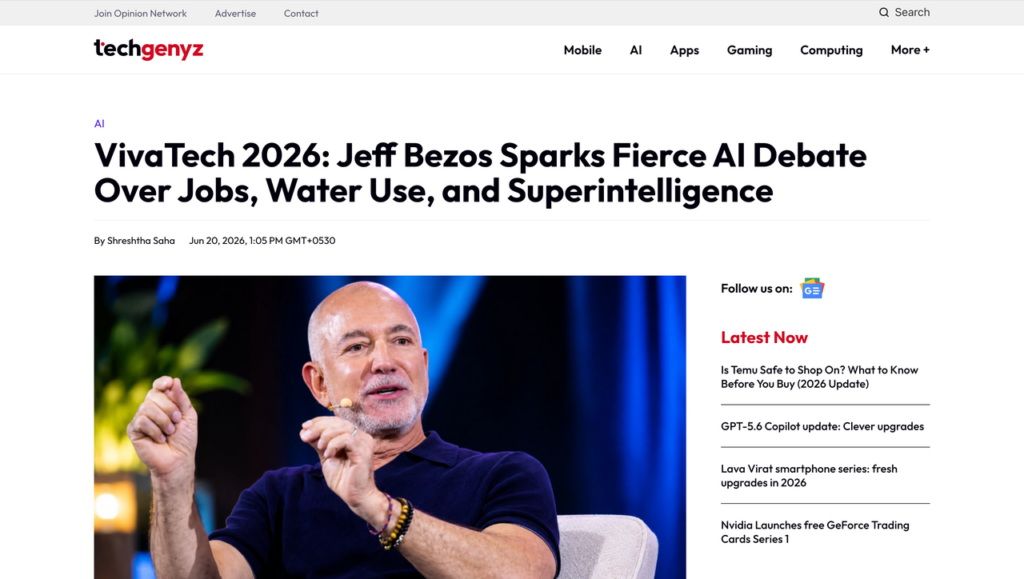
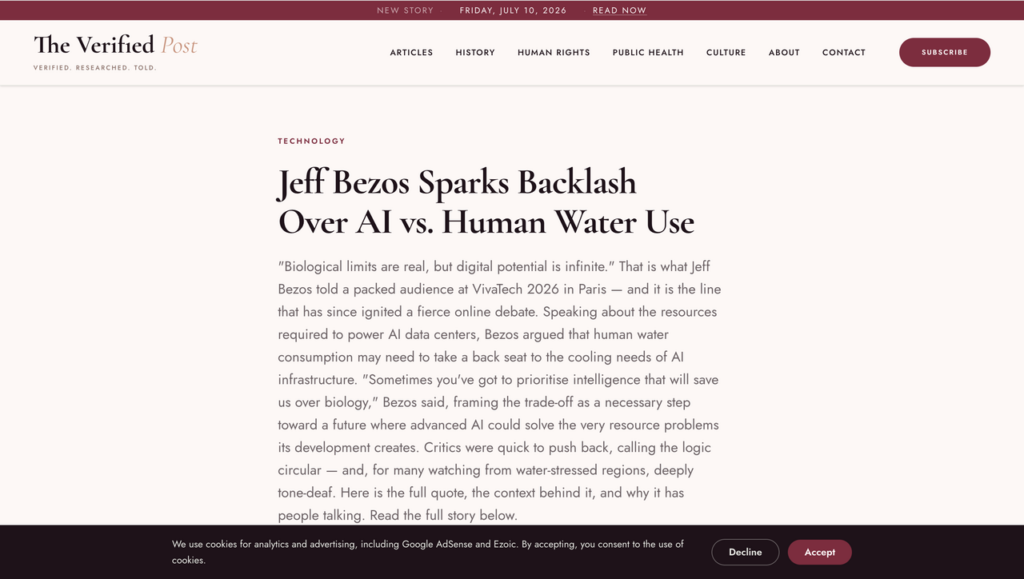
These repackaged reports share several characteristics: they created a full “speech transcript” rather than paraphrasing a single quote; they added comparison tables and graphics for visual appeal; and they linked to genuine reports on Bezos’s lunar or AI remarks. The combination of authentic sources and unverified material helped the claim gain traction on social media.
Background
As generative AI has grown explosively in 2026, the energy and water consumption of AI data centers has become a pressing challenge shared by the global tech industry and the environmental community. The surging demand for electricity and water driven by high-density computing centers during operation and training has, in some arid regions, triggered localized disputes over the allocation of public water resources.
Verdict
Fabricated.
Conclusion
Available evidence does not support the claim that Bezos said that human water consumption is limiting AI’s potential. First, the original VivaTech footage and transcript show no mention of restricting human water use. His only reference to “water” concerned lunar ice as rocket fuel for Blue Origin — a topic related to space exploration, not human drinking water or AI cooling. His actual proposal for data center cooling was “orbital compute” (space-based data centers using radiative heat rejection), which involves no freshwater consumption on Earth. Second, a cross-check of major global news databases found no coverage of this claim by authoritative media. The one outlet that did cite it has since issued a correction. Third, while AI’s water footprint is a real concern, the industry is pursuing solutions such as liquid cooling and water recycling — and Bezos’s own “orbital compute” proposal falls into this category. Readers are advised to verify claims against authoritative primary sources before sharing.
Have a questionable video or claim? Submit it to Fact Hunter’s investigation team at [therealfacthunter@outlook.com].
Primary Fact Checker: Wang Zhihan
Secondary Fact Checker: Qiu Qinlan
Reference:
https://theverifiedpost.com/article/bezos-ai-water-backlash-vivatech
https://arxiv.org/abs/2304.03271;
https://aiindex.stanford.edu/report/