Last updated on August 9th, 2026
Editor's note
Over the past month, we have tracked two disputed claims involving colored water bodies. After green algae appeared in the renovated Lincoln Memorial Reflecting Pool in the United States, social media posts alleged that algae had been deliberately introduced. Soon afterward, footage of blue-green water in China’s Jiuzhaigou was interpreted as evidence that the scenic area dyes its lakes with pigment.
Last year, Fact Hunter also examined a claim that used a localized stretch of green water in the Huai River to allege that 80 percent of China’s water sources were polluted. In our latest review, the account that circulated the Huai River claim appeared most frequently among relevant negative posts, publishing or reposting 29 related items over the course of a year.
Although the bodies of water, their formation conditions, and the circumstances of the events differ, each narrative relies primarily on visual evidence of blue or green water and then advances claims about the cause of the color and possible human intervention.
This report examines two representative claims: that Jiuzhaigou’s lake water is colored with pigment, and that Antifa members dumped toxic algae into the Reflecting Pool. The investigation combines source tracing, reverse image searches, verification of official documents, and social media analysis to examine the video location, the causes of the water color, the origins of the accompanying images, the dissemination chain, and the actors identified in the claims.
The purpose is to show that the visual appearance of a colored water body, its material composition, its formation mechanism, any deliberate human action, and the attribution of responsibility are separate questions that must be verified independently through a complete chain of evidence.
1. Claim that Antifa dumped toxic algae into the U.S. Reflecting Pool originated as satire
(1) Background
On April 10, 2026, the National Park Service closed the Lincoln Memorial Reflecting Pool for renovations. The work included cleaning the basin, repairing joints and leaks, and installing a tinted polyurea waterproof lining on the pool bottom that Trump described as “American flag blue.” At 4 p.m. on June 3, the work was completed and the pool began to be refilled.
On June 25, the White House acknowledged algae in the Reflecting Pool and said that “advanced nanobubble ozone technology” had been used to address it. In an affidavit filed on June 24, Frank Lands, deputy director of operations for the National Park Service, said Park Police had responded on June 9 to reported damage that included caulk over foam sealant cut with a sharp knife or razor, as well as damage to “delaminating surface material.” On July 2, the U.S. Department of Justice separately announced that a man had been charged over a June 19 incident in which he allegedly “ripped a piece of the recently installed blue pool sealant” from the bottom of the Lincoln Memorial Reflecting Pool.
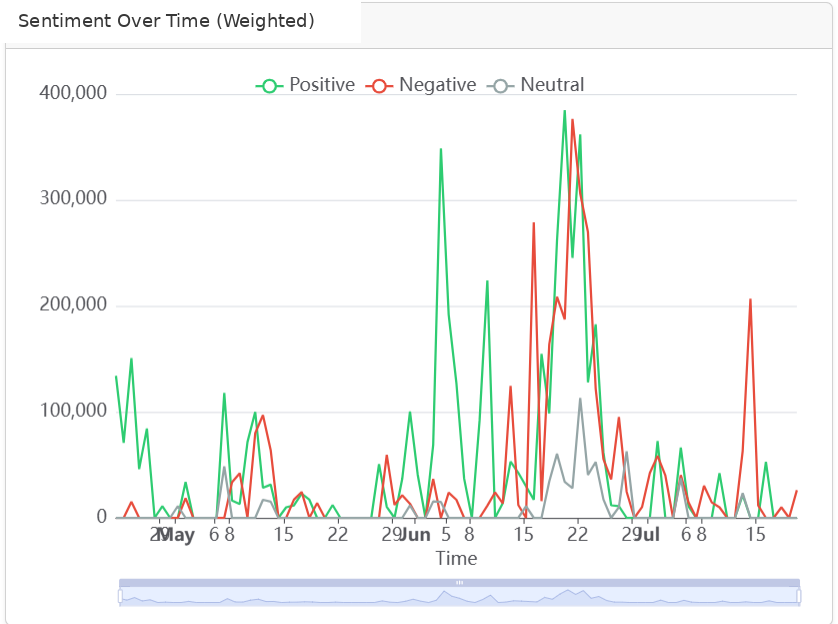
Using “Reflecting Pool” as the keyword, we conducted a weighted sentiment analysis of 10,000 high-engagement posts on X from April 1 to July 23, 2026. From April through May, discussion was relatively dispersed and predominantly positive, focusing on renovation progress, visual improvements and the pool’s symbolic significance. In early June, the completion of the work and the unveiling of the blue pool bottom produced the first pronounced peak in positive sentiment. After green algae and related problems entered public discussion, negative sentiment rose rapidly from mid-June and peaked alongside positive sentiment in late June. Overall attention declined after July, although negative sentiment rebounded several times. Neutral content consistently carried relatively little engagement weight, indicating that highly interactive discussion was driven mainly by content expressing clear praise, criticism or political attribution.
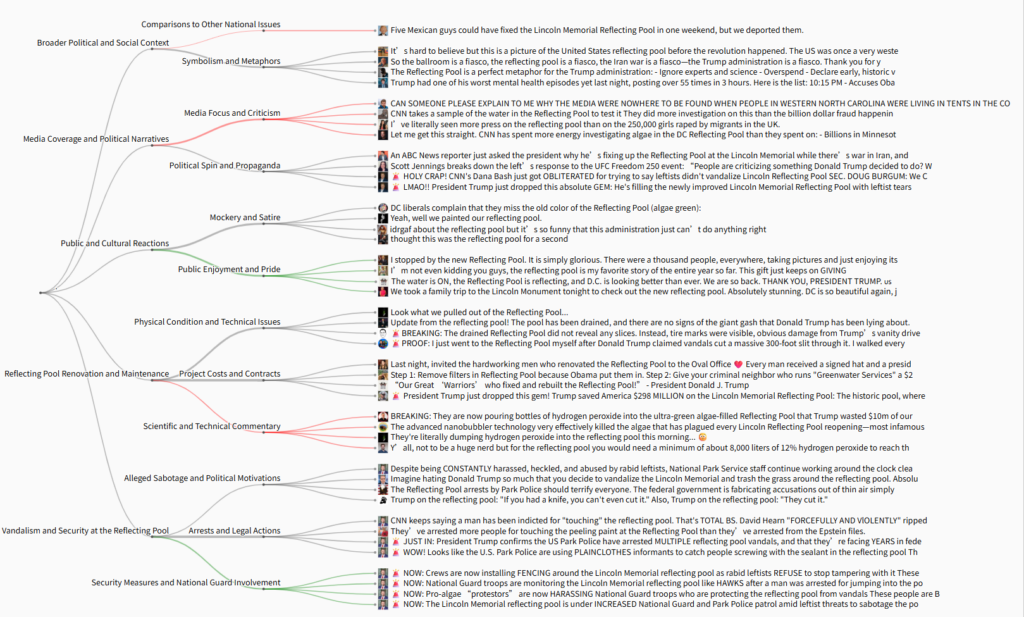
The topic tree further shows that discussion of the Reflecting Pool formed five main clusters: its political symbolism, social metaphors and comparisons with other national issues; media attention, editorial framing and political messaging; public admiration and satire; the technical condition of the renovation, project costs, contracts and water treatment; and allegations of vandalism, arrests, legal proceedings and security measures.
Four closely related categories of misinformation emerged around these key themes, prompting concentrated fact-checking by multiple organizations.
- a) Under the themes of water quality and algae, and political interpretations of vandalism, claims alleged that “Antifa members dumped toxic algae” or that the “FBI uncovered an Antifa algae weapons laboratory,” framing the green algae as an organized political attack. The content in fact originated from a satire network, and there is no evidence that those arrested were connected to Antifa or to the introduction of algae.
- b) Under the themes of security and protective measures, and disputes over media coverage, an image showing the Reflecting Pool fencing completely covered by blue tarp was used to imply that the government was concealing problems with the project. Fact-checking found that the original scene showed fencing only; the blue tarp had been added later.
- c) Under the theme of arrests and charges involving alleged vandals, clear images purportedly showing suspects were circulated after being completed or enhanced with artificial intelligence. The original police footage was blurry, and facial details fabricated through generative enhancement cannot be used to confirm identity.
- d) Under the theme of political figures and statements, a fabricated screenshot of a Trump social media post claimed that the Reflecting Pool showed a reflection of Trump with Jeffrey Epstein.
Taken together, misinformation about the Reflecting Pool developed along three principal narrative lines amid negative sentiment:
First, attribution to sabotage, in which the green algae were explained as the result of political opponents introducing algae or carrying out a chemical attack;
Second, failure and concealment, in which manipulated images were used to claim that the government was attempting to hide problems with the renovation;
Third, symbolic attack, in which the Reflecting Pool was turned into a visual metaphor for corruption or political scandal.
Among these claims, the allegation that “Antifa members dumped toxic algae into the Reflecting Pool” directly addressed the central controversy over the pool turning green and was constructed in a manner similar to the Jiuzhaigou and Huai River claims. This report therefore selected it for detailed examination.
(2) Claim
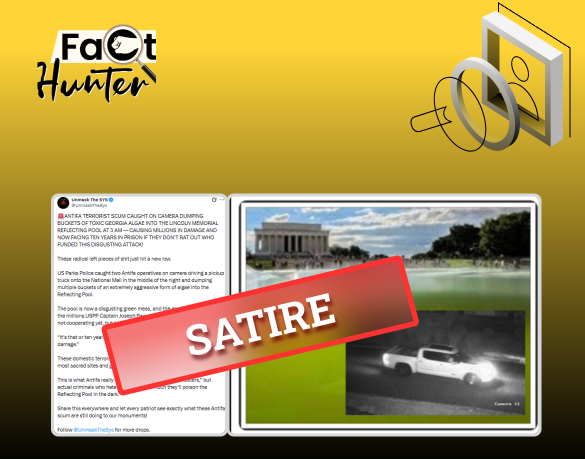
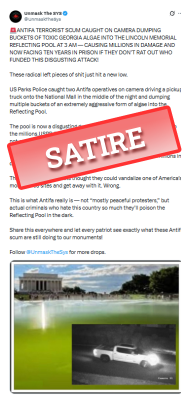
On June 17, the X account @UnmaskTheSys claimed that two “Antifa members” drove a pickup truck onto the National Mall at 3 a.m. and dumped multiple buckets of “TOXIC GEORGIA ALGAE” into the Lincoln Memorial Reflecting Pool, turning the water green and causing millions of dollars in damage. The post used a composite image of the green Reflecting Pool and nighttime surveillance footage of a pickup truck. By July 20, it had received approximately 541,500 views, 12,000 reposts, 16,000 likes and 1,700 comments.
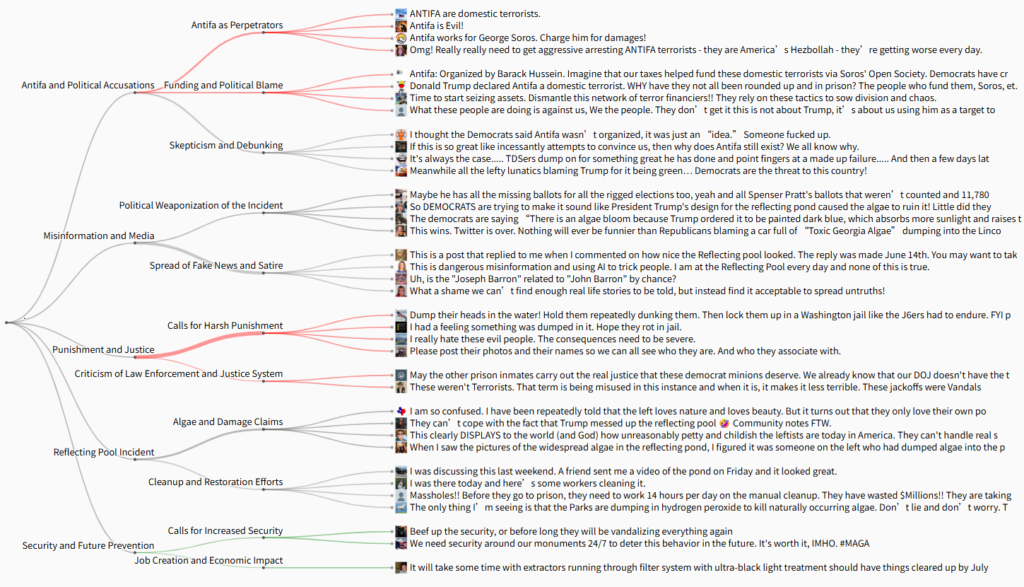
The comments fell into two broad groups. Some users accepted the claim that Antifa had dumped algae into the pool and extended the blame to the Democratic Party and alleged funding networks, while calling for harsh punishment, asset seizure and stronger security at national monuments. Others questioned the authenticity of the post, noted the lack of evidence for the alleged perpetrators or dumping, or recognised the story as satire. Overall, the misinformation prompted not only judgments about whether the claim was true, but also broader partisan accusations, demands for punishment and concerns about public security.
(3) Fact check
1) Source analysis
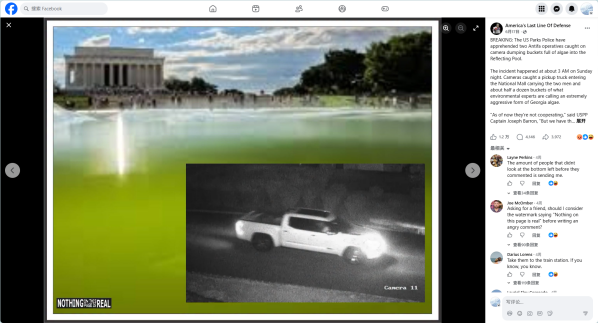
The story originated in a June 16 Facebook post by America’s Last Line of Defense (ALLOD). The original version claimed that two Antifa operatives drove a pickup truck onto the National Mall during the night and dumped several buckets of “an extremely aggressive form of Georgia algae” into the Reflecting Pool. It quoted an alleged “USPP Captain Joseph Barron” as saying that the two had been detained and could face ten years in prison.
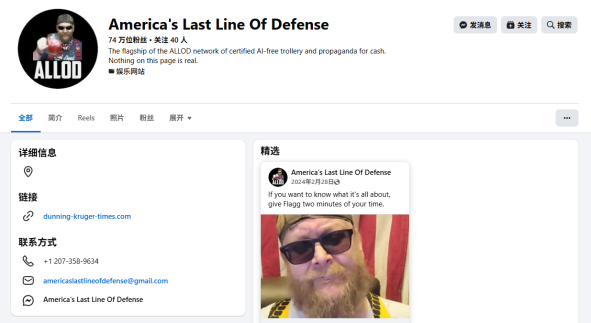
ALLOD is not the U.S. Park Police, a news organization or an investigative body. It is a satire network that produces fictional political content. Its affiliated website, the Dunning-Kruger Times, describes itself on its About Us page as a subsidiary of the ALLOD “network of parody, satire, and tomfoolery.” It states that “Everything on this website is fiction” and that all images should be considered altered and satirical.
The image accompanying the original Facebook post also carried the disclaimer “Nothing on this page is real.” When the content was reposted on X, however, the satire label was removed and the text was further rewritten as a definitive news report. It did not disclose that the story came from a satire account, but instead added expressions such as “domestic terrorists” and “poison the Reflecting Pool in the dark,” while urging users to share the post widely.
The original phrase “an extremely aggressive form of Georgia algae” was also changed to “TOXIC GEORGIA ALGA.” The former primarily describes strong growth or invasive characteristics, while the latter directly assigns toxicity to the algae, escalating a purported ecological problem into a poisoning narrative involving a threat to public safety.
2) Image tracing
The upper part of the composite image establishes only that algae were present at the time, a phenomenon documented in public records. The lower image, presented as surveillance footage of a pickup truck used in a 3 a.m. operation, had already appeared in August 2024 in materials from the Hopatcong Police Department in New Jersey concerning an abandoned-cat investigation. Police were seeking two people suspected of abandoning several hairless cats, and the individuals were reported to have been driving a white Toyota Tundra. The surveillance image is unrelated to the Reflecting Pool in Washington.

3) Verification of the named individual
No public source supports the alleged quotation from “USPP Captain Joseph Barron.” Public U.S. Park Police leadership lists, press releases and contact information contain no statement by an official of that name concerning the Reflecting Pool. Based on publicly available information, no record was found showing that Joseph Barron served as a U.S. Park Police captain, or linking the name to the Reflecting Pool investigation, any suspect arrest or the quotation circulated online.
(4) Verdict
Satire.
2. Insights into misinformation about China's natural water bodies
The Jiuzhaigou and Huai River cases followed a similar pattern of dissemination: blue or green water was first used to create visual impact; the color was then assigned an explanation such as “artificial dyeing” or “severe pollution”; and a localized image was ultimately used to draw conclusions about an entire scenic area, river basin or even China’s environmental governance.
The following section uses the misleading claim that Jiuzhaigou’s lakes were dyed as a case study, connects it with Fact Hunter’s earlier examination of green water in the Huai River, and uses social media data to show how localized water color can be extended into a broader narrative about China’s aquatic environment and ecological governance.
(1) Claim
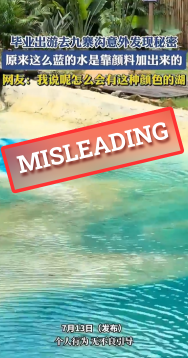
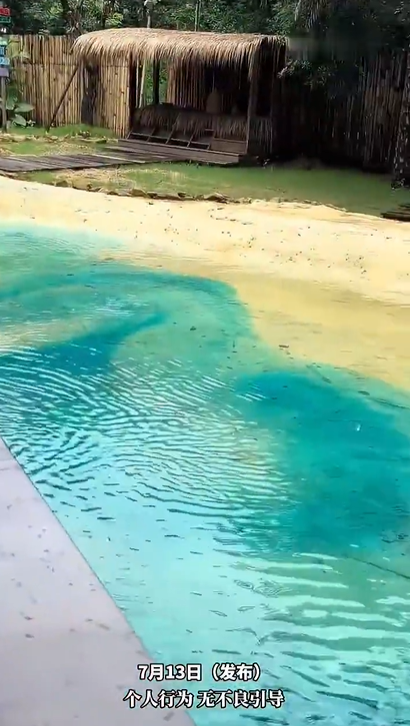
On July 13, a video posted on Douyin stated: “On a graduation trip to Jiuzhaigou, I accidentally discovered the secret: water this blue is made by adding pigment.” The video showed a person pouring a blue-green substance at the edge of a body of water, which the poster presented as evidence that Jiuzhaigou had “artificially dyed” its lakes. At the time of verification, the original Douyin post was no longer accessible. So the uploader’s identity and the reason the post became unavailable could not be independently verified.
(2) Fact check
1) Misidentified video location
Tips for Practicing Digital Minimalism
On July 16, the Aba Prefecture government website published a response from the Jiuzhaigou administration, which stated that the video had not been filmed in Jiuzhaigou and that the claim that its lakes were colored with pigment was false.
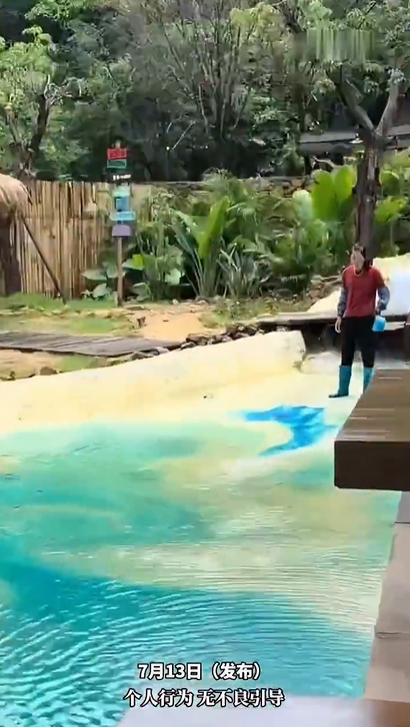
The scene itself shows a relatively small body of water with a gently sloping, uniform bottom, a straight hard edge and level pale sand along the bank. A worker wearing rubber boots is able to stand directly in the shallow water. The surrounding area contains broad-leaved evergreen plants, bamboo fencing and a thatched shelter, features that differ markedly from Jiuzhaigou’s high-altitude mountain landscape, coniferous forests and travertine lakes. Although the precise filming location has not been identified, the official response and environmental features indicate that the scene is more consistent with an artificial landscape pool than with a natural water body.
2) Factors contributing to the blue-green color of Jiuzhaigou’s waters
China’s karst landforms are concentrated mainly in southwest and south China, with major examples in Yunnan, Guizhou, Guangxi and Chongqing. Jiuzhaigou also contains karst lakes and travertine landscapes.
In 2020, researchers from the Chengdu Institute of Biology, Chinese Academy of Sciences, the Jiuzhaigou Nature Reserve Administrative Bureau and other institutions published “The Color Formation Mechanism of the Blue Karst Lakes in Jiuzhaigou Nature Reserve, Sichuan, China” in the journal Water. Using hyperspectral instruments and hydrochemical analysis, the team sampled and measured the spectra of Colorful Lake, Mirror Lake, Rhinoceros Lake and other waters. The study found that Jiuzhaigou’s lakes are primarily blue and green, and that their color is not produced by a single factor. Travertine deposition is the core link in the process, while the selective reflection and scattering of visible light by suspended calcium carbonate particulate matter provide its optical basis. Water depth, transparency, water-quality parameters and bottom sediments also affect the color visible to the human eye.
Karst waters may therefore display different shades of blue or green. The specific cause must still be determined separately for each water body, and color alone cannot establish artificial dyeing.
On July 16, the Jiuzhaigou administration gave a consistent explanation: clean water absorbs and scatters different wavelengths of light differently, while travertine particles intensify the scattering of blue and green light. Changes in depth, season, weather and viewing angle can cause the same water body to display different shades and layers. No water-testing results, procurement records, construction documents or credible images were found that would show Jiuzhaigou adding pigment to its lakes.
3) Social media analysis
To examine the information environment surrounding the claim that Jiuzhaigou’s lakes are colored with pigment, we searched X using the query “(China water pollution) OR (china water pollute) OR (chinese water pollution) OR (chinese water pollute)” and retrieved 1,067 relevant posts from the year ending July 22, 2026. We then conducted topic clustering on approximately 100 to 150 posts with the highest engagement.
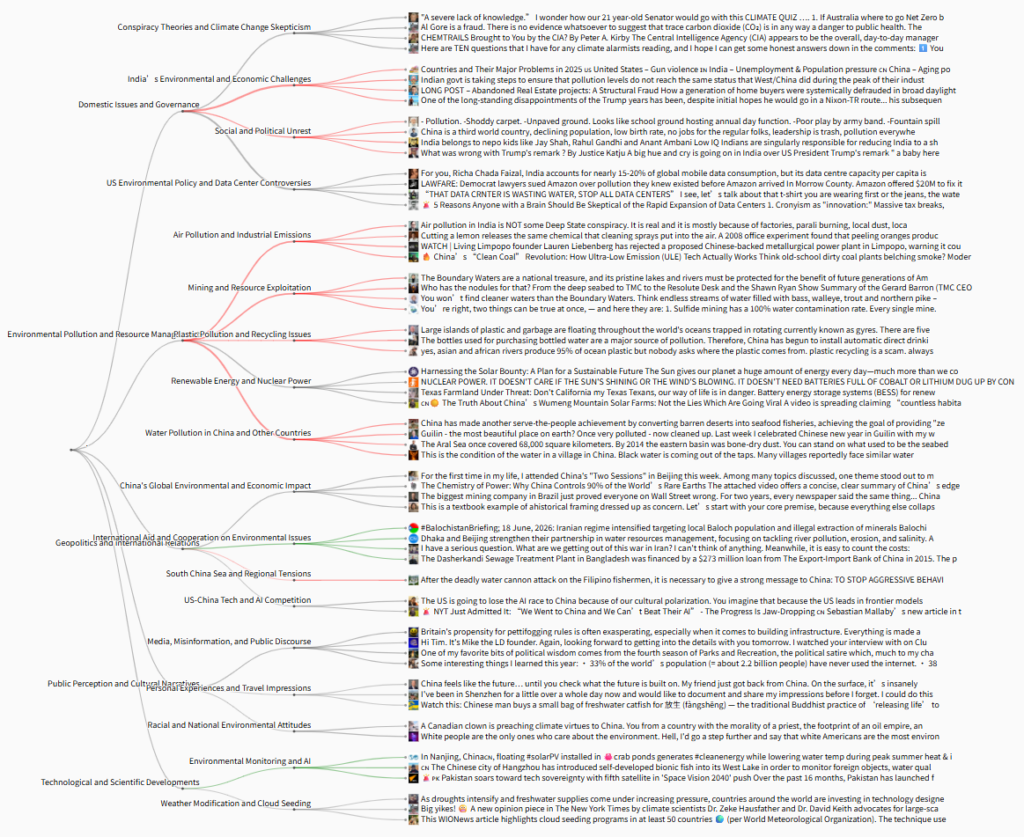
The topic tree places “Water Pollution in China and Other Countries” within the broader category of “Environmental Pollution and Resource Management,” alongside air pollution and industrial emissions, mining and resource exploitation, plastic pollution and recycling, and renewable energy and nuclear power. Posts in the water-pollution branch include claims about garbage in rivers, unsafe village tap water and discolored water bodies, as well as references to water cleanup and environmental improvements. These specific cases are frequently connected to broader discussions of domestic governance, China’s global environmental and economic impact, geopolitical tensions, public perceptions and technological development. This indicates that high-engagement discussion of water pollution in China often extends beyond water quality itself and becomes part of wider narratives about industrial development, environmental governance, national comparison and China’s international role.
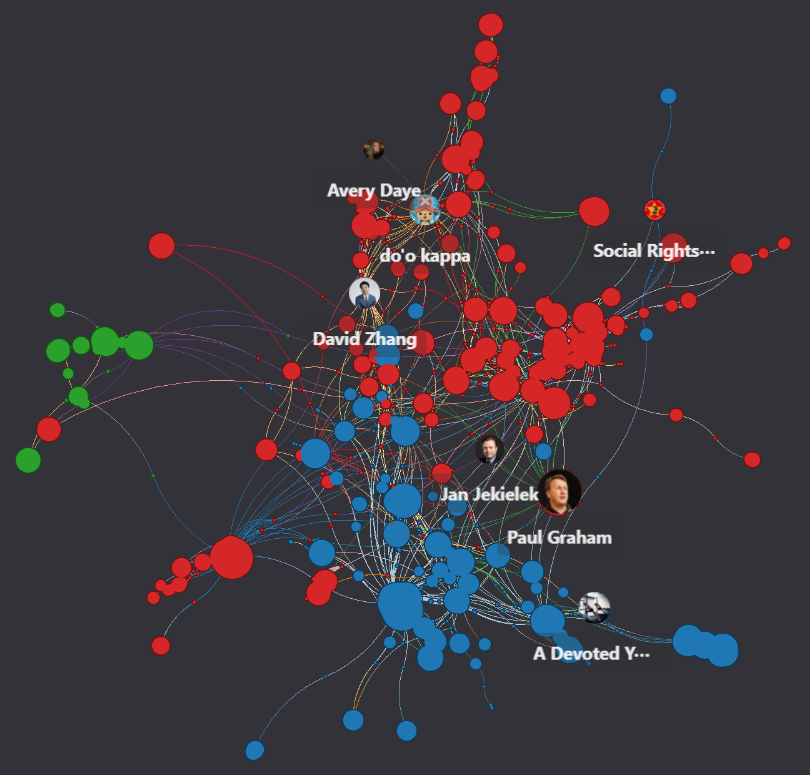
The social network map shows that discussion of “water pollution in China” formed three clearly bounded clusters with very weak connections between them, producing a highly polarized echo-chamber structure. The red cluster was the largest, with 6,599 users, and focused mainly on China-India relations, the global economy, social issues and geopolitics. The blue cluster contained 5,453 users, was predominantly English-speaking and focused more heavily on climate-change skepticism. The green cluster was the smallest, with 619 users, and concentrated primarily on environmental protection, social justice and foreign capital.
The e-i indices of all three clusters were close to -1, their conductance ranged only from 0.008 to 0.010, and more than 99 percent of retweets occurred within the same cluster. Information therefore circulated mainly within each community, with very limited cross-cluster transmission. In this highly closed network, a small number of high-frequency accounts can repeatedly reinforce particular narratives within their own communities. Examining the most frequent publishers of negative content can therefore help identify the accounts that continually advance claims about “water pollution in China.”
The red cluster primarily focuses on China-India relations, global economic, social, and geopolitical issues. Its users include economists, investors, and environmental advocates. Major nodes are geographically diverse, with a distinct advocacy or critical orientation, and frequently engage in sustained commentary centered on specific political actors, countries, or ideological positions. The blue cluster is mainly composed of English-speaking users, with major nodes based in the United States. These accounts are more likely to be professional commentators or political activist accounts, focusing on climate change skepticism and right-wing conservative perspectives.
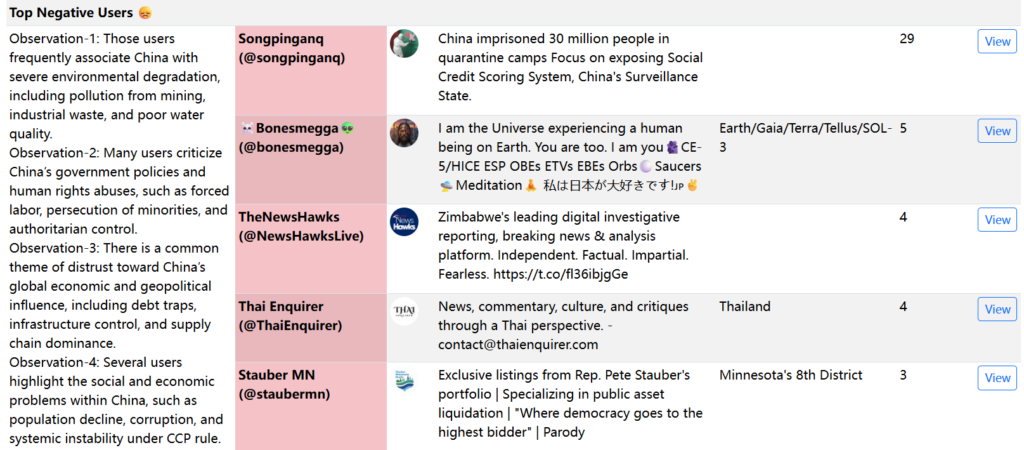
The “Top Negative Users” results show that @songpinganq appeared most frequently in the relevant negative posts, publishing or reposting 29 items over one year, substantially more than any other account. In August 2025, the account used footage of a localized green water surface to claim that it showed the “severely polluted Huai River,” and further alleged that “80 percent of China’s water sources are severely polluted and unfit for drinking or bathing.” An earlier fact check found that the original uploader posted footage of clear water at the same location several days later. The green surface was more consistent with a localized and temporary algal bloom. A video from a single point in time cannot represent long-term water quality throughout the Huai River, much less support the claim that 80 percent of China’s water sources are severely polluted. See: Fact-check: Videos of “green rivers” misused in allegations that 80% of China’s water is polluted
(3) Verdict
Misleading.
3. Conclusion
Jiuzhaigou, the Huai River and the Lincoln Memorial Reflecting Pool are different types of water bodies, and the misinformation surrounding them advances different claims: Jiuzhaigou’s blue-green water was attributed to pigment introduced by the scenic area; the green surface of a localized section of the Huai River was expanded into a claim that the entire basin was “severely polluted”; and after green algae appeared in the Reflecting Pool, the condition was described as the result of political opponents deliberately introducing algae.
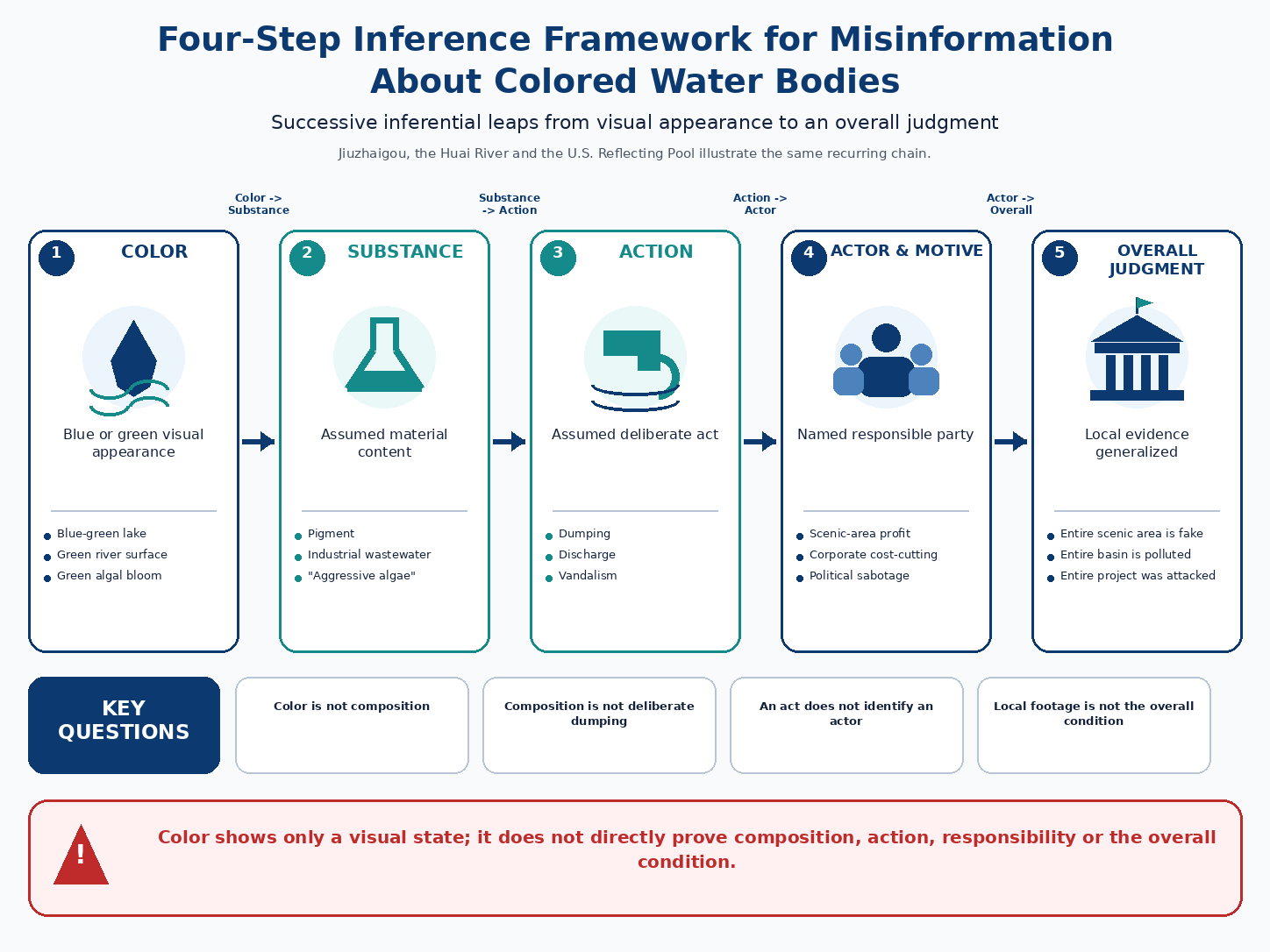
This type of misinformation typically involves four successive inferential leaps.
(1) From color to substance
Blue water is treated as proof that blue pigment is present; green water is treated as proof of industrial wastewater, toxic chemicals or deliberately introduced “aggressive algae.” Color, however, is only a visual phenomenon. It can be affected by light scattering, water depth, bottom material, mineral particles, algae, suspended matter, an artificial pool bottom and recording equipment, and cannot substitute for testing the water’s composition.
(2) From substance to deliberate human action
Even if algae, nutrients or another colored substance are confirmed to be present, that does not establish that someone deliberately introduced them. Algal blooms can result from a combination of high temperatures, nutrients, slow-moving water and abnormalities in circulation systems. In an artificial pool, the visible color may also come from the pool-bottom material rather than dye added to the water. “What is in the water” and “whether someone put it there” are separate questions requiring separate evidence.
(3) From action to actor and motive
Online narratives often supply an actor without direct evidence: the Jiuzhaigou scenic area allegedly “dyed the lakes” to attract visitors; companies allegedly discharged waste into the Huai River to reduce costs; and Antifa allegedly damaged the Reflecting Pool because it opposed Trump. The alleged actor’s identity, organizational ties and subjective motive commonly derive from the publisher’s own interpretation and political standpoint.
(4) From local footage to an overall judgment
Footage of an artificial pool at another location was used to allege that the entire Jiuzhaigou scenic area was fraudulent. Green water in one river section at one point in time was used to represent severe long-term pollution across the entire Huai River basin. Damage to one area of material and isolated suspected acts of vandalism were expanded into a claim that the entire Reflecting Pool project had been subjected to an organized attack. A localized image does not automatically represent a larger geographic area or the overall condition over a longer period.
When examining claims involving colored water bodies, fact-checkers should first establish the time and location of the footage and the characteristics of the water body. Even where deliberate dumping or damage is identified, it is still necessary to demonstrate the chronology and causal relationship between the act and the change in water color. A single river section, one recording or damage at one location cannot represent a long-term condition or the overall situation.
Have a questionable video or claim? Submit it to Fact Hunter’s investigation team at [therealfacthunter@outlook.com].
Primary Fact Checker: Ma Xianzhi
Secondary Fact Checker: Liao Qin
References
1.https://www.nps.gov/nama/learn/management/notice-to-the-public-reflecting-pool-closure.htm
2.https://www.nps.gov/nama/learn/management/reflecting-pool-renovations-rod.htm
3.https://www.whitehouse.gov/releases/2026/06/radical-lunatics-deface-americas-reflecting-pool-and-president-trump-was-right-again/
4.https://storage.courtlistener.com/recap/gov.uscourts.dcd.292242/gov.uscourts.dcd.292242.22.1.pdf
5.https://www.justice.gov/usao-dc/pr/maryland-man-indicted-vandalizing-reflecting-pool
6.https://home.nps.gov/nama/learn/management/notice-to-the-public-temporary-closures-between-lincoln-memorial-and-washington-monument.htm
7.https://home.nps.gov/nama/learn/management/extension-of-temporary-closure-of-parkland-around-the-lincoln-memorial-reflecting-pool-public-notice.htm
8.https://www.factcheck.org/2026/06/trumps-unsupported-claims-about-reflection-pool-vandalism/
9.https://leadstories.com/hoax-alert/2026/06/fact-check-us-park-police-did-not-arrest-antifa-operatives-for-dumping-algae-into-reflecting-pool-.html
10.https://factcheck.afp.com/doc.afp.com.B83D8G3
11.https://leadstories.com/hoax-alert/2026/06/fact-check-fbi-did-not-raid-antifa-storage-unit-find-aggressive-algae-its-from-satire-site.html
12.https://factcheck.afp.com/doc.afp.com.B8FF9CQ
13.https://leadstories.com/hoax-alert/2026/06/fact-check-ai-images-of-reflecting-pool-dipper-are-not-real.html
14.https://leadstories.com/hoax-alert/2026/06/fact-check-trump-has-not-posted-image-of-reflecting-pool-showing-him-together-with-epstein-in-june-2026.html
15.https://x.com/UnmaskTheSys/status/2066996710744764423
16.https://www.facebook.com/ALLODSatire/posts/breaking-the-us-parks-police-have-apprehended-two-antifa-operatives-caught-on-ca/1334394915489463/
17.https://www.facebook.com/ALLODSatire
18.https://dunning-kruger-times.com/about-us/
19.https://wrnjradio.com/police-searching-for-2-people-accused-of-abandoning-cats-at-construction-company-in-sussex-county/
20.https://www.facebook.com/permalink.php?story_fbid=801729948804540&id=100069026266108&ref=embed_post
21.https://www.nps.gov/search/?query=Joseph%20Barron&sitelimit=www.nps.gov%2Fsubjects%2Fuspp&affiliate=nps
22.https://www.huya.com/video/play/1117663514.html
23.https://whc.unesco.org/en/list/637/
24.Li, X., Zhang, M., Xiao, W., Du, J., Sheng, M., Zhu, D., Plenković-Moraj, A., & Sun, G. (2020). The Color Formation Mechanism of the Blue Karst Lakes in Jiuzhaigou Nature Reserve, Sichuan, China. Water, 12(3), 771. https://doi.org/10.3390/w12030771
25.https://www.abazhou.gov.cn/abazhou/c101955/202607/3c4cf90e75884590addcff79ddd22f22.shtml
26.https://www.therealfacthunter.com/fact-check-videos-of-green-rivers-misused-in-allegations-that-80-of-china-s-water-is-polluted